Changing a URL sounds simple until you have to decide what should happen to the old one.
Should it redirect permanently? Temporarily? Should you use a 301 or 302? What if several old URLs point to the same new page? And what happens when a page has no relevant replacement at all?
These decisions matter because redirects help search engines understand how URLs relate to one another. They can also affect crawling, indexing, canonicalization, user experience, and how smoothly a website handles changes such as URL restructuring or a full migration.
The most important thing is not to memorize every HTTP status code. It is to match the redirect to what actually happened to the URL.
In this guide, you’ll learn:
- What SEO redirects are and how they affect search
- The difference between 301 and 302 redirects
- When 307 and 308 redirects matter
- Which redirect to use in common SEO situations
- How redirect chains and loops create problems
- How to handle redirects during a website migration
- When to use a redirect, canonical tag, or 404/410
- How to audit and implement redirects correctly
What Are SEO Redirects?
An SEO redirect sends a visitor and their request from one URL to another.
For example:
https://example.com/old-page/
might redirect to:
https://example.com/new-page/
Redirects are commonly used when:
- A page has moved to a new URL
- A website changes its URL structure
- A site moves from HTTP to HTTPS
- A domain changes
- Several pages are consolidated into one
- A temporary page or test needs to send visitors elsewhere
- An old URL has a relevant replacement
For SEO, the important question is not simply whether a redirect exists. The important questions are why the redirect exists, which type is being used, and whether the destination is relevant.
Google uses redirects as one of several signals when determining which URL should represent content in search. Redirects can therefore play an important role in URL changes and consolidation.
How Do Redirects Affect SEO?
A properly implemented redirect is not inherently bad for SEO.
In fact, permanent redirects are an important part of normal website maintenance and migrations. Google states that 301 and other permanent redirects do not cause a loss in PageRank.
The problems usually come from how redirects are implemented, not from the existence of redirects themselves.
Redirects can help when:
- A page has permanently moved
- An old URL has a clear replacement
- Several genuinely overlapping pages are consolidated
- A site changes its domain
- A site changes from HTTP to HTTPS
- An old URL needs to point users toward the correct current resource
Redirects can cause problems when:
- A temporary redirect is used for a permanent move
- The destination is irrelevant
- Multiple redirects are chained together
- Redirects create a loop
- Large numbers of unrelated URLs are sent to the homepage
- Internal links continue pointing to outdated URLs
- Redirects conflict with other canonicalization signals
- A migration is launched without properly testing the redirect map
The goal is therefore not to avoid redirects. The goal is to make the relationship between the old and new URLs as clear and useful as possible.
If redirect problems are part of a broader crawlability, indexation, or technical site issue, they may also need to be addressed as part of a wider process called as Technical SEO Services.
301 vs 302: What's the Difference?
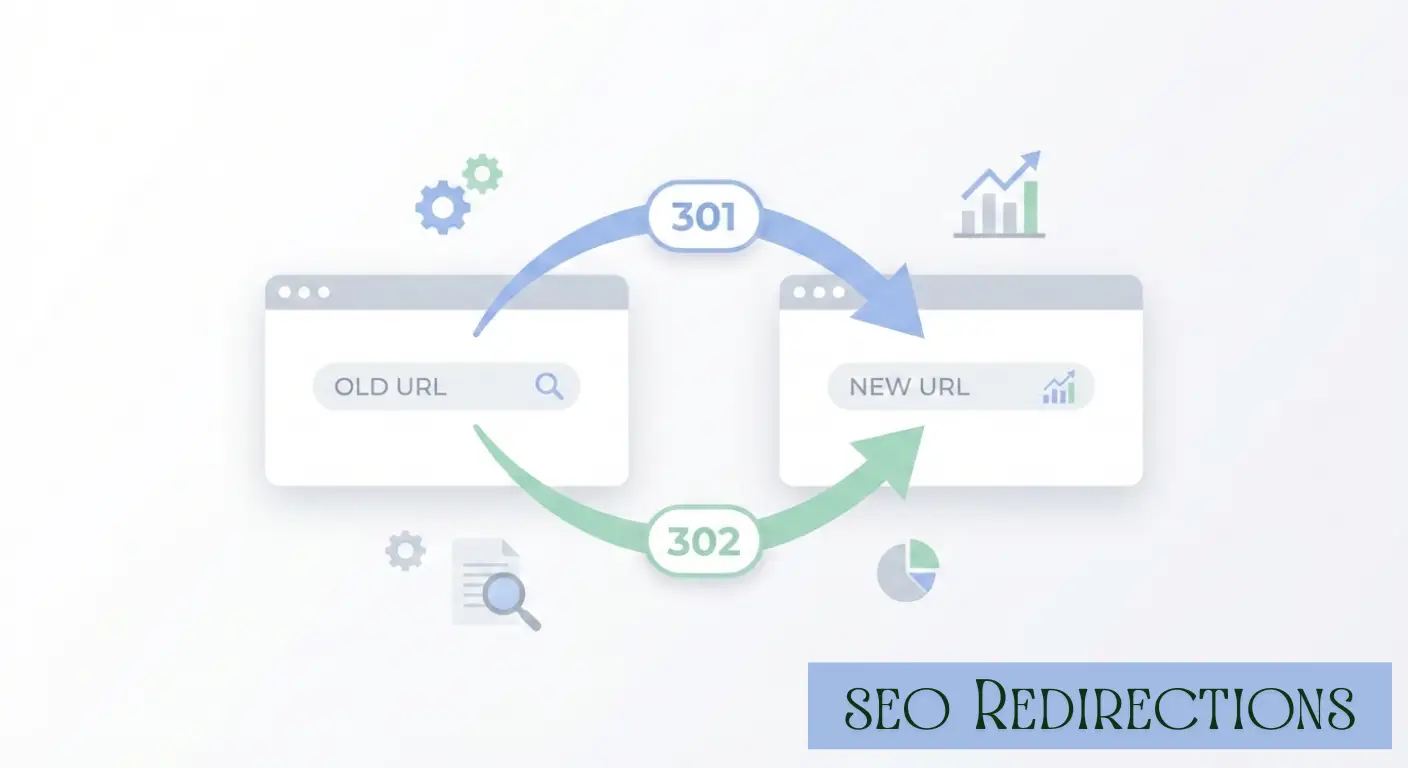
The 301 and 302 redirects are the two types SEOs encounter most often.
The simplest distinction is:
301 = permanent move
302 = temporary move
Google classifies 301 and 308 as permanent redirects, while 302, 303, and 307 are temporary redirects.
What Is a 301 Redirect?
A 301 redirect tells browsers and search engines that a URL has moved permanently to another location.
Typical uses include:
- Permanently changing a page URL
- Moving from HTTP to HTTPS
- Changing domains
- Restructuring URLs
- Consolidating similar or overlapping pages
- Moving content during a website migration
For example:
/old-services/ → 301 → /seo-services/
If the new page is the genuine replacement for the old page, a permanent redirect is usually the appropriate choice.
Google recommends server-side permanent redirects for permanent URL changes and specifically recommends 301 or 308 redirects when possible.
What Is a 302 Redirect?
A 302 redirect indicates that the move is temporary.
For example, imagine you temporarily move visitors from:
/original-page/
to:
/temporary-page/
but expect the original URL to return.
A 302 can make sense for situations such as:
- Temporary testing
- Temporary promotions
- Short-term changes
- Temporary availability issues
- Certain URL-based experiments
A common mistake is using 302 simply because it is convenient when the URL has actually moved permanently.
If you permanently replace a page, don’t use a temporary redirect just because you plan to “change it later.”
Choose the redirect based on the actual intent of the URL change.
301 vs 302: Quick Comparison
| Situation | Recommended redirect |
|---|---|
| Permanent URL change | 301 |
| Temporary URL change | 302 |
| Domain migration | 301 |
| HTTP → HTTPS | 301 |
| Permanent URL restructuring | 301 |
| Temporary promotion | 302 |
| Temporary testing | 302 |
| URL-based A/B testing | 302 |
Google’s testing guidance also recommends temporary redirects such as 302 for URL-based A/B testing rather than permanent redirects.
307 vs 308: When Do They Matter?
307 and 308 redirects are similar to 302 and 301 respectively, but they have an important technical distinction: they preserve the HTTP request method.
In simplified terms:
- 301: permanent redirect
- 302: temporary redirect
- 307: temporary redirect with method preservation
- 308: permanent redirect with method preservation
For many ordinary SEO page moves, 301 and 302 are the redirects you’ll work with most often.
307 and 308 become more relevant when the technical behavior of the request matters, particularly for non-GET requests and application-level workflows.
Google supports 307 and 308 as temporary and permanent redirects respectively, and recommends permanent server-side redirects such as 301 or 308 when a move is permanent.
The important takeaway is simple:
Don’t choose a redirect because the number sounds more advanced. Choose it based on the actual behavior you need.
Which Redirect Should You Use? Real SEO Scenarios
Rather than memorizing status codes, it is easier to choose the redirect based on the situation.
Scenario1: You’re Changing a Page URL
If the old URL is permanently replaced by a new URL, use a 301 redirect.
Example:
/seo-audit/ → /website-seo-audit/
assuming the new URL genuinely replaces the old page.
Scenario 2: You’re Moving to HTTPS
If your website moves from HTTP to HTTPS, permanent redirects should take visitors and crawlers from the HTTP URLs to their HTTPS equivalents.
For example:
http://example.com/page/
→
https://example.com/page/
A site-wide HTTPS move is a permanent URL change, so temporary redirects are not the right strategy.
Scenario 3: You’re Migrating to a New Domain
If a business moves from:
oldbrand.com
to:
newbrand.com
the old URLs should be mapped to their corresponding new URLs and redirected appropriately.
This is much better than sending every old URL to the new homepage.
Scenario 4: You’re Temporarily Testing Another URL
If the change is genuinely temporary, a 302 may be appropriate.
The important word is temporary.
Don’t use 302 as a substitute for deciding where a permanently moved page belongs.
Scenario 5: You’re Consolidating Multiple Pages
Suppose you have:
/seo-audit-guide//technical-seo-audit//seo-audit-checklist/
and you genuinely consolidate the useful content into:
/seo-audit/
The old URLs can potentially be permanently redirected to the new consolidated page.
The destination should represent the content users previously expected to find.
Scenario 6: The Content Has No Meaningful Replacement
Not every deleted URL should be redirected.
If a page is permanently gone and there is no relevant replacement, allowing it to return a proper 404 or 410 response may be more appropriate.
Google’s site-migration guidance specifically recommends 404 or 410 responses for old content that is not being moved to a new URL.
Scenario 7: Two URLs Represent the Same or Similar Content
A redirect is not always the right answer.
If both URLs need to remain accessible but one should be treated as the preferred version, a canonical URL may be more appropriate.
That distinction becomes especially important when dealing with duplicate or near-duplicate URLs.
Server-Side vs Client-Side Redirects
Not every redirect is implemented in the same way.
Server-Side Redirects
Server-side redirects happen before the destination page is served.
For SEO-related permanent URL changes, these are generally the preferred approach.
Common implementation methods include:
.htaccessrules on Apache- Nginx configuration
- CMS-level redirect systems
- Server-side application logic
Google recommends server-side permanent redirects when technically possible.
Meta Refresh Redirects
A meta refresh redirects through HTML rather than through the server’s HTTP response.
They can have legitimate uses, but they are generally not the first choice when a proper server-side redirect is available.
JavaScript Redirects
JavaScript can also redirect users from one URL to another.
This can be useful in situations where server-side implementation isn’t practical, but for normal SEO URL changes, a server-side redirect is usually the cleaner approach.
The basic rule is:
Use the simplest reliable server-side solution when you control the server or CMS.
Do Redirects Hurt SEO?
No. Redirects do not inherently hurt SEO.
Poorly implemented redirects can create SEO problems, but that is different from saying redirects themselves are harmful.
Consider these two examples.
Good redirect
/old-product/
→ 301 →
/new-product/
The new page is the legitimate replacement.
That’s a sensible redirect.
Problematic redirect
/old-product/
→ 301 →
/homepage/
The homepage has nothing to do with the old product.
That’s a weak destination and may create a poor experience for users and search engines.
Google specifically warns against redirecting many unrelated old URLs to one destination such as the homepage. Such redirects can confuse users and may be treated as soft 404s. There is an exception when multiple pages have genuinely been consolidated into one relevant new page.
The same principle applies throughout your redirect strategy:
The destination should make sense.
Redirect Chains and Loops
Redirects become more complicated when one redirect points to another redirect.
What Is a Redirect Chain?
A redirect chain looks like this:
Old URL
↓
301
Intermediate URL
↓
301
Final URL
The cleaner structure is:
Old URL
↓
301
Final URL
Google recommends redirecting directly to the final destination whenever possible. It notes that Googlebot can follow multiple hops, but recommends keeping chains short if they cannot be avoided.
Chains can add latency and make crawling, debugging, and migration management more complicated.
What Is a Redirect Loop?
A redirect loop occurs when URLs keep sending the request back around without reaching a final page.
For example:
URL A → URL B → URL A
The browser cannot reach a final destination because the redirect instructions never resolve.
Loops should be fixed immediately.
Why Direct Redirects Are Better
A direct redirect:
Old URL → Final URL
is easier to:
- Crawl
- Test
- Maintain
- Debug
- Understand
- Monitor
If you’re auditing a large website, redirect chains and loops should be among the first issues you investigate.
A Real-World Redirect Loop I Encountered
I’ve actually dealt with a redirect loop on my own website, and it showed me how quickly a seemingly small URL change can turn into an indexing problem.
One of my pages originally used this URL:
https://ahmadfrazseo.com/about/
I later changed the page to:
https://ahmadfrazseo.com/about-me/
The intention was straightforward: the old /about/ URL should permanently redirect to the new /about-me/ URL.
However, the redirect configuration was not implemented correctly.
Instead of ending at the final page, the redirect sequence effectively became:
/about-me → /about-me/ → /about-me → /about-me/ → …
In other words, the destination URL itself was caught in another redirect back to the same URL without the trailing slash.
The browser eventually reported a “too many redirects” error because it could not reach a final page.
More importantly, the page became inaccessible to search engines while the problem existed. I later noticed that the page had disappeared from Google’s index as well.
After investigating the redirect configuration, I found the problem: the final URL that was supposed to serve the actual page was itself redirecting back to the non-slash version. The redirect chain never reached a normal 200 OK page.
I removed the conflicting redirect and made sure the final URL:
https://ahmadfrazseo.com/about-me/
served the actual page instead of redirecting again. Once the issue was fixed, the page became accessible and was indexed again.
The lesson is simple:
A redirect should always have a clear final destination.
When implementing or changing redirects, don’t just check whether the first 301 exists. Follow the entire sequence and verify that the final URL actually returns the intended page.
For important URLs, you can also use Google Search Console’s URL Inspection tool to check how Google sees the URL after the redirect is fixed. Google recommends testing redirects during URL changes and migrations rather than assuming they are working correctly.
SEO Redirects During a Website Migration
Redirects become especially important when a website is redesigned, replatformed, restructured, or moved to a new domain.
But a migration is much bigger than a list of 301 redirects.
Google recommends preparing a URL mapping, implementing the redirects, checking canonical and robots directives, testing the redirects, updating internal links and sitemaps, and monitoring the move after launch.
Build a Redirect Map Before Launch
Before launching the new website, create a mapping between the old URLs and their new destinations.
For example:
| Old URL | New URL | Redirect |
|---|---|---|
/old-service/ | /new-service/ | 301 |
/old-blog/ | /updated-blog/ | 301 |
/temporary-test/ | /test-version/ | 302 |
The important part is not the spreadsheet itself. It’s making sure every important old URL has the correct destination.
Map Old URLs to Relevant New URLs
Don’t automatically send every old page to the homepage.
If an old service page has a new equivalent, redirect it there.
If an old article has been replaced by an updated article, redirect it to that article.
If several genuinely overlapping pages have been consolidated into one stronger resource, those old URLs can point to the consolidated page.
But if there is no meaningful replacement, a 404 or 410 may be the better outcome.
Test the Migration Before Launch
A redirect map can look perfect in a spreadsheet and still fail in implementation.
Test:
- HTTP status codes
- Destination URLs
- Final response status
- Redirect chains
- Redirect loops
- Broken destinations
- Canonical URLs
- Internal links
- Robots directives
- XML sitemap URLs
Google recommends using URL Inspection for individual checks and scripts or other tools for testing larger numbers of URLs.
Update Internal Links
Redirects are useful when old URLs are still requested, but your own website should not unnecessarily keep linking to URLs that redirect.
After a migration, update internal links so they point directly to the new URLs.
This reduces unnecessary hops and gives search engines a clearer picture of the new site structure.
Check Canonicals and Sitemaps
The new site should use the correct canonical URLs.
Your XML sitemap should also contain the new URLs rather than relying on redirected old URLs.
Google specifically recommends checking canonical annotations and updating sitemaps during a site move.
Monitor Search Console After Launch
A migration isn’t finished when the new site goes live.
Monitor:
- Indexing
- Crawl errors
- Redirect errors
- 404s
- Organic traffic
- Rankings
- Sitemap processing
- Unexpected canonical selections
Some fluctuation during a migration can be normal while Google recrawls and reprocesses the URLs.
How Long Should You Keep Redirects?
Google recommends keeping redirects for as long as possible, generally at least one year after a site move.
If old URLs continue receiving meaningful traffic or external links, keeping the redirects longer can make sense.
At the same time, update your own internal links and important external links where possible so users don’t have to pass through a redirect unnecessarily.
A website migration involves much more than setting up redirects. URL mapping, canonical signals, internal links, crawlability, sitemap management, launch testing, and post-launch monitoring all need to work together.
If you’re planning a redesign, replatforming, URL restructuring, or domain migration, you can learn more about my Website Migration SEO Services.
Redirect vs Canonical vs 404/410: Which Should You Use?
These concepts are often mixed together, but they solve different problems.
| Situation | Usually appropriate |
|---|---|
| Page permanently moved | 301 or 308 |
| Page temporarily moved | 302 or 307 |
| Duplicate/similar URLs should remain accessible | Canonical |
| Content is permanently gone with no replacement | 404 or 410 |
| Several genuinely overlapping pages were consolidated | 301/308 to the consolidated page |
Redirect
Use a redirect when you want a request for one URL to lead somewhere else.
Canonical
Use a canonical when multiple accessible URLs represent duplicate or substantially similar content and you want to indicate which URL should be treated as the preferred representative.
Google describes canonicalization as the process of selecting a representative URL from a group of duplicate or similar pages. It also emphasizes that canonical signals are hints rather than absolute rules.
404 or 410
If content is genuinely gone and there is no meaningful replacement, don’t create a random redirect just to avoid returning an error.
A proper 404 or 410 can be the correct technical response.
The key is to match the technical solution to what actually happened to the content.
How to Audit SEO Redirects
A redirect audit doesn’t have to be complicated if you approach it systematically.
Step 1: Find Redirects
Crawl the website and identify URLs returning 3xx responses.
Also review redirects from:
- Old URLs
- Previous URL structures
- HTTPS versions
- Old domains
- Previous migrations
- Deleted or consolidated pages
Step 2: Classify Them
For each redirect, determine:
- Is the move permanent?
- Is it temporary?
- Is the destination relevant?
- Should both URLs actually remain accessible?
- Is a 404/410 more appropriate?
Step 3: Trace the Final Destination
Don’t stop after seeing a 301.
Follow the redirect until you reach the final URL.
Check whether the redirect goes:
Old URL → Final URL
or:
Old URL → Redirect → Redirect → Final URL
Step 4: Check for Chains and Loops
Look for:
- Multiple hops
- Circular redirects
- Broken destinations
- Redirects to redirected URLs
Step 5: Validate Relevance
Ask one simple question:
Would a user who requested the old URL reasonably expect to land on this destination?
If the answer is no, the redirect probably needs attention.
Step 6: Check Canonicals and Internal Links
Make sure the destination uses the appropriate canonical URL and that your internal links point directly to the preferred URLs where possible.
Step 7: Fix the Problems
Prioritize:
- Redirect loops
- Broken redirect destinations
- Irrelevant redirects
- Long chains
- Incorrect redirect types
- Outdated internal links
Step 8: Monitor After Changes
After making changes, monitor Search Console and your crawl data to confirm that the problems have actually been resolved.
Common SEO Redirect Mistakes
1. Using 302 for a Permanent Move
If the URL has permanently changed, a temporary redirect sends the wrong signal about the nature of the change.
2. Redirecting to an Irrelevant Page
A redirect should have a logical destination.
Don’t redirect an old blog post to an unrelated service page simply because you want to avoid a 404.
3. Redirecting Everything to the Homepage
The homepage is not a universal replacement for every URL.
Only use it when it is genuinely the relevant destination.
4. Creating Redirect Chains
Whenever possible, redirect the old URL directly to the final destination.
5. Creating Redirect Loops
Always test redirects rather than assuming they work.
6. Forgetting Internal Links
If your own website still links to old URLs, update those links after a URL change.
7. Creating Conflicting Canonical Signals
Redirects, canonical tags, internal links, and sitemaps should tell a consistent story.
8. Leaving Old URLs in the Sitemap
Your sitemap should generally contain the URLs you want search engines to discover and index, not a collection of old URLs that simply redirect elsewhere.
9. Skipping Migration Testing
A redirect spreadsheet is not enough.
The actual implementation needs to be tested.
10. Treating Redirects as the Entire Migration
Redirects are important, but they are only one component of an SEO migration.
A migration can also involve:
- Canonicals
- Internal linking
- XML sitemaps
- Robots directives
- Structured data
- Crawlability
- Indexation
- Templates
- Site architecture
- Search Console monitoring
How to Implement SEO Redirects
The exact implementation depends on your hosting environment, server, CMS, and application.
Apache / .htaccess
Apache websites can use .htaccess rules to implement redirects.
For example, a simple permanent redirect may look like:
Redirect 301 /old-page/ https://example.com/new-page/More complex sites may use rewrite rules instead.
Always test configuration changes carefully because an incorrect server rule can affect multiple URLs.
Nginx
Nginx redirects are typically configured at the server level.
A simple example is:
location = /old-page/ {
    return 301 https://example.com/new-page/;
}
Again, the exact configuration depends on the server setup.
WordPress
WordPress sites can implement redirects through:
- Server configuration
- SEO or redirect plugins
- Custom code
- Hosting-level redirect tools
For larger sites, don’t blindly create hundreds of individual redirects without understanding the URL patterns and migration structure.
Shopify
Shopify provides built-in URL redirect functionality for many common URL changes.
For larger migrations or complex URL structures, map the old and new URLs systematically before implementing the changes.
Whatever platform you use, the principle remains the same:
Choose the correct redirect, send users to the most relevant final URL, and test the result.
FAQs About SEO Redirects
What is an SEO redirect?
An SEO redirect sends users and search engine crawlers from one URL to another. It is commonly used when content moves, URLs change, sites migrate, or pages are consolidated.
Is a 301 or 302 better for SEO?
Neither is universally “better.” A 301 is generally appropriate for a permanent move, while a 302 is intended for a temporary move. Choose the redirect based on the actual purpose of the URL change.
Does a 301 redirect hurt SEO?
A properly implemented 301 redirect does not inherently hurt SEO. Google states that permanent redirects such as 301 redirects do not cause a loss in PageRank.
Does a 302 redirect pass SEO value?
The more important question is whether the redirect is actually temporary. Don’t choose a 302 based on assumptions about a specific amount of ranking value being transferred. Use it when the URL change is genuinely temporary.
When should I use a 307 instead of a 302?
A 307 is a temporary redirect that preserves the HTTP request method. It can therefore be more appropriate when preserving request behavior matters at the technical level.
What’s the difference between 301 and 308?
Both indicate permanent redirects. A 308 preserves the HTTP request method, while 301 does not guarantee that behavior in the same way.
How many redirects are too many?
There is no useful universal number that makes a site “SEO-safe.” The better practice is to avoid unnecessary chains and redirect directly to the final destination whenever possible. Google recommends keeping unavoidable chains low.
Do redirects affect crawl budget?
Redirect chains and unnecessary hops can make crawling less efficient because crawlers have to process additional requests. That’s one reason direct redirects are preferable.
Should I redirect a deleted page?
Only when there is a genuinely relevant replacement. If the content is permanently gone and no meaningful replacement exists, a 404 or 410 may be the better response.
Should I redirect old pages to the homepage?
Not automatically. Redirecting unrelated old URLs to the homepage can confuse users and may be treated as soft 404 behavior. Use the homepage only when it is genuinely the appropriate destination.
How long should I keep a 301 redirect?
For a site move, Google recommends keeping redirects as long as possible, generally at least one year.
Should I use a redirect or canonical tag?
It depends on what happened to the URLs.
If one URL has permanently replaced another, use a permanent redirect.
If both URLs should remain accessible but represent duplicate or similar content, canonicalization may be more appropriate.
Final Thoughts
SEO redirects are not a ranking trick. They are a way of communicating what happened to a URL.
The right approach is usually straightforward:
- Use permanent redirects for permanent URL changes.
- Use temporary redirects for genuinely temporary changes.
- Send redirects to the most relevant destination.
- Avoid chains and loops.
- Don’t redirect unrelated pages to the homepage.
- Use canonicalization when duplicate URLs need to remain accessible.
- Return 404 or 410 when content is gone and has no meaningful replacement.
- Treat redirects as one part of a larger migration or technical SEO process.
The goal isn’t to have as many redirects as possible or to avoid them altogether.
The goal is to make every URL change clear, intentional, and technically consistent.