
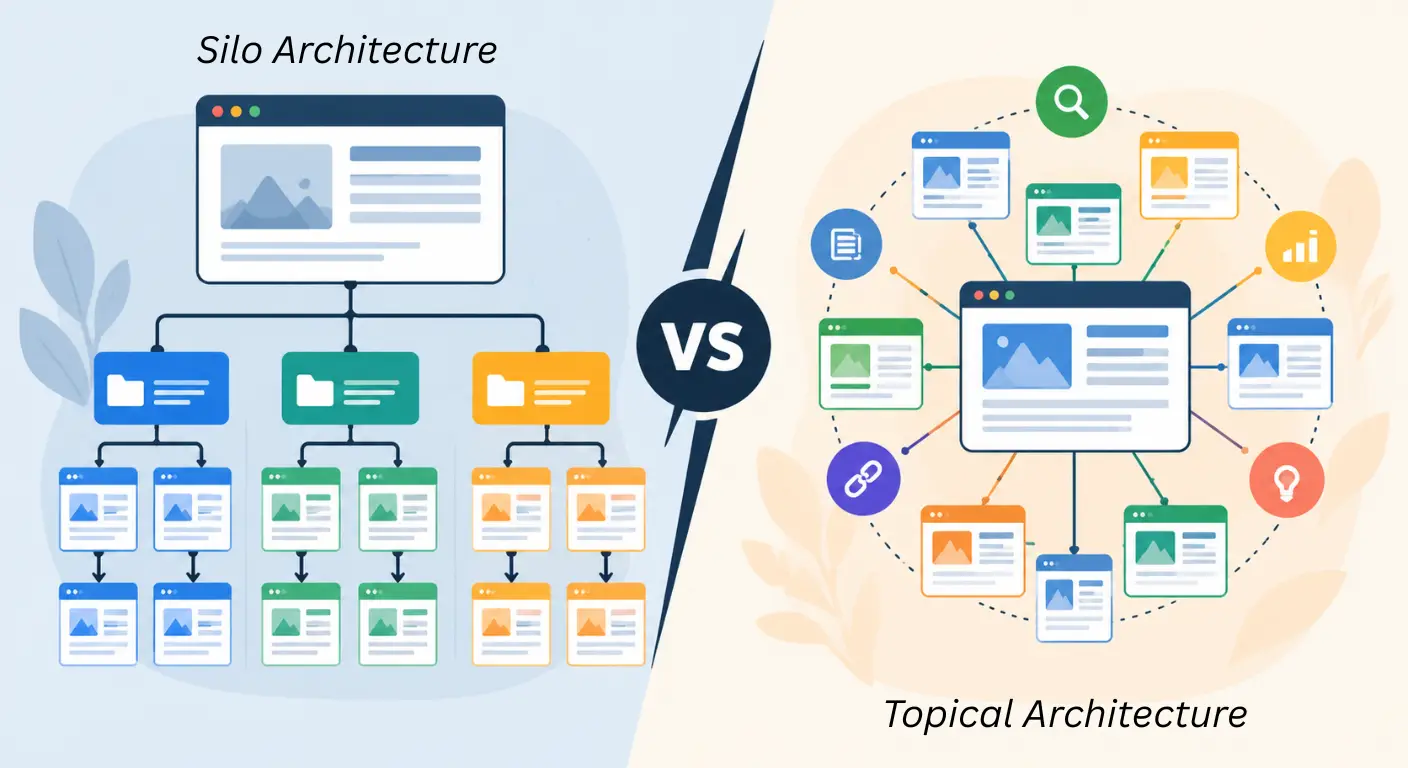
Every website architect eventually reaches a fork in the road: Should you organize your content like a strict file system (Silo Architecture), or build it like a interconnected brain (Topical Architecture)?
In early SEO, the answer was simple: build strict, watertight directory folders, lock down internal linking between silos, and pass link authority down a linear ladder.
Then came modern semantic search engines, Knowledge Graphs, and entity parsing.
Today, forcing a website into an overly rigid directory silo often creates user friction, limits content discovery, and prevents natural topical authority. But completely abandoning structure leads to “link soup” and split keyword intent.
In this guide, we break down the definitive comparison between Silo Structure and Topical Structure without the outdated myths or confusing jargon.
What We Will Cover in This Blueprint
To help you design the right architectural layout for your project, this comparison guide walks through:
- Physical containment vs. logical entity mapping.
- How hard vs. soft siloing works, PageRank containment dynamics, and where silos fail modern UX.
- Hub-and-spoke cluster networks, entity relationships, and why Google prefers semantic nodes over folder paths.
- Direct evaluation across PageRank flow, URL dependency, UX flexibility, and scalability.
- Exactly when to pick Silo (e.g., multi-category E-Commerce) vs. Topical (SaaS, Niche Publications, Consulting).
- How enterprise SEOs combine physical folder sanity with logical topical cross-linking.
- 4 architecture-ruining mistakes and an audit checklist.
The Architectural Dilemma (Isolation vs. Connectivity)
When structuring a website, every technical SEO faces a fundamental design choice: Should you group your pages into isolated, watertight compartments, or connect them into a flexible, semantic network?
This decision determines how search engine crawlers allocate crawl budget, how link equity (PageRank) flows across your domain, and how easily users can discover related content.

The Real-World Analogy: Department Store vs. Mind Map
To understand the core difference without getting lost in technical jargon, consider two real-world concepts:
The Department Store (Silo Architecture)
Imagine walking into a high-end department store.
- Electronics are on Floor 1.
- Clothing is on Floor 2.
- Home Goods are on Floor 3.
To go from “Running Shoes” to “Fitness Watches,” you must walk back to the floor entrance, take the escalator down, and navigate into a completely separate department. The departments are strictly separated to keep inventory clean and prevent store clutter.
The Mind Map (Topical Architecture)
Now imagine a digital mind map or Wikipedia page about Human Fitness.
- The concept of “Running” naturally links directly to “Cardiovascular Health.”
- “Cardiovascular Health” links directly to “Heart Rate Monitors.”
- “Heart Rate Monitors” links directly to “Fitness Watches.”
There are no artificial floor barriers. Every topic connects naturally based on relevance and intent, allowing a visitor to traverse concepts effortlessly.
The Two Core Architectural Philosophies
When we translate these analogies into technical web architecture, we get two distinct paradigms:
| Architectural Metric | Silo Architecture (Isolation) | Topical Architecture (Connectivity) |
| Primary Focus | Physical directory containment (/folder/subfolder/) | Entity relevance and contextual hub-and-spoke graphs |
| Link Restriction | Strict Boundaries: Pages in Silo A rarely link to Silo B to prevent authority leakage | Fluid Routing: Pages link wherever semantic context and user intent dictate |
| Main Advantage | Prevents keyword cannibalization and preserves strict authority boundaries | Delivers superior UX, reduces click depth, and builds fast topical authority |
| Main Drawback | Rigid structure; risks creating deep, orphan sub-pages | Risk of “link soup” or diluted signals if cross-links lack clear context |
Why Modern Search Engines Shifted the Playing Field
In the early days of SEO, search crawlers evaluated websites primarily as hierarchical document trees. If a page was placed in /services/seo/technical/, Google assumed it was explicitly related to “SEO” because of its directory string.
However, modern search engines rely heavily on Natural Language Processing (NLP), Entity Graphs, and Vector Embeddings. Google no longer needs a strict /folder/ path to understand that two pages are topically linked. It parses the semantic relationship between entities directly within the body text and anchor links.
This evolution is why rigid siloing is no longer the default choice for every website and why understanding when to use each model is critical for SEO performance.
Deep-Dive into Silo Architecture (Physical Containment)
Silo Architecture is an organizational model designed to group content into strict, isolated categories on your website. The goal of siloing is simple: maximize topical purity within a specific category and prevent link equity from “leaking” into unrelated sections of your site.
When you implement a silo, every page within that category reinforces a single core topic, signaling to search engines that your site possesses focused, deep authority in that specific area.
Hard Silos vs. Soft Silos: What Is the Difference?
In technical SEO, siloing is executed in two distinct ways: through physical URL directories or through internal linking boundaries.
Hard Siloing (Physical Directory Containment)
Hard siloing relies on your server’s physical directory structure. Pages are nested directly within specific URL subfolders:
https://example.com/services/technical-seo/audit/https://example.com/services/ppc/audit/How Crawlers See It: Search engines analyze the URL path itself to establish parent-child relationships. Every slash (
/) indicates a deeper step down the physical hierarchy.The Catch: If you ever need to move a page from one category to another, you are forced to change its URL and implement a 301 redirect, creating technical debt.
Soft Siloing (Virtual/Anchor Containment)
Soft siloing (also known as Virtual Siloing) keeps clean, flat URLs at the root level while using strict internal linking rules to isolate topics:
https://example.com/technical-seo-audit/https://example.com/ppc-audit/How Crawlers See It: Instead of relying on URL folder paths, crawlers determine the silo boundary purely through incoming and outgoing
<a href>links. Pages in the “Technical SEO” virtual silo only link to other “Technical SEO” pages.
PageRank Containment & The Mechanics of Link Isolation
The primary technical benefit of Silo Architecture is controlling how PageRank (link equity) flows across your domain.
When an external site links to one of your category articles, that page receives an injection of authority. In an unorganized site structure, that authority diffuses randomly across unrelated pages.
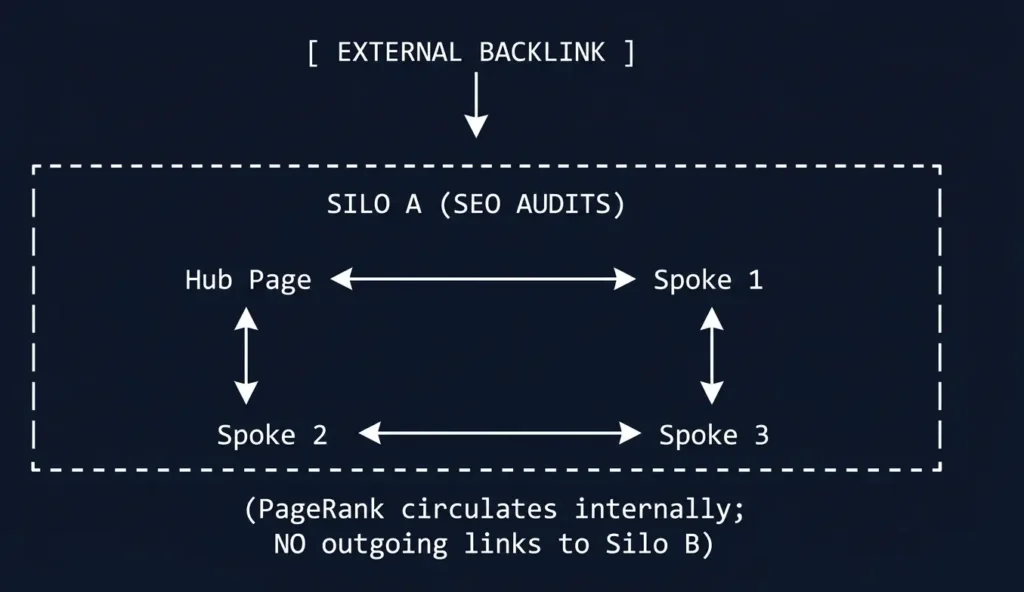
The Rules of Silo Isolation:
Vertical Equity Passing: Spoke pages pass authority upward to their parent Hub page, and the Hub passes equity back down to supporting Spokes.
Horizontal Link Blocking: A page in Silo A (SEO Audits) is strictly forbidden from linking to a page in Silo B (PPC Management).
Preserving Topical Purity: By blocking cross-silo links, you prevent search engines from mixing the semantic signals of unrelated entities.
The Downside: Usability Friction & Scale Bottlenecks
While strict siloing sounds ideal on paper, it introduces severe operational and user-experience (UX) challenges on modern websites:
User Journey Dead-Ends: Real users do not think in isolated directory folders. A user reading about “Technical SEO Audits” might naturally want to check your “PPC Audit Pricing”. Forcing them to go back to the main menu creates friction.
Orphan Sub-Pages: Deeply nested hard silos (
/cat1/subcat2/subcat3/page/) often push deep articles beyond 4+ clicks from the homepage, leading to indexation drops.Content Duplication Traps: If a topic fits into two categories (e.g., a tool used for both SEO and Content Marketing), a hard silo forces you to either duplicate the content or pick an arbitrary home, weakening topic depth.
Deep-Dive into Topical Architecture (Semantic Clustering)
Topical Architecture is a modern site organization strategy built around entities, semantic context, and user intent, rather than strict physical URL subfolders.
Instead of forcing articles into isolated directory silos, a topical structure organizes content into Hub-and-Spoke Topical Clusters. The core objective is to build complete, unquestionable authority over an entire topic domain by interlinking related sub-topics through natural, contextual relationships.
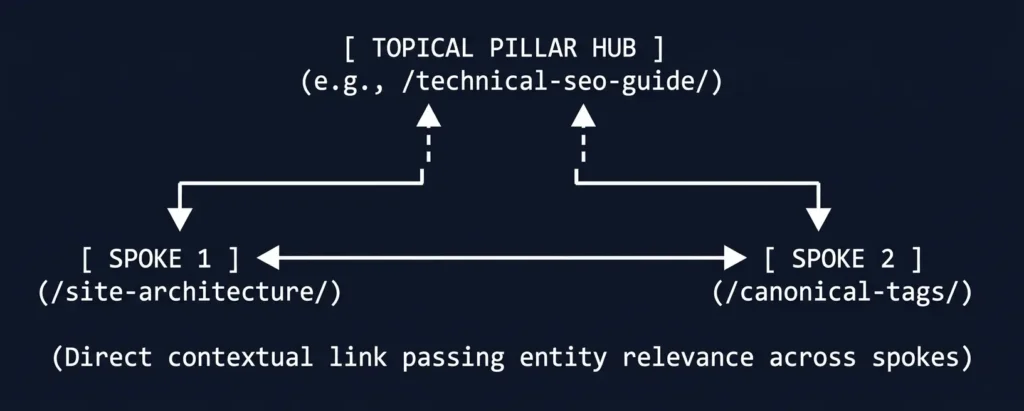
The Hub-and-Spoke Engine: Pillars, Spokes & Contextual Bridges
Unlike rigid physical siloing, a topical network operates on a flexible 3-tier relationship model:
The Pillar Asset (The Hub): A comprehensive, high-level guide addressing a broad core entity (e.g., Technical SEO). This page targets high-volume, competitive head terms.
Cluster Articles (The Spokes): Targeted sub-articles diving deep into specific long-tail entities (e.g., Site Architecture, Canonical Tags, Robots.txt Optimization).
Contextual Cross-Bridges: Spoke pages pass authority upward to the Pillar, while simultaneously cross-linking to neighboring Spokes whenever the context naturally warrants it, regardless of whether they share the same URL folder path.
Why Google Prefers Topical Graphs over Physical Folders
In early search algorithms, Google relied heavily on URL directory paths (/folder/subfolder/) to understand content relationships. Modern search engines, powered by Knowledge Graphs, Vector Embeddings, and LLM-driven parsers, process web pages differently:
Entity Recognition Over URL Strings: Google parses the text and anchor text to identify entity connections. A page titled “Internal Linking Strategies” is recognized as topically tied to “Site Architecture”, even if both live directly at the root domain
https://example.com/internal-linking/andhttps://example.com/site-architecture/.The Reasonable Surfer Model: Search engines evaluate links based on the likelihood of a real user clicking them. Contextual in-content links between topically related articles carry high semantic weight, whereas links hidden in strict footer menus or isolated directory sidebars receive lower weight.
Semantic Vector Traversal: By building tightly connected topical clusters, you signal to search crawlers that your domain completely covers a “topical vector,” earning faster indexation and higher rankings across long-tail variations.
The Downside: Topical Bleeding & “Link Soup” Risks
While Topical Architecture provides maximum flexibility and superior user experience, it comes with specific architectural risks if executed without discipline:
Topical Bleeding (Diluted Context): If you randomly cross-link articles without genuine semantic overlap (e.g., linking a Local SEO guide to a Shopify Schema tutorial just to build links), search engines lose clarity on the core theme of the cluster.
Keyword Cannibalization: Without clear hierarchy boundaries, spoke pages can accidentally compete for the same target keywords as the main Pillar page.
Uncontrolled Link Equity Sprawl: Without structural planning, internal PageRank diffuses aimlessly across low-value pages instead of concentrating on primary commercial assets.
Head-to-Head Technical Comparison (Silo vs. Topical)
Choosing between Silo Architecture and Topical Architecture is not about finding which model is universally “better”. It is about selecting the right framework for your website’s scale, content velocity, and target audience behavior.
While Silo Architecture prioritizes strict physical boundaries and PageRank containment, Topical Architecture optimizes for entity connections, user discovery, and semantic authority.
| SILO ARCHITECTURE | TOPICAL ARCHITECTURE | |
| Hard URL directory locks | Clean / flat URL flexibility | |
| Zero cross-silo link leakage | VS | Semantic entity-based links |
| Higher risk of deep orphans | Shallow click depth (<3) | |
| Ideal for strict categories | Ideal for topical authority |
Direct Technical Comparison Matrix
To evaluate how both models perform under real-world SEO conditions, here is a detailed side-by-side comparison across core technical metrics:
| Technical Metric | Silo Architecture (Physical Isolation) | Topical Architecture (Semantic Clustering) |
| URL Directory Structure | Hierarchical & Rigid: Depends heavily on /category/subcategory/page/ subfolders. | Flat & Flexible: Operates efficiently on root URLs (/page-title/) or broad category paths. |
| PageRank / Equity Flow | Vertical Isolation: Circulates authority inside a single folder block; restricts horizontal leakage. | Fluid Network: Passes authority dynamically across related hub and spoke entities. |
| Click Depth Efficiency | Higher Click Depth: Sub-pages can easily end up 4+ clicks away from the homepage. | Shallow Click Depth: Contextual bridges keep spoke articles within 1–3 clicks of main hub pages. |
| Risk of Topical Bleeding | Very Low: Strict rules prevent mixing unrelated entity keywords. | Moderate to High: Poorly planned cross-linking can dilute cluster context. |
| Scalability & UX Flexibility | Rigid: Adding cross-category items requires URL redirects or duplicate pages. | Highly Scalable: New sub-topics plug naturally into existing entity graphs without URL changes. |
| Modern Search Engine Alignment | Aligns with traditional document-tree crawlers. | Aligns with semantic parsers, Knowledge Graphs, and LLM search agents. |
Key Architectural Trade-Offs
PageRank Security vs. Contextual Flow
Siloing acts like a series of watertight bulkheads in a ship. If one silo receives low-quality traffic, the negative signals or canonical confusion are contained within that compartment.
Topical Architecture acts like an open irrigation network. It channels PageRank from high-performing blog posts directly into related product or commercial pages, but requires strict anchor-text discipline to avoid diluting thematic focus.
Directory Maintenance vs. Logical Mapping
In a Silo model, restructuring your site requires setting up server-level 301 redirect chains because the physical URL changes whenever a page moves.
In a Topical model, restructuring is purely a database/linking update. You adjust contextual internal links and breadcrumb schema, while keeping the underlying URL completely intact.
Decision Framework (Which Site Architecture Fits Your Website?)
Choosing between Silo Architecture and Topical Architecture should never be based on guesswork or SEO trends. It depends entirely on your website type, business monetization model, and inventory complexity.
When Silo Architecture Wins (The Isolated Model)
Silo Architecture shines when you need to maintain strict boundary segregation between unrelated commercial offerings or large product catalogs.
Best Fit Scenarios:
Large Multi-Category E-Commerce Stores: A department store selling both Furniture and Cosmetics must isolate those two categories. Linking a Living Room Sofa directly to a Lipstick guide creates confusion for both users and search engine parsers.
Example Path:
https://example.com/furniture/sofas/leather-sofa/
Multi-Niche Marketplaces & Aggregators: Websites that cover completely separate industries (e.g., Real Estate vs. Automotive) rely on hard directory silos to ensure that link equity and keyword intent stay strictly within their respective domains.
Enterprise Portals with Strict Compliance / Franchises: Businesses that operate across distinct legal entities or regional branches use physical folder silos to control site permissions and directory-level tracking.
When Topical Architecture Wins (The Entity Graph Model)
Topical Architecture dominates when your main SEO objective is building deep domain authority around specific concepts, driving organic brand discovery, and creating frictionless user pathways.
Best Fit Scenarios:
SaaS Platforms & Tech Product Websites: Software companies need to educate users through top-of-funnel (TOFU) informational guides and route them smoothly toward bottom-of-funnel (BOFU) solution pages.
Example Setup: A blog post on
https://example.com/blog/what-is-cloud-backup/links contextually directly to the core product pagehttps://example.com/features/cloud-storage/without rigid subfolder barriers.
B2B Services & Consulting Agencies: Service businesses thrive on topical authority. Interlinking related case studies, service modules, and strategy guides via natural contextual anchors builds strong entity relevance across your entire domain.
Niche Publications & Affiliate Content Hubs: Media sites that cover specialized subjects (e.g., Digital Photography or Fitness) benefit from fluid hub-and-spoke clusters, allowing readers to explore related sub-topics without hitting artificial directory walls.
Quick Decision Framework Matrix
To help you determine the optimal structural model for your next web build, use this strategic evaluation matrix:
| Business Objective / Site Metric | Recommended Architecture | Architectural Rationale |
| Clear, non-overlapping product categories | Silo Architecture | Preserves catalog organization and isolates PageRank within specific product lines. |
| High content velocity & blogging focus | Topical Architecture | Allows rapid cluster creation without restructuring server directory folders. |
| Minimizing click depth (<3 clicks) | Topical Architecture | Contextual links bypass deep physical subfolders, keeping sub-pages accessible. |
| Strict keyword cannibalization control | Silo Architecture | Prevents cross-category pages from competing for identical transactional terms. |
| Optimizing for AI Search & Knowledge Graphs | Topical Architecture | Directly aligns with semantic vector parsing and entity relationship models. |
The Modern Hybrid Model (Combining Physical Sanity with Semantic Links)
In real-world SEO, choosing between Silo Architecture and Topical Architecture is rarely a binary, all-or-nothing decision. The most resilient, high-performing websites execute a Hybrid Architectural Framework.
The Hybrid Model combines the physical directory sanity of Silos at the top level with the logical entity fluidity of Topical Clusters at the content layer.
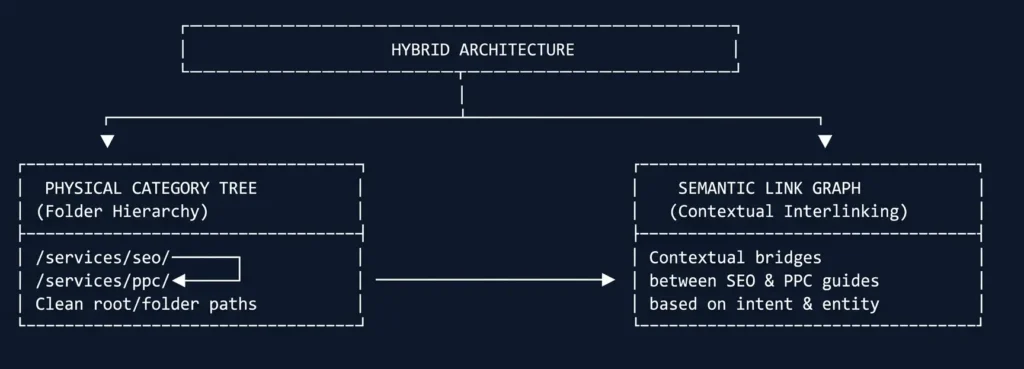
How the Hybrid Model Operates
The hybrid approach uses a simple, highly scalable structural rule:
Top-Level Structural Isolation (Physical Sanity): Use distinct, parent-level directory paths to organize primary business categories (
/services/,/e-commerce/,/blog/). This keeps server routing, analytics reporting, and XML sitemaps structured and clean.Mid-to-Bottom Semantic Interlinking (Logical Fluidity): Inside your content layers, break rigid horizontal siloing barriers. Allow articles in different sub-categories to link contextually to one another whenever there is a clear entity connection or user navigation trigger.
The Rules for Safe Cross-Silo Linking
To prevent topical bleeding while maintaining contextual flow, cross-silo links must adhere to strict architectural rules:
Rule 1: Anchor Text Explicit Precision: Never use generic anchors like “click here” or “read more” when crossing category boundaries. The anchor text must explicitly name the target page’s core entity (e.g., “Web Performance Audits”).
Rule 2: High Contextual Relevance: Cross-links must live directly inside body paragraphs where the surrounding copy naturally transitions between concepts. Avoid forced cross-links placed at the bottom of unrelated articles.
Rule 3: No Site-Wide Navigation Bleed: Keep header mega-menus and site-wide footers focused on core pillar hubs. Do not dump every sub-page into global menus, as this causes PageRank dilution across all silos.
Real-World Architecture Blueprint: Modern SaaS / Enterprise Site
Here is how a hybrid layout looks in practice for a growing business domain:
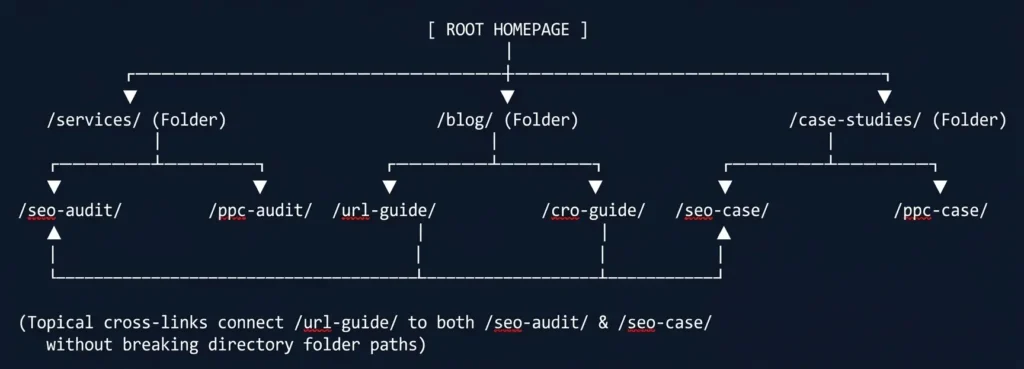
Directory Hygiene: Clean, predictable URL folders maintain structural sanity.
PageRank Routing: In-content contextual links dynamically pass authority from high-traffic blog guides (
/blog/url-guide/) straight to conversion-oriented service pages (/services/seo-audit/).
Execution Roadmap & Common Architecture Pitfalls
Even the most well-thought-out site architecture can fail if common execution mistakes break your link graph or confuse search crawlers.
To ensure your architecture delivers maximum ranking power and flawless navigation, follow this implementation roadmap and avoid these four costly pitfalls.
The 4 Architecture-Ruin Pitfalls (And How to Fix Them)
Pitfall 1: Mega-Menu Link Leaks
The Error: Placing dozens of deep, sub-category links inside site-wide header mega-menus or footers.
The Impact: Site-wide navigation links force PageRank to bleed uniformly across all pages, completely diluting your strict silo boundaries and weakening the authority of core pillar assets.
The Fix: Limit global header menus to top-tier Pillar Hubs and high-value commercial landing pages. Render deep sub-category navigation via dynamic HTML sidebars or scoped contextual menus that load only when viewing that specific category.
Pitfall 2: Inconsistent Breadcrumb Trails
The Error: Using URL-based breadcrumbs that do not match the actual logical category hierarchy, or missing
BreadcrumbListSchema entirely.The Impact: Search engine crawlers receive conflicting signals between the URL path, internal links, and structured data, leading to incorrect breadcrumb display in SERPs.
The Fix: Implement structured JSON-LD
BreadcrumbListmarkup that explicitly reflects your parent-child entity taxonomy, regardless of whether your URLs are flat or nested.
Pitfall 3: Deep Orphan Spoke Pages
The Error: Publishing supporting articles (spokes) without linking them directly back to their main topic hub page or neighboring spokes.
The Impact: Spoke articles drift beyond 4+ clicks from the homepage, leading to crawl budget waste, slow indexation, or dropped rankings.
The Fix: Audit your click depth regularly using site crawlers (like Screaming Frog). Ensure every spoke page sits within 1 to 3 clicks of the homepage via parent hub links.
Pitfall 4: Over-Optimized or Diluted Anchor Text
The Error: Forcing identical exact-match anchor text on every internal link, or using vague anchors like “click here” or “source”.
The Impact: Exact-match spam triggers algorithmic over-optimization flags, while generic anchors fail to pass semantic entity context.
The Fix: Use descriptive, natural variations of your entity keywords as anchor text (e.g., “improving site structure”, “organizing category hierarchies”).
Step-by-Step Architecture Audit Checklist
Before launching a new site layout or migrating an existing structure, run through this final checklist:
Summary: Silo vs. Topical Architecture at a Glance
Choose Silo Architecture if you run a large multi-category E-Commerce store, an inventory aggregator, or a site requiring strict physical folder containment between unrelated product lines.
Choose Topical Architecture if you run a SaaS platform, a B2B service agency, or a niche publication building deep semantic entity authority.
Choose the Hybrid Model for enterprise scale—combining clean physical URL directory paths with flexible, contextual in-content cross-linking.
Conclusion
Choosing between Silo Architecture and Topical Architecture is not a matter of selecting a “winning” trend, but of aligning your site’s link graph with your business model and target user intent. While rigid physical siloing protects PageRank containment across large, multi-category catalogs like e-commerce, modern semantic search engines increasingly favor fluid, entity-driven topical clusters that minimize click depth and maximize content discovery.
For most growing digital platforms, the ultimate architectural play is a hybrid approach maintaining clean physical folder boundaries at the root level while empowering in-content contextual bridges to pass topical authority smoothly across related nodes.
Need Help Structuring a Scalable Site Architecture?
A broken site architecture, messy directory structure, or deep orphan pages can silently cap your organic search growth, no matter how great your content is. Whether you are launching a new domain, restructuring an enterprise publication, or fixing crawl efficiency issues, getting your information architecture right is critical. Explore my Technical SEO Services & Internal Linking Services or Get in touch today to audit your website structure and map out a custom, search-friendly site architecture.
Frequently Asked Questions (FAQs)
What is the main difference between a Silo Structure and a Topical Structure?
The primary difference lies in how pages are connected and constrained. A Silo Structure organizes content into rigid, isolated directory folders (e.g., /category/subcategory/) where cross-linking between categories is restricted to isolate PageRank. In contrast, a Topical Structure organizes content using semantic hub-and-spoke networks, allowing contextual cross-links between related entities regardless of URL folder paths.
Is a Silo Structure better for E-Commerce websites?
Yes, in most cases. E-Commerce platforms with distinct product catalogs (e.g., Men’s Shoes vs. Kitchenware) benefit significantly from physical Silo Structures. Isolating product lines into clear directory subfolders prevents keyword cannibalization, keeps product attributes clean, and prevents link equity from bleeding into unrelated product categories.
Does modern Google SEO still favor Silo Site Structure?
Google still understands and crawls traditional directory silos, but modern algorithms (powered by Natural Language Processing and Knowledge Graphs) heavily favor Topical Structure. Google evaluates entity relationships and contextual link relevance directly within content rather than relying strictly on URL folder strings.
Can I use clean, flat URLs with a Silo Structure?
Yes. This is called a Virtual Silo (or Soft Silo). Instead of creating deep physical directory paths like https://example.com/seo/technical/audit/, you keep flat root URLs like https://example.com/technical-seo-audit/ while enforcing strict internal linking rules that prevent cross-category links.
Will cross-linking between two different silos damage my rankings?
Not if it is done contextually and sparingly. Uncontrolled, generic cross-linking (like site-wide footer links or unrelated sidebar widgets) causes PageRank leakage and dilutes topical purity. However, a contextual in-content link using explicit entity anchor text passes relevant authority without ruining your silo structure.
How do I avoid keyword cannibalization in a Topical Cluster structure?
Define clear intent boundaries before interlinking. Your Pillar Hub page should target broad, high-volume head terms (e.g., “Technical SEO”), while supporting Spoke pages target specific long-tail intent queries (e.g., “Canonical Tag Setup”). Always link spoke pages back upward to the pillar asset to reinforce hierarchy.
What is a Hybrid Site Structure model?
A Hybrid Site Structure combines top-level physical folder organization (keeping clean directory buckets like /services/ and /blog/) with flexible topical interlinking at the content layer. It gives enterprise websites the organizational clarity of a silo with the ranking power and shallow click depth of a topical graph.
Explore Other Articles Under Technical SEO Side
Pillar Blogs
What is Technical SEO? (Parent Blog)
- Website Architecture (Child Blog)