

Imagine trying to navigate a sprawling library where millions of books are dumped onto random shelves without categories, indexes, or sections. Even if every book contained world-class knowledge, finding specific answers would be an absolute nightmare.
For years, search engine crawlers faced a similar issue on the web. Websites published hundreds of disconnected articles, hoping individual keywords would magically rank.
Then search engines evolved.
With the arrival of entity parsing, vector search, and semantic Knowledge Graphs, search engines stopped evaluating web pages as isolated documents. Instead, they began asking a fundamental question: “Does this website demonstrate complete, organized authority over an entire topic domain?”
This is where Topic Clusters and Hub-and-Spoke Architecture become the core engine of modern technical SEO.
By structuring your content around central authority hubs connected to highly targeted supporting spokes, you transform a chaotic blog into a search-driven content network driving faster indexation, higher keyword rankings, and seamless user conversion.
What We Will Cover in This Blog
- Deconstructing the bicycle wheel model and clarifying the difference between Topic Cluster strategy vs. Hub & Spoke execution.
- Building authority-driven Pillar Assets, targeted supporting Spokes, and semantic internal link connectors.
- A practical roadmap for mapping entities, establishing URL paths, and configuring bidirectional linking.
- How authority flows through clusters, anchor text rules, and avoiding internal PageRank dampening.
- Spotting internal keyword competition and safely merging or pruning outdated spokes.
- Proven Hub-and-Spoke patterns for SaaS platforms and multi-category E-Commerce stores.
- The 5 most common cluster-ruining mistakes and how to fix them.
The Anatomy of a Search-Driven Site (Hub & Spoke Explained)
To build a website that consistently ranks for competitive keywords, you need to rethink how your content connects. Instead of publishing isolated blog posts and hoping they rank individually, a search-driven site operates as an organized network.
Understanding this network starts with one clear visual framework.
What is a Hub-and-Spoke Model?
Think of your website’s content structure like a bicycle wheel:
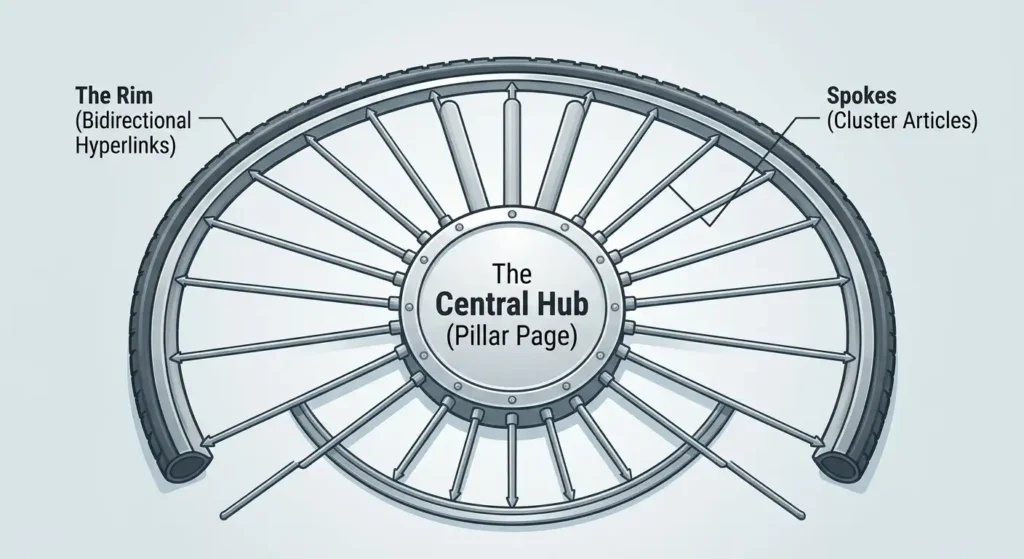
The Central Hub (Pillar Page): This is the wheel’s center. It is a comprehensive, broad resource covering a high-level topic (e.g., Technical SEO). It targets broad, high-volume head terms.
The Spokes (Cluster Articles): These are the individual rods extending outward. Each spoke is a dedicated, highly specific article focusing on a long-tail sub-topic (e.g., Robots.txt Setup, Schema Markup, or Crawl Budget Optimization).
The Rim (Bidirectional Hyperlinks): The internal links connecting every spoke back to the central hub and contextually to neighboring spokes, hold the entire wheel together.
Without the center hub, the spokes fall apart. Without the spokes, the hub lacks structural support and depth.
Topic Clusters vs. Hub & Spoke: Strategy vs. Technical Execution
In SEO discussions, “Topic Cluster” and “Hub-and-Spoke” are often used interchangeably, but they represent two distinct layers of site building:
| Dimension | Topic Cluster (The Strategy) | Hub & Spoke (The Technical Execution) |
| What It Is | Content Planning: Grouping related sub-topics around a core subject entity. | Architecture & Delivery: The physical internal linking and URL routing layout. |
| Primary Goal | Ensures full topical coverage and eliminates content gaps. | Controls PageRank flow, reduces click depth, and guides crawler pathing. |
| Simple Analogy | Designing a university course curriculum. | Building the physical hallway and door navigation between classrooms. |
Key Takeaway: Topic Clustering is what you decide to write about. Hub-and-Spoke is how you interlink those assets so search engines and users can navigate them efficiently.
Why Google’s Knowledge Graph Rewards Semantic Cluster Authority
Modern search engines no longer evaluate web pages as standalone documents matching raw keywords. Through Entity Recognition, Vector Embeddings, and Knowledge Graphs, Google evaluates whether your site is a topically authoritative source on a given entity.
Contextual Proof of Expertise: When a site answers every supporting question around a core entity, search algorithms recognize that the site possesses comprehensive topical depth.
Efficient PageRank Circulation: External links hitting any single spoke post pass equity directly up to the central Hub, boosting the ranking power of the entire cluster.
Intent Coverage: Users entering at different stages of their search journey (informational vs. transactional) can naturally navigate across the cluster without leaving your domain.
The Core Components of a High-Ranking Topic Cluster
A successful topic cluster is not just a collection of articles linked together at random, it is a engineered system. To build a cluster that search engines recognize as topically authoritative, you must construct three distinct structural layers.
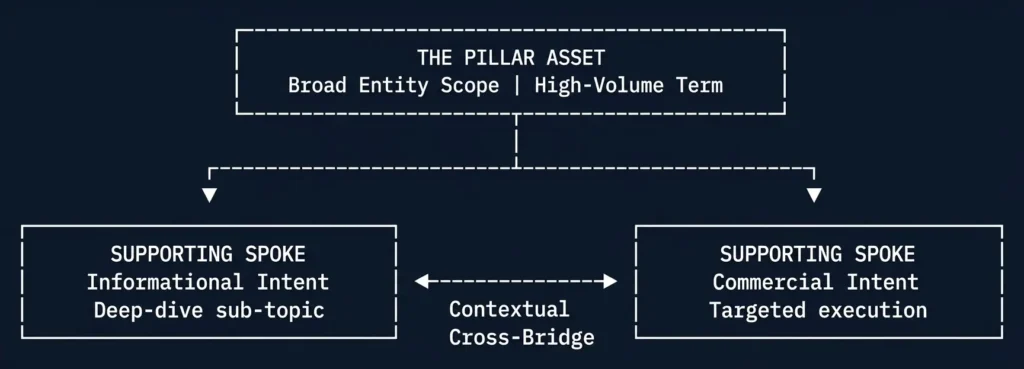
The Pillar Asset (The Hub)
The Pillar Asset serves as the central anchor for your entire cluster. Its job is to provide an authoritative overview of a broad core entity (e.g., Site Architecture, On-Page SEO, or E-Commerce Analytics).
The Pillar Dilemma: How to Avoid Generic Fluff
The biggest mistake SEOs make with pillar pages is writing high-level fluff that provides zero actionable value. A high-ranking Pillar Asset must balance breadth with depth:
High-Level Summary with Deep Touchpoints: Introduce every major sub-topic clearly, explain why it matters, and then pass the reader to a dedicated Spoke page for the step-by-step implementation.
Intent Capture: Target broad, competitive head terms (e.g.,
"website architecture blueprint").Structural Framing: Use clean H2 and H3 section headings that mirror the exact sub-topics covered by your supporting spokes.
Rule of Thumb: If a section on your Pillar page exceeds 500–600 words of tactical execution, it should be carved out into a standalone Spoke article and linked back contextually.
The Supporting Assets (The Spokes)
If the Pillar Asset is the high-level roadmap, the Spoke Assets are the tactical execution guides. Each Spoke addresses a highly specific sub-entity or long-tail user query.
To build a balanced cluster, you must map your Spokes across two distinct user intent profiles:
Informational Spokes (Problem Solving)
Objective: Answer specific “how-to”, “what is”, or troubleshooting questions.
Role in Cluster: Captures top-of-funnel (TOFU) search traffic and builds raw topical authority for long-tail query variations.
Commercial / Transactional Spokes (Solution Seeking)
Objective: Guide users who are actively looking for tools, audits, templates, or service solutions.
Role in Cluster: Captures middle/bottom-of-funnel (MOFU/BOFU) intent and serves as the conversion bridge between informational guides and commercial service pages.
The Contextual Connectors: Anchor Text & Equity Flows
The internal links connecting your Pillar to your Spokes act as the nervous system of the cluster. Without strict linking rules, PageRank gets trapped or diffuses aimlessly.
The Bi-Directional Linking Rule
Upward Link (Spoke → Pillar): Every Spoke article must link back to its parent Pillar Asset using descriptive, primary-keyword anchor text. This signals to search engines which page holds central authority.
Downward Link (Pillar → Spoke): The Pillar Asset must link down to every supporting Spoke page within its respective section summary.
Anchor Text Discipline
To avoid over-optimization flags while maintaining strong semantic signals, vary your internal anchor text naturally:
Primary Entity Anchors (Spoke to Pillar): Use exact or close variations of the core topic (e.g., “website architecture guide”, “site structure frameworks”).
Descriptive Semantic Anchors (Pillar to Spoke): Use specific long-tail anchors that clearly identify the destination page (e.g., “silo vs topical architecture comparison”, “audit site click depth”).
Banned Anchors: Never use generic phrases like “click here”, “read more”, or “this article”. They pass zero entity context to search crawlers.
Step-by-Step Execution: How to Build a Topic Cluster from Scratch
Building a topic cluster from scratch requires a structured workflow. Skipping steps or interlinking without a roadmap creates keyword cannibalization and broken PageRank paths.
Follow this 3-step execution framework to map, structure, and connect your cluster assets correctly from day one.
1. Entity & Intent Mapping:
Identifying Head Terms & Sub-Topic Nodes
Before creating content, you must define the semantic boundary of your cluster.
Identify the Central Entity (Pillar Node): Find a broad head term with high business relevance (e.g.,
"E-Commerce SEO"or"URL Structure"). This page targets broad informational or high-intent commercial head terms.Extract Sub-Topic Nodes (Spokes): Use search tools (Ahrefs, SEMrush, Google SERPs) to pull related sub-questions, long-tail queries, and intent variations. Group them logically so each spoke addresses one explicit intent.
Map Intent Levels: Categorize every sub-topic node into Informational (TOFU) or Commercial/Transactional (MOFU/BOFU).
2.Defining the Architecture Map
Folder Directories vs Flat Root URLs
Before publishing, choose your URL structure. Both models work well for topic clusters, but they handle directory routing differently:
Option A: Nested Subfolder Directory (Physical Structure)
Example:
https://example.com/site-architecture/silo-vs-topical/Pros: Clear directory reporting in Google Analytics & Search Console; explicit folder parent-child signal.
Cons: Can lead to long, messy URLs if nested too deeply.
Option B: Flat Root URL (Logical Semantic Structure)
Example:
https://example.com/silo-vs-topical-architecture/Pros: Clean, user-friendly, shallow click depth, and flexible to re-categorize without setting up server 301 redirects later.
Cons: Requires disciplined internal linking to pass parent-child context to search crawlers.
Consultant Advice: For modern blogs and SaaS platforms, Flat Root URLs paired with strict internal linking offer maximum UX flexibility without risking broken folder redirect chains.
3.Executing Bi-Directional Linking
Connecting Hubs, Spokes & Cross-Bridges
Once content is live, configure your internal link graph using explicit bi-directional rules:
Rule 1: The 1:1 Bi-Directional Hub Rule
Every Spoke page must contain an in-content link pointing straight back up to the Pillar Hub page within the first 200 words. In return, the Pillar Hub must link down to that Spoke within its dedicated sub-section.
Rule 2: Spoke-to-Spoke Contextual Cross-Bridges
Allow neighboring Spokes inside the same cluster to link horizontally to one another only when there is natural semantic overlap.
Rule 3: Anchor Text Precision
Ensure the anchor text clearly identifies the destination page’s target entity (e.g., use “canonical tag guide” instead of “click here to read more”).
Advanced Internal Linking Mechanics & PageRank Distribution
Understanding how search algorithms distribute authority through your internal link graph transforms basic blogging into precise SEO engineering.
Internal links do not merely guide search crawlers, they function as PageRank conduits. By controlling link equity paths, you can harvest external backlinks acquired by popular spoke articles and direct that ranking power straight to low-tier, high-value commercial assets.
How Link Equity Flows: High-Backlink Spokes to Conversion Hubs
In organic search, informational guides naturally earn far more external backlinks than commercial transactional pages. Users and bloggers link to comprehensive guides, research data, and tutorials, rarely to sales landing pages.
You can exploit this behavior using a PageRank Funnel:
Earn Backlinks at the Edge: Publish deep-dive informational spoke articles (e.g., “How to Fix 404 Errors”). These attract organic external links from industry sites.
Funnel Equity Inward: Place targeted, contextual internal links inside those high-equity spoke articles pointing directly to your primary Pillar Asset or core Service Page.
Lift Commercial Rankings: The accumulated PageRank passes through the internal link graph, boosting the domain authority and rankings of your commercial conversion pages without needing direct external backlinks to those sales URLs.
Preventing “Link Loops” and PageRank Dampening
A common mistake in complex topic clusters is creating circular link patterns that waste or dampen PageRank.
The Mechanics of PageRank Dampening
Google applies a Damping Factor (historically estimated around $0.85$) every time PageRank traverses an internal link. This means each additional “hop” a crawler takes reduces the passed authority.
If your core service page sits $4+$ clicks deep inside a nested category chain, the link equity reaching it drops exponentially.
[ HOMEPAGE ] ──(100% Equity)──► [ CATEGORY ] ──(85%)──► [ SUB-CAT ] ──(72%)──► [ TARGET PAGE (Deep/Weak) ]
Avoiding Hazardous Link Loops
Reciprocal Spoke Loops: Linking Spoke A directly to Spoke B, and Spoke B right back to Spoke A without a contextual reason creates a micro-loop that traps crawlers without advancing equity up toward the Pillar Hub.
The Solution (Unidirectional Funneling): Keep horizontal spoke-to-spoke links strictly contextual and purpose-driven. Always ensure the primary link flow travels upward to the parent Pillar page.
Anchor Text Natural Variations: Exact-Match vs. LSI vs. Navigational Anchors
Over-optimizing internal anchor text with repetitive, exact-match keywords across every internal link triggers algorithmic spam filters and weakens semantic context.
To maintain a healthy, natural link profile, diversify your anchor text across three core categories:
| Anchor Type | Example Anchor Text | Recommended Ratio | Strategic Role |
| Exact-Match Anchors | “silo vs topical structure” | 20% – 30% | Explicitly signals the primary target keyword to search crawlers. |
| LSI / Semantic Anchors | “organizing site content hierarchy”, “cluster internal links” | 50% – 60% | Builds semantic entity depth and covers long-tail intent variations. |
| Navigational / Brand Anchors | “Ahmad Fraz SEO architecture guide”, “view blueprint” | 10% – 20% | Maintains natural link graph variance and prevents over-optimization flags. |
Critical Rule: Never use identical exact-match anchor text for two different destination URLs within the same cluster. This causes internal keyword cannibalization, as search engines will struggle to determine which page is the primary authority for that exact phrase.
Cluster Cannibalization & Lifecycle Management
A topic cluster is not a “set-and-forget” asset. As your site grows, adding new spoke articles without audit hygiene eventually causes internal competition.
Managing the lifecycle of your cluster ensures that individual spokes support rather than compete with each other and the central Pillar Hub.
How to Spot Keyword Cannibalization in Your Cluster
Keyword Cannibalization happens when two or more pages within the same cluster target identical search intent. Instead of helping your site rank higher, Google splits ranking signals (PageRank, anchor text context, click signals) between the competing URLs, causing both pages to fluctuate or drop on SERPs.
Diagnostic Signals to Identify Cannibalization:
Google Search Console (GSC) URL Splitting: In GSC’s Performance report, filter by a specific target keyword. If the impression data and clicks switch back and forth between two or more URLs over a 30-day window, you have a active cannibalization conflict.
Ranking Instability (SERP Dance): Your target term rapidly jumps up and down between pages (e.g., Position 6 to Position 24) after publishing a new spoke.
Internal Anchor Conflict: Different internal pages use the exact same anchor text targeting two distinct destination URLs within the cluster.
How to Safely Prune, Merge, or Redirect Outdated Spokes
When two spokes compete or an older spoke loses search value, do not simply delete the URL. Follow this 3-step lifecycle maintenance protocol:
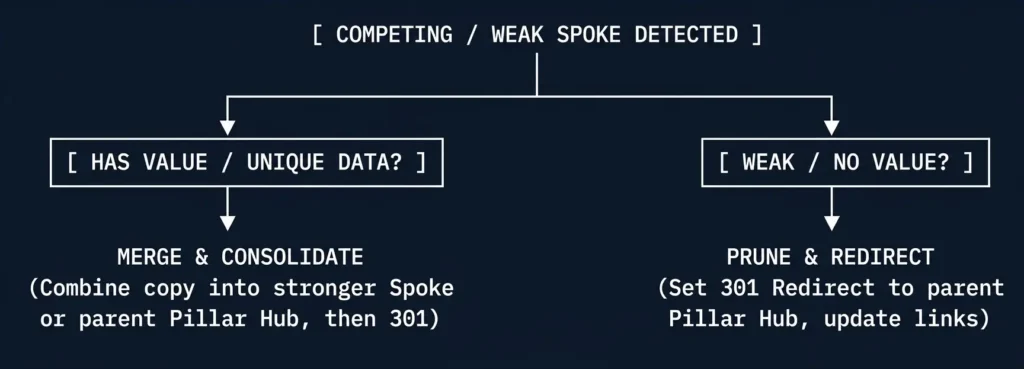
Option A: The Content Merge Protocol (Consolidation)
If Spoke A has better traffic but Spoke B contains valuable unique sections or statistics, merge them:
Copy the unique, high-performing content blocks from Spoke B and integrate them naturally into Spoke A (or the main Pillar Hub).
Set up a permanent 301 Redirect from Spoke B to Spoke A.
Update all internal links across your site that previously pointed to Spoke B so they now point directly to Spoke A.
Option B: The Prune & Redirect Protocol (Elimination)
If a supporting spoke is outdated, thin, or has zero traffic/backlinks and overlaps with the Pillar Hub:
Verify if the page holds any external backlinks in Ahrefs or Search Console.
If it holds backlink equity, execute a 301 Redirect pointing the weak spoke URL directly to the central Pillar Asset. This preserves and transfers that external backlink equity up to the hub.
Remove the weak URL from your XML sitemap.
E-Commerce & SaaS Specific Hub-and-Spoke Patterns
While the underlying logic of a Hub-and-Spoke model remains constant, its physical implementation varies depending on your business model.
A SaaS platform targeting B2B decision-makers requires a different page hierarchy than an E-Commerce store managing thousands of SKU product variants.
The SaaS Hub-and-Spoke Pattern
In B2B SaaS SEO, the goal is to bridge top-of-funnel (TOFU) educational queries directly into product feature adoption (BOFU).
The 3-Tier SaaS Routing Flow:
Tier 1: Informational Pillar Hub (
/blog/technical-seo/) Targets broad educational head terms. Builds domain authority and introduces the overarching problem space.Tier 2: Tactical Feature Spokes (
/blog/how-to-audit-redirects/) Addresses explicit workflow questions. Shows users how to solve a specific problem while referencing your software tool as the ideal solution.Tier 3: High-Intent Conversion Landing Page (
/features/seo-auditor/) Receives internal link equity funneled from both the Pillar Hub and Feature Spokes, driving signups, free trials, or demo bookings.
Key Rule for SaaS: Never link a blog spoke to a feature page without establishing contextual relevance first. Demonstrate the problem in the spoke copy, then present the software feature page as the direct resolution.
The E-Commerce Hub-and-Spoke Pattern
E-Commerce platforms often struggle with severe PageRank fragmentation due to deep category trees and dynamic product variants. The E-Commerce pattern uses content guides to funnel search authority straight down to product listings.
The 3-Tier E-Commerce Routing Flow:
Tier 1: Master Category Hub (
/coffee-makers/) Serves as the root e-commerce category page targeting high-volume commercial keywords.Tier 2: Buying Guides & Comparison Spokes (
/blog/best-espresso-machines/) Contains long-form editorial content addressing buyer intent questions, comparison tables, and buying advice.Tier 3: Transactional Product Pages (SKUs) (
/products/espresso-machine-x/) Receives direct contextual links from buying guides, boosting product page rankings for hyper-specific SKU queries while passing authority back up to the master category.
The Topic Cluster Audit Checklist & Execution Pitfalls
Even a perfectly planned topic cluster can lose ranking power if technical flaws break link equity or confuse search crawlers.
To ensure your cluster operates at maximum efficiency, monitor these five critical execution mistakes and run through the step-by-step audit checklist.
The 5 Critical Topic Cluster Mistakes (And How to Fix Them)
Pitfall 1: Deep Orphan Spokes
The Error: Publishing supporting spoke articles without linking to them from the Pillar Hub or neighboring spokes.
The Impact: These pages sit beyond 3+ clicks from the homepage, resulting in crawl budget waste, slow indexation, or dropped SERP positions.
The Fix: Audit click depth in Screaming Frog or Ahrefs. Ensure every spoke page is linked from the Pillar Hub and accessible within 1 to 3 clicks of the root domain.
Pitfall 2: Missing Return Links (One-Way Hubs)
The Error: Linking down from the Pillar Hub to a Spoke article, but omitting the return link from the Spoke back up to the Hub.
The Impact: Breaks the bi-directional equity loop. Search crawlers view the spoke as an isolated endpoint rather than part of a cohesive entity node.
The Fix: Enforce a strict editorial rule: Every Spoke article must contain an in-content contextual link pointing back up to its parent Pillar Asset within the first 200 words.
Pitfall 3: Internal Anchor Over-Optimization
The Error: Forcing identical exact-match anchor text across 100% of internal links pointing to the Pillar page (e.g., using “technical SEO guide” every single time).
The Impact: Triggers internal link over-optimization filters and limits the cluster’s ability to capture long-tail semantic variants.
The Fix: Maintain natural anchor variance: 20%–30% exact-match, 50%–60% LSI/semantic variations, and 10%–20% brand or navigational anchors.
Pitfall 4: Cross-Cluster Context Bleed
The Error: Indiscriminately linking spokes from completely unrelated clusters (e.g., linking a “Local SEO Google Business Profile” spoke directly into an “Enterprise Technical SEO” cluster).
The Impact: Dilutes topical purity and confuses entity boundaries in Google’s Knowledge Graph.
The Fix: Keep spoke-to-spoke cross-links restricted to pages with natural semantic overlap. If cross-linking across different topics, route the link through top-level category hubs.
Pitfall 5: Weak, Thin Pillar Scope
The Error: Creating a short, 800-word “Pillar” page that merely lists links to spoke articles without providing a comprehensive overview of the core topic.
The Impact: Search engines fail to recognize the Hub as a standalone authoritative resource, causing it to rank poorly for head terms.
The Fix: Structure the Pillar Hub to offer clear foundational value, outlining key concepts while linking out to deep-dive spokes for tactical execution.
Conclusion
Building a search-driven site architecture is no longer about blindly publishing content and praying for rankings. By combining the strategic depth of Topic Clusters with the precise execution of Hub-and-Spoke internal linking, you transform scattered blog posts into an engineered entity graph. This structured approach accelerates indexation, maximizes PageRank circulation, and positions your domain as an undeniable topical authority in Google’s Knowledge Graph. As search engines continue to prioritize semantic depth over isolated keywords, a clean, well-maintained hub-and-spoke model remains your most reliable strategy for scalable organic growth.
Ready to Engineer a High-Ranking Site Architecture?
Flawed internal linking, orphan pages, or internal keyword cannibalization can silently block your organic growth—no matter how strong your content is. Whether you are launching a new site cluster, restructuring a enterprise publication, or auditing crawl efficiency, getting your technical information architecture right is critical. Explore my Technical SEO Services & Internal Linking Services or Get in touch today to audit your domain structure and design a custom, search-first Hub-and-Spoke architecture.
FAQ Section: Hub and Spoke Topic Cluster
What is a hub and spoke model in site architecture?
A hub and spoke model in site architecture is an internal linking and content structure where a central “hub” page (the broad pillar asset) links outward to multiple supporting “spoke” pages (deep-dive sub-topics), and vice-versa. This bi-directional link network controls click depth, guides search crawlers efficiently, and funnels external link equity directly into your core conversion pages.
What is a topic cluster?
A topic cluster is a content strategy where a group of interconnected web pages are organized around a central subject entity. Instead of publishing isolated blog posts that compete with each other, a topic cluster uses semantic grouping to signal complete topical authority to search engines like Google.
What is the topic cluster model?
The topic cluster model is a framework for structuring your website’s content and internal links based on entity relationships rather than rigid folder trees. It consists of three main elements:
The Pillar Page: Covers a broad head term comprehensively.
The Cluster Spokes: Address specific, long-tail sub-intent queries.
The Internal Link Connectors: Bidirectional links that pass PageRank equity up and down the cluster.
How many spokes should a topic cluster have?
There is no fixed limit, but a high-performing topic cluster typically starts with 5 to 10 supporting spokes per Pillar Hub. The key is ensuring each spoke addresses a distinct, non-competing intent. As your domain authority grows, you can naturally scale the cluster to 20+ spokes or branch out into sub-clusters.
Should spoke pages link to each other (horizontal interlinking)?
Yes, but only contextually. Spoke-to-spoke links (horizontal cross-bridges) are highly beneficial when there is a logical, semantic relationship between two sub-topics. However, every spoke must prioritize its upward link back to the primary Pillar Hub to maintain clear parent-child architecture.
Does a hub and spoke structure work without subfolder URLs?
Yes. Modern search engines understand semantic relationships through internal hyperlinks and HTML contextual anchors, not just URL path structures. You can build a fully functional Hub & Spoke model using flat root URLs (e.g., https://example.com/spoke-topic/ as long as your bi-directional internal linking rules are strictly maintained.
Explore Other Articles Under Technical SEO Side
Pillar Blogs
What is Technical SEO? (Parent Blog)
- Website Architecture (Child Blog)