
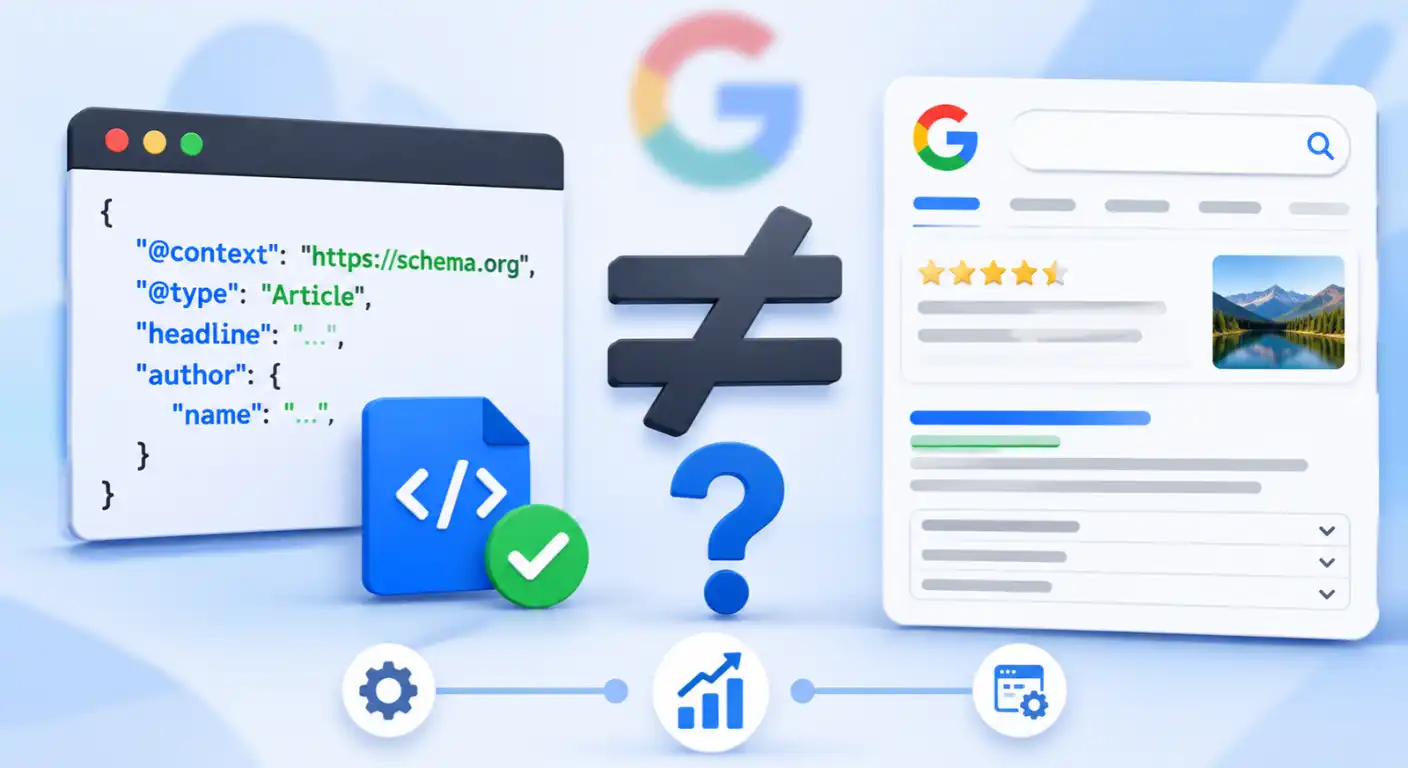
One of the most common frustrations in SEO happens right after a website owner or developer finishes adding schema markup to a page. The code validates cleanly, there are zero errors in testing tools, and everyone expects star ratings, product prices, or breadcrumb trails to immediately appear in Google Search. Days or weeks pass, and the search listing still looks like a plain blue link.
That confusion stems from treating structured data and rich results as the same thing. In reality, they represent two completely different stages in how search engines process and display your website. Adding structured data is like submitting an accurate, machine-readable application to Google, it qualifies your page for visual enhancements, but it does not force Google to display them on every search query.
Whether you are a business owner trying to understand why your pages look plain in search results, or an SEO diagnosing missing SERP features in Google Search Console, separating the underlying code layer from the visual search display is essential.
What You Will Learn in This Guide
- The exact difference between structured data, rich snippets, rich results, and standard SERP features that require no schema at all.
- How your markup moves from raw JSON-LD parsing to eligibility approval and live search display decisions.
- Why valid schema markup still strengthens entity recognition and brand clarity even when no rich result appears on the SERP.
- Which schema types actively generate rich results today, and which legacy features Google has officially retired.
- How to use
validator.schema.orgalongside Google Search Console’s URL Inspection Enhancements section
Structured Data vs. Rich Results: Understanding the Input and the Output
To stop mixing up these terms in client meetings, audits, and strategy discussions, it helps to look at them as input versus output. One is the structured data you place in your website’s code; the other is the visual search enhancement Google may choose to show on the results page.
Structured Data (Schema Markup): The Machine-Readable Code Behind Your Page
Structured data is standardized, machine-readable code added to a webpage to explain what the content on that page actually represents. In SEO, this is most commonly written in JSON-LD format using the Schema.org vocabulary: defining entities such as an organization, product, author, article, or local business along with specific attributes like price, availability, or publication date.
While human visitors read your visible text, headings, and images on the screen, search engine crawlers use structured data to read explicit facts without guessing context from layout alone. You can think of structured data as the backend semantic label attached to your page. It prepares your content to be understood accurately, even though it never appears as raw code to the person searching on Google.
Rich Results (and Rich Snippets): The Visual Enhancements Users See in Search
Rich results are the enhanced, eye-catching visual elements that appear on search engine results pages (SERPs) when Google processes eligible page data and decides it adds value for the searcher. Examples include review star ratings, product prices and stock status, breadcrumb navigation paths, video previews, and interactive carousels or cards.
Historically, SEOs often used the phrase rich snippets to describe these enhanced search listings. Over time, Google broadened its terminology to rich results because modern search enhancements go beyond a small text snippet attached to a single blue link. They now include multi-item carousels, visual cards, and richer interactive layouts. In everyday conversation, people still use “rich snippets” and “rich results” interchangeably, but rich results is the broader, current umbrella term for visual SERP enhancements.
Rich Results vs. Standard SERP Features: What Requires Schema and What Doesn’t
Another common point of confusion is assuming that every special box or feature on Google comes from schema markup. In reality, Google generates many search features directly from your visible page content and ranking signals without needing schema at all.
| Feature Category | What It Actually Is | Does It Require Structured Data? | Examples |
| Structured Data (Schema Markup) | Underlying semantic code (Schema.org / JSON-LD) placed on the page. | It is the code itself (input, not a SERP visual). | Product, Organization, BreadcrumbList, Article JSON-LD blocks. |
| Rich Results (Rich Snippets) | Visual SERP enhancements powered by eligible structured data and Google rules. | Yes (typically requires valid, policy-compliant markup). | Star ratings, product pricing/stock, breadcrumbs, video rich results. |
| Standard / Organic SERP Features | Search elements generated by Google from page content, authority, and queries. | No (driven by content structure and search relevance, not schema). | Featured Snippets, People Also Ask (PAA), standard Sitelinks, image packs. |
Understanding this boundary saves a lot of wasted effort: adding schema helps you qualify for rich results, whereas clear headings, direct answers, and strong page authority drive organic SERP features like Featured Snippets.
Now that the difference between the code input, visual rich results, and other SERP features is clear, let’s trace the exact behind-the-scenes pipeline Google uses to turn structured data into a live search enhancement.
How Google Turns Structured Data into Rich Results: The 3-Stage Pipeline
Once structured data is live on your website, it does not jump straight onto Google’s search results page. Instead, it moves through a multi-step evaluation pipeline where search engines verify the code, check feature eligibility, and decide whether showing an enhancement fits the live search query.
Breaking this process into three stages makes it much easier to see where things can stall, and why passing one check does not automatically guarantee the next.
Stage 1: Crawling and Parsing Your Markup
In the first stage, crawlers fetch your webpage and attempt to read the structured data block without syntax errors. At its purest technical level, this step is about structural validity: making sure the JSON syntax is properly formatted and uses recognized terms from the Schema.org vocabulary.
This is the exact level represented by the Schema Markup Validator (validator.schema.org). If your JSON has a missing comma, an unescaped quote, or a malformed nested object, parsers cannot read the data cleanly and the markup fails right at the starting gate. However, passing validator.schema.org only confirms that your vocabulary and syntax are well-formed; it does not mean Google will generate a rich result for that type even if the schema type is completely valid in Schema.org.
Stage 2: Rich Result Eligibility Checks
Once the code is parsed cleanly, Google evaluates whether your markup qualifies for a supported Google rich result and aligns with its structured data guidelines. Unlike a generic vocabulary check, this stage looks at Google-specific requirements:
- Supported Feature Match: Does the markup correspond to a rich result feature that Google actively supports in Search?
- Required & Recommended Properties: Are essential fields present and properly formatted (for example, valid pricing and availability details on a product offer)?
- Visible Content Alignment & Policy Compliance: Does the structured data accurately reflect what users actually see on the page without violating spam rules or misleading claims?
In Google Search Console, this eligibility layer shows up in enhancement reports and URL inspection checks signaling whether Google recognizes valid, eligible structured data on the page or has flagged errors/issues blocking eligibility.
Stage 3: Live SERPs Display Decisions
Even when a page passes syntax parsing and is marked eligible for a rich result, eligibility is still not a guarantee of display. When someone types a query into Google, a real-time search results assembly system decides which results to show and how each result should be presented.
Google’s display systems weigh dynamic factors on a query-by-query basis such as whether the search intent matches a rich enhancement, how the layout fits on mobile versus desktop screens, whether the result is already well-represented in another format, and overall site quality and trustworthiness. As a result, two pages with identical, valid markup can be treated differently depending on the query and context, which is why rich results can appear, fluctuate, or disappear even when your code has not changed.
Why Structured Data Still Matters Even When No Rich Result Appears
When a page does not show star ratings, price tags, or extra visual badges in search results, it is easy to assume the schema markup on that page is doing nothing. In practice, rich results are only one visible outcome of structured data, not its only purpose.
Even when a search result looks like a standard listing, clean markup continues to support how search engines understand your site, connect entities, and extract page details.
Entity Disambiguation and Knowledge Graph Connections
Search engines do not just match keywords on a page; they also map entities: real-world people, organizations, products, places, concepts and how they connect to one another. Structured data helps clarify those relationships explicitly instead of leaving search systems to infer every connection from surrounding text alone.
- Brand and Organization Clarity: Defining your organization, official profiles, and core details gives search systems a consistent anchor for your brand identity across the web.
- Author and Content Context: Connecting articles or resources to clear author and publisher entities helps search engines associate content with credible sources over time.
- Service and Topic Relationships: Even when a schema type (such as
Service) does not trigger a dedicated visual rich result on its own, structured relationships help clarify what your site offers and how different pages fit together.
Over time, consistent entity signals strengthen semantic clarity and knowledge graph understanding even on pages that never display a single star or badge on the SERP.
Can Google Show Rich Results Without Structured Data?
Yes. In certain cases, Google can infer or generate enhanced search elements directly from well-structured HTML, site architecture, and existing search signals even without explicit schema markup on the page. For example, search engines can sometimes derive navigational breadcrumb trails from URLs and on-page links, surface sitelinks for established domains, or pull certain product and page details from clear HTML structure.
However, relying on guesswork has clear trade-offs compared to explicit JSON-LD:
- Less Control Over Representation: Without structured data, search engines choose how to interpret and label elements on their own, which can result in awkward titles, truncated paths, or mismatched details.
- Higher Ambiguity on Complex Pages: Pages with multiple prices, locations, authors, or sections are much easier for parsers to misread when context is only implied by visual layout.
- Explicit Clarity Wins: Clean, accurate structured data gives search engines a direct, unambiguous reference alongside your visible page content.
Now that we have covered why structured data matters even without visual search badges and how it compares to HTML-only extraction. The next step is looking at where things stand today. Let’s do a 2026 reality check on which rich result types are still active and which ones Google has retired.
The 2026 Reality Check: Which Schema Types Still Trigger Rich Results?
One of the costliest mistakes in modern SEO is treating every valid Schema.org type as a guaranteed path to a visual search enhancement. Google regularly updates which rich result formats it supports, retires lower-value or redundant SERP treatments, and tightens eligibility around page quality and relevance.
To make smart decisions whether you are investing in an SEO campaign or auditing a site’s search presence, you need to separate the rich result types Google actively supports today from features that are no longer shown in Google Search.
Active Rich Result Types Supported in Google Search Today
When your structured data matches an active Google Search feature and satisfies content and technical guidelines, it can unlock high-impact visual enhancements on the results page. Some of the most practical, commercial, and discovery-focused rich result types include:
- Product & Merchant Listings: Displays pricing, availability, shipping/return details, ratings, and merchant information for products especially valuable for e-commerce stores and commercial listings.
- Review Snippets: Surfaces star ratings or review summaries on eligible items such as products, local businesses, recipes, or courses where structured review guidelines allow them.
- BreadcrumbList: Replaces raw or cluttered URLs with clean, human-readable navigation paths so searchers see where a page sits within your site hierarchy.
- LocalBusiness: Helps ground local business identity, location details, hours, and offerings for local search visibility.
- VideoObject: Enables video previews, key moments, or video-related search surfaces when video content is a core part of the page.
- Recipe & Event: Supports specialized search enhancements such as cooking times, ratings, and ingredients for recipes, or dates, times, and locations for events.
Even for these active features, structured data simply makes a page eligible; Google still decides when and how to display them based on search intent, layout, and quality signals.
Retired Rich Results You Should Stop Chasing
Search results evolve constantly, and several once-popular structured data features are no longer displayed as rich results in Google Search:
FAQPageRich Results (Completely Discontinued in May–June 2026): While Google initially restricted FAQ dropdowns to authoritative government and health websites back in August 2023, it officially ended FAQ rich results across all sites in May 2026 and completely removed the Search Console report, Rich Results Test support, and official documentation in June 2026. (QAPagemarkup remains separate and supported only for genuine single-question, multi-answer forum or Q&A pages.)7 Structured Data Features Phased Out in 2025: Google retired Book Actions, Course Info, ClaimReview, Estimated Salary, Learning Video, Special Announcement, and Vehicle Listing removing their Search Console reports and appearance filters.
Practice Problems (Documentation Removed January 2026): Deprecated alongside the 2025 cleanup and fully removed from Google Search documentation in January 2026.
Sitelinks Search Box &
HowToRich Results: Google retiredHowTorich results in September 2023 and removed theSitelinks Search Box(SearchAction) enhancement in November 2024 (note that standard organic sitelinks still appear automatically from site structure, not schema).Bonus Nuance – Mobile Breadcrumbs: While
BreadcrumbListis still active on desktop, Google stopped displaying breadcrumb trails on mobile search results in January 2025. So missing mobile breadcrumbs are a layout change, not a schema bug.
Why does valid markup for retired types still pass validator.schema.org without showing a snippet?
Because validator.schema.org checks whether your JSON-LD syntax and Schema.org vocabulary are structurally valid, not whether Google Search currently displays a rich result for that type. A type can remain completely valid in the Schema.org specification while producing zero rich result enhancements in Google Search.
How to Diagnose Missing Rich Results Using Google Search Console and Testing Tools
When a page ranks on Google without the star ratings, product details, or breadcrumb trails you expected, guessing at the cause wastes time. Instead, you can isolate the exact delays in minutes by pairing 2 free validation tools with Google Search Console’s URL Inspection report.
Using validator.schema.org vs. Google’s Rich Results Test to Isolate the Gap
The fastest way to separate a code problem from a Google feature limitation is to run your live URL through both official testing tools:
- Schema Markup Validator (
validator.schema.org): Checks whether your JSON-LD syntax and Schema.org vocabulary are technically valid across all Schema.org types regardless of whether Google displays a rich snippet for them. - Google’s Rich Results Test: Checks only whether Googlebot can parse markup for actively supported Google Search rich result features and flags missing required or recommended properties.
By comparing both outputs side-by-side, you can immediately diagnose the gap:
| validator.schema.org Result | Google Rich Results Test Result | What It Proves |
| Errors / Syntax Failures | Errors / Invalid Items | Broken JSON-LD syntax or malformed properties, fix the code first. |
| 0 Errors (Valid Schema) | No Rich Results Detected | Your structured data is valid Schema.org code, but the type is not supported as a Google rich result (for example, Service or retired FAQPage markup). |
| 0 Errors (Valid Schema) | Valid Items Detected | Your page is technically eligible for a Google rich result. Any missing SERP display is now a crawling, policy, or live ranking decision. |
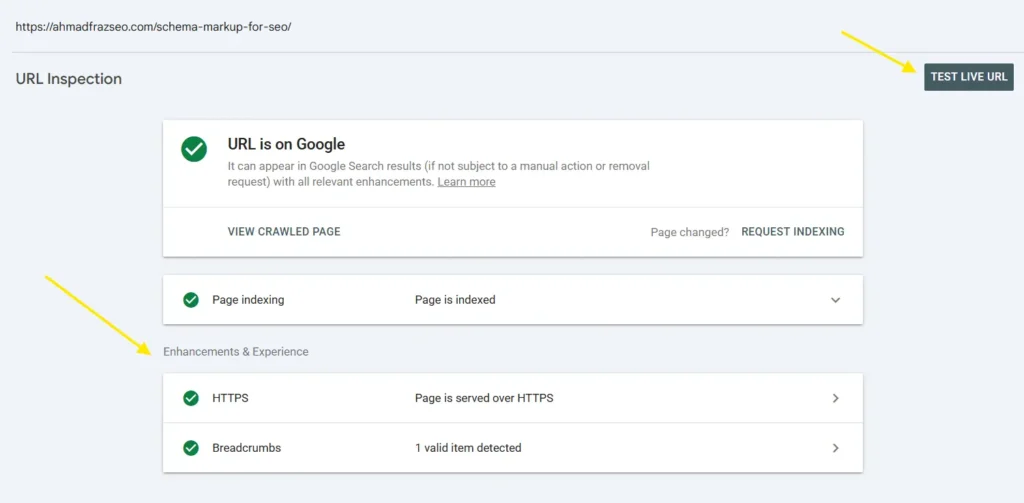
Reading the “Enhancements” Section in GSC’s URL Inspection Tool
Testing tools show what could happen on a live fetch, while Google Search Console (GSC) shows what Google actually saw and processed on your page.
- Inspect the Exact URL: Paste your full page URL into the top search bar of Google Search Console.
- Compare Indexed vs. Live Test: Check the Google Index view first to see what Google recorded during its last crawl. If you recently updated your markup, click Test Live URL in the top-right corner to run a real-time check.
- Look Directly Below “Page Indexing” for “Enhancements”: Right underneath the Page indexing summary (and alongside page experience/HTTPS signals), GSC displays an Enhancements section whenever it detects supported rich result markup on that URL.
- Judge Your Eligibility Status:
- Green Checkmark with Supported Feature Names (such as Breadcrumbs, Product snippets, or Review snippets): Google has parsed your structured data and confirmed your page is eligible for those rich results. Clicking into the enhancement row reveals the exact detected items and any non-blocking warnings.
- Red Error Flag on an Enhancement: Required fields are missing or invalid. Google will withhold that rich result until fixed.
- No Enhancements Section Listed at All: Either the URL is not indexed yet, no supported rich result schema was found, or the markup uses a schema type that Google does not turn into a rich result.
If GSC’s Enhancements section shows a clean green status on the indexed version of your URL, you can stop troubleshooting your code, the technical setup is working as intended.
5 Reasons Valid Rich Results Still Don’t Appear in Live Search
When both the Rich Results Test and GSC’s Enhancements section confirm valid, eligible markup, a missing snippet comes down to Google’s live search quality and display decisions:
- Query Intent Overrides: Google tailors each SERP dynamically. On broad informational searches or queries where Google prioritizes a clean text layout or AI summary, it frequently suppresses inline rich results even when the ranking page is eligible.
- Mobile vs. Desktop Layout Differences: Search appearances vary by device. For example, Google displays desktop breadcrumb trails on eligible pages while keeping mobile search listings streamlined without breadcrumb paths.
- Site-Wide Quality and Trust Thresholds: Google’s automated systems evaluate overall domain credibility, content originality, and user trust before granting prominent visual enhancements across a site.
- Subtle Policy or Content Mismatches: Automated syntax validators cannot verify editorial accuracy. If marked-up reviews, ratings, or pricing are hidden from visible page text, self-serving, or misaligned with the main topic, Google withholds the rich result.
- Recrawl and Reprocessing Latency: Passing a Live URL Test in GSC confirms Google can read your new markup, but live search listings do not update until Googlebot recrawls, re-indexes, and reprocesses the page, which can take anywhere from a few days to several weeks.
With a clear diagnostic workflow in place to separate code errors from Google’s live display decisions, the final step is matching your structured data strategy to the specific type of pages you publish.
When to Focus on Entity Schema vs. Rich Result Optimization: A Practical Framework
Not every page on a website needs the same structured data priorities. Chasing visual snippets on pages where they rarely fit wastes engineering effort, while ignoring entity relationships on core pages leaves search engines with a thinner understanding of your brand.
A practical approach is to balance entity schema (building clear relationships for organizations, authors, products, and topics) with rich result optimization (targeting active, relevant SERP enhancements where they genuinely serve searchers).
Matching Your SEO Strategy to Your Page Type
Different page types play different roles in your SEO strategy, whether you are growing organic traffic, generating service inquiries, winning local leads, or driving product sales:
Informational Blogs & Guides: Prioritize entity clarity: connecting articles to real authors, publishing organizations, and clear topic context alongside eligible enhancements like
BreadcrumbList(on desktop) orVideoObjectwhen embedded video adds value. Avoid relying on outdatedFAQPagedropdowns or chasing visual badges on every post as the sole measure of success.Service Pages & B2B / Agency Sites: Focus on entity disambiguation and trust signals. Clearly defining your
Organization, brand identity, offerings, and service context rather than expecting a specialServicerich result badge. Strong page content, clear positioning, and consistent entity markup do the heavy lifting here.Local Businesses: Pair location and brand entity signals (
LocalBusinessdetails, accurate address/hours/contact info, and consistent business identity) with eligible enhancements such asBreadcrumbListor qualifying review/rating markup where allowed. Local visibility depends heavily on accuracy and consistency across your site and search profiles.E-Commerce Stores: Prioritize both accurate
Productand merchant offer details (price, availability, shipping/return context, and eligible ratings) plus clean entity connections across your catalog. Accurate structured data helps shoppers compare options and keeps your product data aligned with what appears on the page.
If you are ready to move from strategy into writing and deploying JSON-LD code, you may follow my step-by-step walkthrough in Structured Data & Schema Markup for SEO: Complete Implementation Guide.
With a clear framework for matching structured data priorities to each page type, all that remains is addressing the most common questions around structured data and rich results in one quick reference.
Conclusion
Understanding the difference between structured data and rich results removes one of the biggest sources of confusion in modern SEO. Structured data is the machine-readable semantic layer you control on your page, while rich results are the visual enhancements Google may choose to surface when a query, page quality, and feature eligibility align.
Even when no star rating, product badge, or rich snippet appears on the search results page, clean entity markup still helps search engines connect your brand, authors, products, and topics with greater accuracy. Pairing validator.schema.org with Google Search Console’s URL Inspection Enhancements section and keeping an eye on active versus retired Google Search features lets you diagnose gaps objectively instead of chasing outdated tactics or guessing why a listing looks plain.
Need Help Auditing Rich Result Eligibility or Custom Schema Architecture?
Diagnosing why valid markup isn’t showing up in search or deploying clean, connected JSON-LD across dynamic templates without plugin conflicts or validation errors takes careful technical execution. If you want a second pair of eyes on your current site setup, need help untangling Google Search Console enhancements, or want custom entity modeling built into your templates, explore my dedicated Schema Markup Services and broader Technical SEO Services. Or if you have a specific diagnostic challenge or architectural question, feel free to get in touch directly to discuss your setup.
Frequently Asked Questions (FAQs)
Does structured data directly improve Google rankings?
No. Adding structured data is not a direct ranking factor that pushes a page higher in search results on its own. Instead, it helps search engines accurately understand your page entities and makes your listing eligible for visual rich results. Which can improve click-through rates and user engagement when displayed.
What is the difference between rich results, rich snippets, and featured snippets?
Rich results (formerly called rich snippets) are visual enhancements such as review stars, product pricing, or breadcrumbs powered by valid structured data on your page. Featured snippets (and People Also Ask boxes) are standard organic SERP features that Google extracts algorithmically from clear page content and headings without requiring schema markup.
Why are my rich results not showing in Google Search even though Search Console says my markup is valid?
Passing Google’s Rich Results Test and seeing valid items in Search Console’s Enhancements report only confirms technical eligibility; it is never a display guarantee. Google’s live search systems decide query-by-query whether to show a rich result based on search intent, device layout (desktop vs. mobile), overall site quality and trust, policy alignment with visible content, and recrawl timing.
Why does my schema pass validator.schema.org with zero errors but show nothing in Google’s Rich Results Test?
validator.schema.org validates whether your JSON-LD syntax and Schema.org vocabulary are structurally correct across all Schema.org types. Google’s Rich Results Test only checks for schema types that trigger an actively supported Google Search rich result meaning valid types like Service or retired types like FAQPage will pass Schema.org validation cleanly without generating a rich snippet.
Should I remove FAQPage or Service schema if they no longer trigger rich results?
No, you do not need to strip out clean, accurate schema markup just because it does not produce a visual SERP badge. As long as the markup accurately reflects your visible page content, keeping valid Organization, Service, or FAQPage entities in place continues to support machine readability and semantic clarity without harming your site.
How can I check if Google actually detected my structured data on a specific page?
Open Google Search Console, paste the exact URL into the URL Inspection bar, and look directly below the Page indexing section for Enhancements. If Googlebot parsed supported markup on that URL, you will see the detected feature names (such as Breadcrumbs or Product snippets) along with their valid or error status and you can run Test Live URL to verify recent updates before recrawling.
Understanding the boundary between structured data (the machine-readable foundation you control) and rich results (the visual search enhancements Google chooses to display) eliminates guesswork from technical SEO audits and sets realistic expectations for every page you publish. When you pair clean entity markup with active rich result optimization and verify both through validator.schema.org and Search Console’s URL Inspection tools, you give search engines the clearest possible picture of your brand whether a visual badge appears on the SERP or not.
Explore Other Articles Under Technical SEO Side
Pillar Blogs
What is Technical SEO? (Parent Blog)
Other Related Articles
- JavaScript SEO: Crawling, Rendering and Indexing
- Googlebot Mini Guide
- How to Fix Google Indexing Issues
- Indexability in SEO
- Crawlability and Indexability in SEO
- Website Crawlability Guide
- Mobile Technical SEO & Mobile-First Indexing
- Website Architecture: Structure and SEO Best Practices
- Entity SEO: How Search Engines Understand Entities
External References
- Google Search Central – Introduction to Structured Data
- Google Search Central – General Structured Data Guidelines
- Google Search Central – Structured Data Markup Supported by Google Search
- Google Rich Results Test
- Schema.org – Structured Data Validator
- Google Search Console – URL Inspection Tool
- Google Search Console – Missing Features in Search Results
- Google Search Central – Latest Structured Data Documentation Updates