Last Updated: June 2026
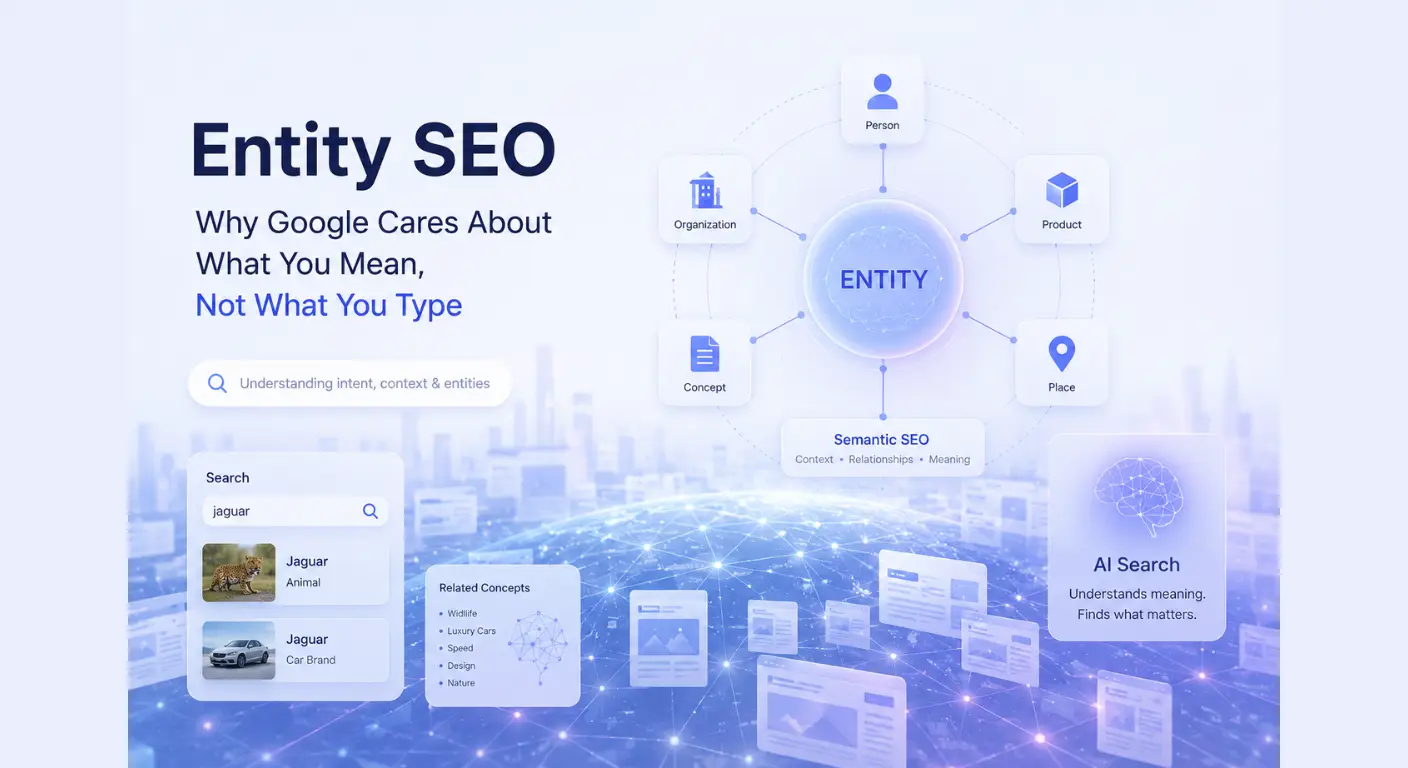
Quick question: When you search “jaguar,” do you mean the animal or the car?
You know which one you mean, obviously, because of context. The wild part is Google knows too, even without you specifying. That’s entities at work, and it’s the reason search has gotten so much better at understanding what you actually want, not just matching the words you typed.
Here’s why this matters for your content: if you’re still optimizing purely around keywords, you’re playing a game search engines mostly stopped scoring that way a while back.
Keywords vs. Entities in SEO: The Difference That Actually Mattersth a New Name?
A keyword is just a string of text. “Best CRM software” is a keyword. HubSpot and Salesforce are entities, real, identifiable things that Google can recognize, store facts about, and connect to other things.
Entities aren’t the opposite of keywords. Keywords still matter, you still need to know what people are actually typing. But entities are the layer underneath: the actual concepts, brands, people, and ideas your content is about, and how those things relate to each other.
| Aspect | Keywords | Entities |
|---|---|---|
| Definition | Specific words or phrases users type into search engines | Real-world people, brands, places, products, or concepts search engines can identify |
| Nature | Text-based string | Meaning-based identifiable object |
| Example | “Best CRM software” | HubSpot, Salesforce |
| Focus | Matches search queries | Understands search intent and context |
| Search Engine Interpretation | Google sees words on a page | Google connects facts, attributes, and relationships |
| Role in SEO | Helps target what users search | Helps search engines understand what content is truly about |
| Relationship Mapping | Limited to phrase relevance | Strong semantic relationships between concepts |
| Example of Context | “Yoga” as a word | Yoga linked with Meditation, flexibility, wellness |
| Optimization Goal | Rank for specific queries | Build topical depth and semantic authority |
| Weakness if Used Alone | Can lead to keyword stuffing or shallow content | Hard to leverage without good content structure |
| Best Use | Keyword research, titles, headings | Topic coverage, internal linking, schema, semantic SEO |
Keywords tell Google what people searched for; entities help Google understand what your content actually means.
Think about “yoga” for a second. Google doesn’t just see that word sitting on a page. It connects “yoga” to “flexibility,” “wellness,” and “meditation,” because those concepts genuinely show up together across the web. If your page about yoga never touches any of those related ideas, that’s a signal your coverage might be thinner than it looks.
Why This Matters Even More for AI Search
Here’s the part that’s easy to miss: AI systems like ChatGPT, Perplexity, and Google’s AI Overviews lean on entity recognition even more heavily than traditional search did.
When these systems decide who to cite, they’re not asking “does this page contain the right words.” They’re asking something closer to “is this a recognized, credible source on this specific concept.” A site with clear entity identity, consistent information across the web, and genuine topical depth gets treated very differently than a site that just happens to mention the right keyword a few times.
There’s a real, measurable version of this too: one documented case showed a two-year entity-reinforcement effort producing a 119.5% increase in organic traffic and a 14.1% gain in domain authority. That’s not an overnight tactic. It’s what compounding entity authority actually looks like over time. (Source link: https://www.frac.tl/work/content-marketing-case-studies/finance-b2c/)
How to Actually Build This (Without Overcomplicating It)
Pick 3 to 5 core topics, not fifty
Spreading thin across dozens of disconnected ideas is the opposite of what builds authority. Decide what you actually want to be known for, and go deep there first.
Cover the related concepts, not just the main one
If your core topic is “AI SEO,” Google increasingly expects to see you also touch on the concepts that naturally sit next to it, things like entity optimization, AI search visibility, and the tools people use to track it. Missing these isn’t neutral, it actually signals incomplete coverage.
Use schema markup to spell things out explicitly
Structured data (Organization, Person, Product, FAQ schema, depending on what fits) gives search engines facts they don’t have to guess at. The sameAs property is a particularly useful one, it links your entity to verified profiles elsewhere (like LinkedIn), helping Google confirm who you are instead of inferring it from page text alone.
Note: While Google has reduced FAQ rich results for most websites, structured data such as Organization, Person, Product, and FAQ markup still helps search engines better understand entities, relationships, and factual context. (Source: https://developers.google.com/search/docs/appearance/structured-data/intro-structured-data)
Disambiguate when there’s any chance of confusion
If you mention “Amazon,” say whether you mean the rainforest or the company. A sentence of context costs you nothing and removes any doubt about which entity you’re actually talking about.
Link things together with real, descriptive anchor text
Internal links aren’t just navigation, they’re how you tell search engines which concepts on your site relate to each other. Generic anchors like “click here” carry none of that signal; specific, descriptive anchors do.
How to apply suffeient internal linking you must read my dedicated blog on Internal Linking in SEO
Let your E-E-A-T signals back up the entity
Being recognized as an entity is one thing. Being trusted as that entity is another. Clear authorship, real credentials, and consistent brand presence across the web are what convince search engines (and AI systems) that your entity is one worth citing, not just one that exists.
What This Looks Like in Practice
Publishing one well-connected article a week for six months gets you to 26 interconnected pieces on a topic, that’s genuinely serious coverage for most niches. Most sites start seeing real ranking movement for that topic cluster around the 3 to 4 month mark.
Here’s a detail worth knowing if you’re tracking results: AI citation improvements tend to lag traditional SEO gains by about 1 to 2 months. AI systems don’t re-evaluate your site’s authority as frequently as Google re-crawls and re-ranks it. So if your rankings improve in month 4, don’t be surprised if AI citation movement doesn’t show up until month 5 or 6. That’s normal, not a sign something’s wrong.
A Simple Way to Check Your Own Coverage
Pick one core topic you want to be known for. Write down every related concept a genuine expert in that space would naturally mention. Now check your own content, how many of those related concepts actually show up anywhere on your site?
Gaps in that list are gaps in your entity coverage, and they’re usually the most efficient thing to fix next, more efficient than writing another article that just restates your main topic from a slightly different angle.
Where This Fits
This is part of the bigger AI SEO picture. If you haven’t read it yet, AI SEO in 2026: What Actually Works covers the full framework, including how entity and topic coverage connects to citation optimization and the practical AI-plus-human workflow that ties everything together.
FAQ Section
No, they work together. Keyword research still tells you what people are actually searching for. Entity thinking tells you how to cover that topic with enough depth and connected context that search engines (and AI systems) recognize you as a genuine authority on it, not just a page that happens to match the phrase.
Most sites see initial ranking movement for a topic cluster around 3 to 4 months of consistent, connected publishing. Meaningful AI citation improvements tend to follow about 1 to 2 months after that.
Pick a small number of core topics (3 to 5, not fifteen), map the related concepts a real expert would mention, and check your existing content against that list. Filling genuine gaps usually beats writing more content on what you’ve already covered.
Yes. A complete, consistent Google Business Profile combined with uniform information across directories and review sites is essentially an “entity stack” for a local business, and it’s a major reason some local businesses dominate map-pack results while others with similar service quality stay invisible.