Something fundamental has changed in Google Search.
Not because traditional SEO suddenly stopped working. And not because Google replaced the familiar search results with AI.
The bigger change is that Google can now answer more complex searches directly inside the search experience.
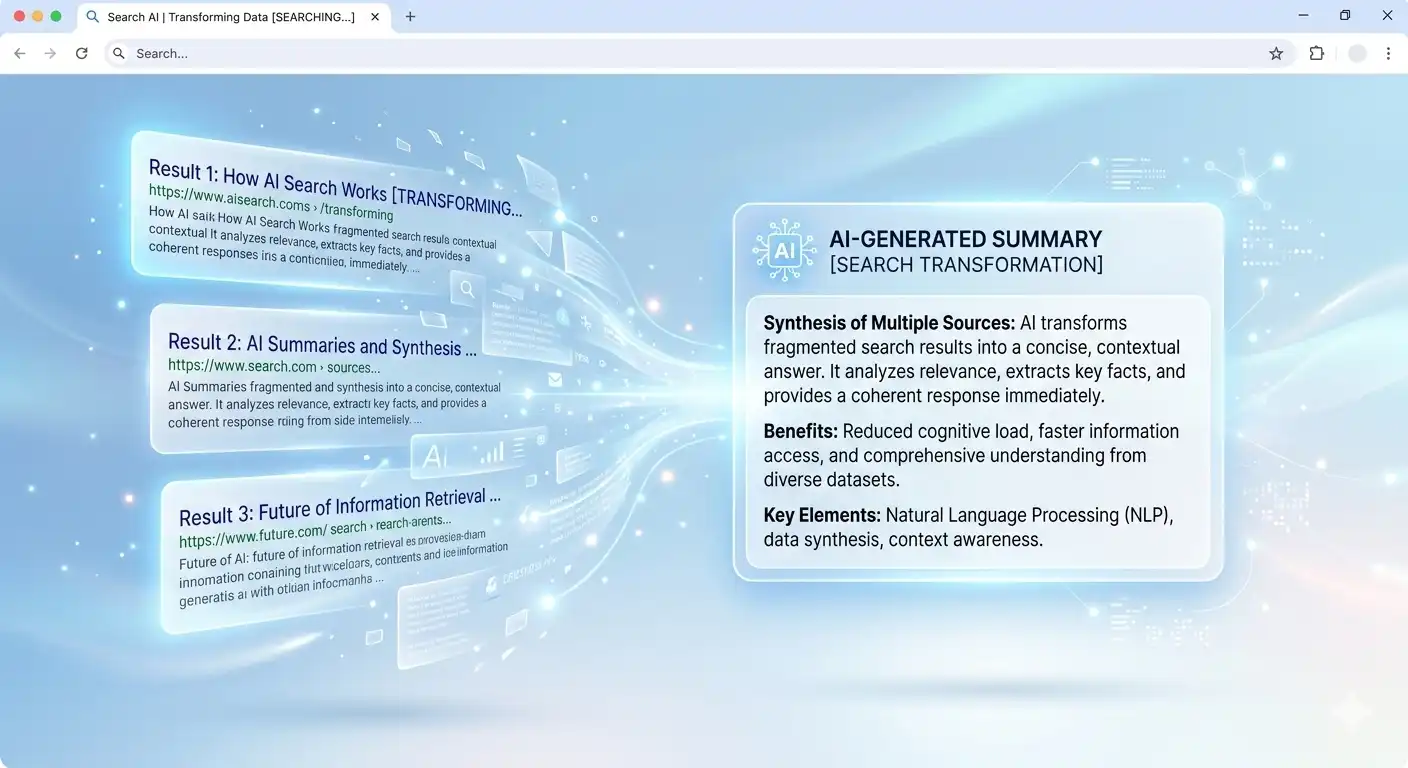
That means a user may see an AI-generated overview before interacting with the traditional organic results. The overview can summarize information from multiple sources and provide links to supporting pages.
For website owners and SEOs, that creates a new question:
How do you make sure your website remains visible when Google can answer part of the search itself?
This is where Google AI Overviews come in.
You may still see people refer to this as Google SGE (Search Generative Experience), but SGE was the experimental name used during Google’s earlier development of generative search. Google Search now refers to the live experience as AI Overviews, alongside a broader conversational experience called AI Mode.
The important thing is not the terminology.
The important thing is understanding how AI-powered search changes the path between a search query and your website and how to adapt your SEO strategy without chasing imaginary “AI ranking factors.”
What We’ll Cover in This Article
In this guide, I’ll break down what Google’s AI Overviews actually are, how they differ from the old SGE experience and traditional Search, and what this shift means for SEO visibility and organic traffic.
More importantly, we’ll look at the practical side of AI search including:
What makes content useful and visible in AI-powered search
How AI Overviews can change the traditional search journey
Whether ranking in Google still matters for AI Overviews
Which types of searches are more likely to surface AI-generated responses
How AI Overviews differ from Google’s AI Mode
How to structure and improve content without chasing “AI ranking hacks”
Why topical depth, genuine expertise, and original value still matter
How technical SEO affects your eligibility for AI search visibility
How to measure your visibility in AI Overviews and AI Mode using Google Search Console
And how to build an SEO strategy that works across both traditional and AI-powered search
The goal isn’t to predict Google’s next algorithm or find a secret formula for getting cited. It’s to understand where search is heading, separate Google’s confirmed guidance from SEO speculation, and build a strategy that can adapt as the search experience continues to evolve.
SGE vs. AI Overviews: What's the Difference?
If you’ve been researching AI search for a while, you’ve probably encountered the terms SGE, AI Overviews, generative search, AI Search, AEO, and GEO.
They aren’t all interchangeable.
Search Generative Experience (SGE) was Google’s experimental generative search experience. It helped Google test how AI-generated responses could be incorporated into Search.
Google subsequently moved from the SGE terminology to AI Overviews for the AI-generated summaries that can appear within regular Google Search.
Today, AI Overviews are part of Google’s broader AI-powered search experience, alongside AI Mode.
So throughout this guide:
- SGE refers primarily to Google’s earlier experimental experience.
- AI Overviews refers to the current Google Search feature.
- AI Mode refers to Google’s more conversational, exploratory AI search experience.
- AI search is the broader term covering these newer search experiences.
You’ll still see “SGE” used in older articles, SEO discussions, and search queries, which is why the term is worth understanding.
But if you’re optimizing a website today, your strategy should be based on how AI Overviews and AI Mode actually work now, rather than treating SGE as though it were still the current product.
Something I Want to Clear About HEO
You may also come across the newer term HEO (Hybrid Engine Optimization), which some SEO practitioners use to describe an integrated approach to traditional SEO, answer-engine visibility, and generative/AI search. It is an emerging industry term, not an official Google optimization framework, so I wouldn’t treat it as a separate set of ranking factors.
What Do Google AI Overviews Actually Do?
AI Overviews are designed to help searchers understand complicated questions more quickly.
Instead of presenting only a list of traditional organic results, Google may generate an AI-powered response that summarizes information and provides links to relevant supporting websites.
Google describes AI Overviews as a way to get people to the gist of a complicated topic while providing a starting point for exploring additional sources. AI Mode takes the idea further by supporting deeper exploration, follow-up questions, reasoning, and comparisons.
That changes the search journey.
A traditional search might look like:
Query → Search results → Choose a result → Visit website
An AI-assisted search may look more like:
Query → AI-generated response → Supporting sources → Website
That does not mean Google has stopped ranking webpages.
In fact, Google’s current documentation is explicit that AI features continue to rely on Google’s existing Search systems and SEO foundations. AI Overviews and AI Mode use relevant links to help users explore information beyond the generated response.
For publishers and businesses, this creates another form of search visibility to think about.
Your page may still compete for traditional organic visibility.
But it can also become a supporting source within an AI-generated search experience.
That’s an important distinction.
The goal isn’t to abandon traditional SEO and optimize for some mysterious AI algorithm.
The goal is to build pages that are useful, technically accessible, relevant to the search, and strong enough to deserve visibility across different parts of Google Search.
What Makes Content Useful in AI Search?
Here’s where a lot of AI SEO advice becomes unnecessarily complicated.
You’ll find recommendations about “AI-friendly formatting,” perfect content chunks, special prompts, AI-specific markup, or secret structures supposedly designed to make Google cite your page.
Google’s own guidance tells a much simpler story.
There are no additional requirements or special optimizations necessary to appear in AI Overviews or AI Mode. A page needs to meet Google’s normal technical requirements for Search, including being indexed and eligible to appear with a snippet.
That doesn’t mean content quality is irrelevant.
It means you shouldn’t confuse good SEO and useful content with a separate technical “AI ranking checklist.”
A strong page should still do the things that make it genuinely useful to a searcher.
1. Answer the main question clearly
Don’t make readers dig through five paragraphs of introduction before they find the answer.
If the page targets a specific question, answer that question clearly and then provide the explanation, examples, context, limitations, and next steps.
2. Cover the subject naturally
A useful page often answers several related questions because real users rarely have only one question.
For example, someone searching:
“How does technical SEO affect AI search?”
may also want to understand:
- whether indexing still matters
- how crawling affects visibility
- whether structured data is required
- how internal links help discovery
- whether AI search changes technical SEO
- how to measure AI visibility
You don’t need to create a separate page for every variation.
You need to decide what information genuinely belongs on the page.
Google’s current generative AI guidance specifically warns against creating separate pages for every possible variation simply to manipulate AI responses or rankings.
3. Make your expertise visible
If you’re writing about something based on genuine professional experience, don’t hide that experience.
Use:
- original examples
- first-hand observations
- data where available
- practical explanations
- clear authorship
- relevant credentials
- real limitations and caveats
This doesn’t mean adding an “E-E-A-T paragraph” to every article.
It means making the actual value behind your content visible.
4. Give readers something beyond common knowledge
Google’s current guidance places particular emphasis on unique, valuable, non-commodity content.
That’s important.
If your article simply repeats what dozens of other pages already say, there is little reason for a search system or a human to prefer it.
Original analysis, examples, comparisons, first-hand experience, useful data, and genuinely better explanations can make a page more valuable.
5. Keep the page technically accessible
An excellent article cannot help much if Google cannot properly discover, crawl, index, or understand it.
Technical SEO still matters.
That includes crawlability, internal linking, indexability, page experience, and making important information available as text.
We’ll come back to this later because it is one of the most overlooked parts of AI search optimization.
AI Overviews vs. Traditional Google Search: What Has Actually Changed?
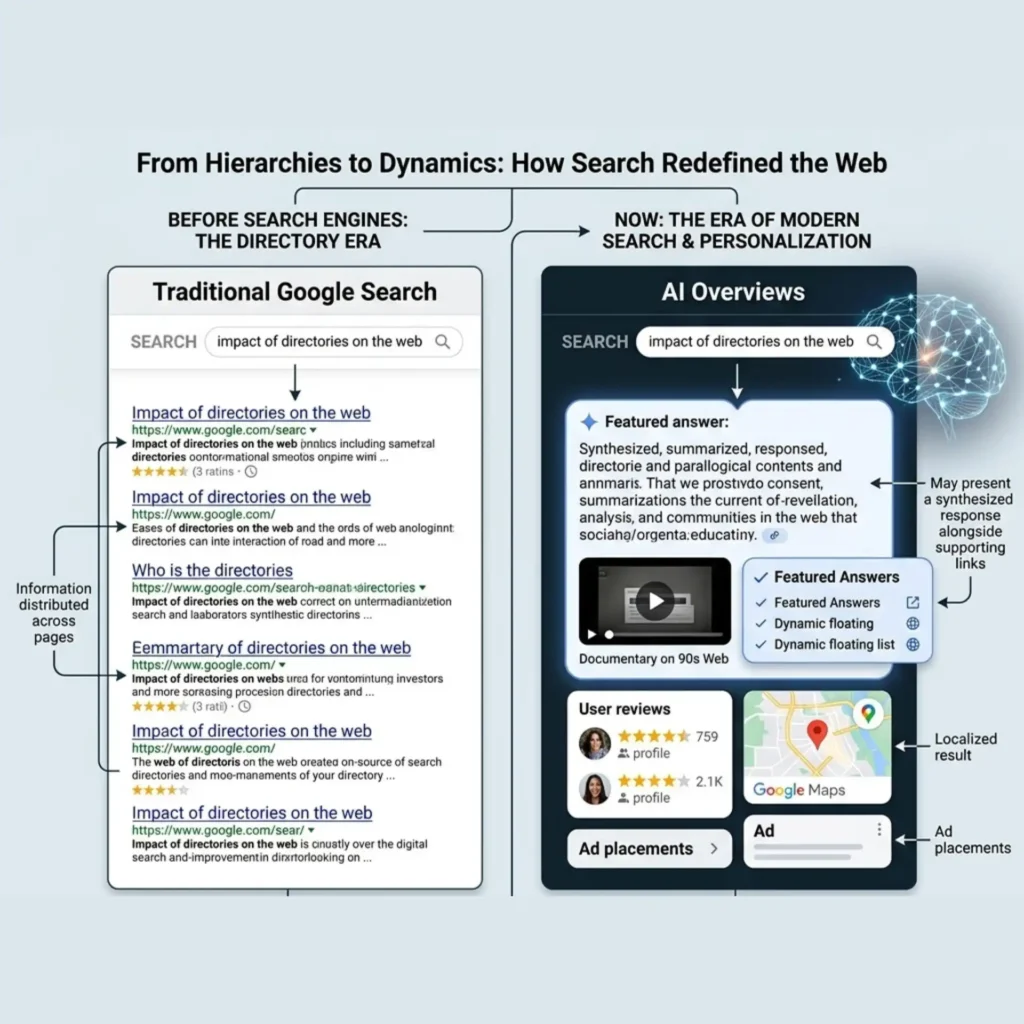
The biggest change isn’t that traditional search disappeared.
It’s that the search results page can now provide more information before a user chooses a traditional result.
| Traditional Google Search | AI Overviews |
|---|---|
| Primarily presents ranked search results | May present an AI-generated summary alongside supporting links |
| User typically evaluates individual results | User may first consume a synthesized response |
| Information is distributed across multiple pages | Information may initially be summarized in one response |
| Clicks often begin the research journey | Some questions may be partially answered before the click |
| Organic rankings remain central | Organic visibility can coexist with AI-generated source visibility |
The distinction matters because the same page can potentially have multiple visibility opportunities.
For example, a page might:
- rank organically for a query,
- appear as a supporting source in an AI Overview,
- receive a click from the traditional results,
- receive a click from an AI search experience.
Google also notes that AI Overviews and AI Mode may use different models and techniques, so the exact responses and links can vary between them.
So I wouldn’t think of AI search as a replacement for rankings.
Think of it as another layer of the search experience.
How AI Search Changes SEO Visibility
AI search does not create an entirely separate version of SEO.
It does, however, change the number of ways your content can become visible.
1. Rankings Still Matter But They Aren’t the Only Visibility Signal
One of the biggest mistakes in AI SEO is assuming that traditional rankings no longer matter.
They do.
Google’s generative AI systems rely on its Search index and core Search ranking and quality systems to retrieve relevant pages. Google describes this process as using techniques such as retrieval-augmented generation (RAG) to ground AI responses in relevant, up-to-date web content.
That means traditional SEO remains part of the foundation.
But search visibility can now involve more than a blue link.
You should think about visibility across:
- traditional organic results
- AI Overviews
- AI Mode
- branded search
- relevant supporting-source appearances
- eventual website engagement and conversions
The practical lesson?
Don’t trade organic SEO for AI SEO. Build a strategy that supports both.
2. Topical Depth Matters More Than Isolated Keyword Targeting
Modern SEO has never really been about putting one keyword into one article and calling the job finished.
AI-powered search makes that limitation even more obvious.
A business that publishes one shallow article about “technical SEO” has less useful context than a site that thoroughly covers:
- crawling and indexing
- robots.txt
- XML sitemaps
- canonicalization
- internal linking
- JavaScript SEO
- redirects
- site architecture
- structured data
- technical audits
- migration SEO
This doesn’t mean you should create hundreds of pages simply because AI systems can generate related queries.
Google explicitly warns against producing large amounts of content primarily to manipulate rankings or generative AI responses.
The better approach is to build useful topical coverage.
Create supporting content where users actually need it.
Connect related pages with logical internal links.
Update important resources when the subject changes.
That gives both users and search systems a clearer understanding of what your website actually covers.
3. Expertise Is More Valuable When It Is Real
There’s a difference between claiming expertise and demonstrating it.
Anyone can write:
“As an SEO expert, I recommend…”
That sentence doesn’t prove anything.
A stronger page demonstrates expertise through the substance of the content.
For example:
- explaining why a particular recommendation matters
- showing how an issue appears in a real audit
- discussing trade-offs
- using original examples
- acknowledging situations where a tactic doesn’t apply
- citing primary documentation
- sharing lessons learned from implementation
This is especially important for competitive commercial topics.
If a page is trying to influence a business decision, generic AI-generated summaries are easy to produce.
Useful professional judgment is harder to replicate.
That is where your content can differentiate itself.
Are AI Overviews Reducing Organic Traffic?
Sometimes they can.
But “AI Overviews reduce traffic” is too simplistic to be useful.
The impact depends heavily on the query, search intent, SERP layout, user’s needs, and what happens after the AI response appears.
For some informational searches, a user may get enough information from the AI-generated response that they don’t need to visit another website immediately.
For other searches, the user may want to investigate the sources, compare options, verify claims, read a detailed guide, or take an action that requires visiting a website.
Google itself has encouraged site owners to look beyond clicks alone when evaluating search performance, noting that visits originating from search pages with AI Overviews can be higher quality in some cases.
For businesses, that distinction is critical.
A 20% increase in organic clicks isn’t automatically better than a 5% increase in highly qualified visits.
You should ultimately care about:
- qualified traffic
- leads
- signups
- purchases
- engagement
- assisted conversions
- revenue
For a US-based service business, for example, the real question isn’t:
“Did I get cited by an AI Overview?”
It’s:
“Did my increased search visibility put my business in front of the right potential customers?”
AI visibility is useful.
Business outcomes are better.
What Types of Queries Can Trigger AI Overviews?
There is no permanent list of “AI Overview keywords.”
Google decides when an AI Overview adds value to a particular search, and the feature does not appear for every query. Google describes AI Overviews as being shown when its systems determine that the AI response adds value beyond traditional Search.
That means the exact query landscape can change.
However, AI-powered search experiences are particularly relevant to searches involving:
- complex questions
- informational research
- how-to problems
- comparisons
- broad topics
- multi-step questions
- product or service research
- questions that benefit from information gathered from multiple sources
For example:
“What is technical SEO?”
is relatively straightforward.
But:
“How should a SaaS company structure technical SEO when migrating from a subdomain to a new domain?”
requires considerably more context.
This is exactly the type of situation where AI-powered search can be useful because the system can explore multiple related aspects of a question.
And that leads to an important concept.
How Query Fan-Out Changes the Search Journey
Google says AI Overviews and AI Mode may use a technique called query fan-out.
Instead of relying only on the exact words in the original query, the system can issue multiple related searches across different subtopics and data sources before generating a response.
Imagine someone searches:
“How do I improve my website’s local SEO?”
The system may need information related to:
- Google Business Profile
- local relevance
- citations
- reviews
- location pages
- local links
- on-page signals
- business information
That doesn’t mean you should create eight articles just because those eight topics could become fan-out queries.
In fact, Google explicitly warns against creating content primarily around every possible fan-out query.
Instead, ask:
What does my audience genuinely need to understand to solve this problem?
That’s the better content strategy.
AI Overviews vs. AI Mode: What's the Difference?
AI Overviews and AI Mode are related, but they aren’t the same experience.
AI Overviews
AI Overviews appear within Google Search when Google’s systems determine that an AI-generated response can add value.
They are designed to help users understand a topic quickly while providing links to supporting sources and opportunities to explore further.
AI Mode
AI Mode is more conversational and exploratory.
It is designed for questions where users may want:
- deeper explanations
- follow-up questions
- comparisons
- multi-step research
- more nuanced exploration
Google says AI Mode can break complex questions into multiple related searches and return a more comprehensive response with links to supporting websites.
The two experiences can therefore produce different responses and links.
Google explicitly notes that AI Overviews and AI Mode may use different models and techniques.
From an SEO perspective, however, the foundation is remarkably similar:
Make your content crawlable, indexable, useful, reliable, relevant, and genuinely valuable to the searcher.
You don’t need one completely separate SEO strategy for AI Overviews and another for AI Mode.
How to Build Content That Performs Well in AI Search
This is where the strategy becomes practical.
Instead of looking for an “AI Overview ranking hack,” build content that works well for users and remains accessible to Google’s Search systems.
1. Start With the User’s Actual Problem
Don’t begin with:
“What keywords can I add?”
Begin with:
“What is this person actually trying to accomplish?”
A person searching “technical SEO audit” may not simply want a definition.
They may want to know:
- what an audit includes
- which issues matter most
- how to prioritize problems
- what tools to use
- what mistakes to avoid
- whether they should do it themselves
- what the findings mean for rankings and traffic
A page that understands the underlying problem is more useful than one built around keyword repetition.
2. Structure the Content Clearly
Good structure helps humans navigate long content.
It also makes the subject easier to understand.
Use:
- descriptive H2s
- useful H3s
- short paragraphs
- tables when comparisons genuinely help
- lists where they improve scanning
- examples
- definitions
- logical transitions
But don’t turn every paragraph into a tiny “AI chunk.”
Google’s current generative AI guidance explicitly says there is no requirement to break content into tiny pieces, and there is no ideal page length.
Structure the page for people first.
3. Make Your Expertise Visible
If you’ve actually done the work, use that experience.
Instead of writing:
“Internal linking is important for SEO.”
Explain:
“When auditing a large site, I usually look beyond the number of internal links and examine whether important pages are receiving contextual links from pages that are topically relevant.”
The second statement provides actual professional judgment.
That’s the kind of differentiation generic content struggles to provide.
4. Build Useful Topic Ecosystems
A strong article shouldn’t exist in isolation.
If your website covers a broad subject, build a logical network of related resources.
For example:
Technical SEO
→ Crawlability
→ Indexing
→ Robots.txt
→ XML Sitemaps
→ Canonicalization
→ Internal Linking
→ Site Architecture
→ JavaScript SEO
→ Redirects
→ Technical SEO Audits
The purpose isn’t to manufacture “topical authority.”
The purpose is to give users a deeper path through the subject.
Then use contextual internal links to help users move from the broad explanation to the deeper resource they actually need.
5. Keep the Traditional SEO Foundation Strong
Google’s message here is unusually clear:
AI search still depends on the fundamentals of Search.
Your pages should be:
- crawlable
- indexable
- internally discoverable
- technically accessible
- useful
- people-first
- eligible to appear in normal Search
Google also recommends making important content available in textual form, maintaining good page experience, using relevant high-quality media where appropriate, and ensuring structured data matches the visible content.
So if someone tells you:
“Traditional SEO doesn’t matter anymore because AI is taking over.”
Be skeptical.
Google itself says the opposite.
6. Create Something Beyond Commodity Content
This may be the most important content lesson for AI search.
If your page says exactly what every other page says, what makes it worth visiting?
Try adding something genuinely useful:
- original research
- first-hand experience
- proprietary data
- screenshots
- real examples
- expert commentary
- practical workflows
- comparisons
- case studies
- limitations
- mistakes you’ve seen repeatedly
Google’s current generative AI guidance specifically recommends focusing on unique, valuable, non-commodity content.
That’s a much more sustainable strategy than trying to reverse-engineer a supposed AI citation formula.
How to Measure Your Visibility in AI Search
This is one area where 2026 brought a major practical improvement for SEOs.
Google introduced dedicated Generative AI performance reports in Search Console to help site owners understand visibility within generative AI features such as AI Overviews and AI Mode.
As of August 31, 2026, Google says these reports have rolled out to all websites worldwide.
The reports provide information including:
- impressions
- pages appearing in AI features
- countries
- devices
- dates and performance over time
That gives SEOs something much better than screenshots of AI results.
You can start looking at your actual search visibility.
What should you measure?
Don’t stop at impressions.
For a business website, connect AI-search visibility with broader performance data.
Look at:
Search visibility
- Which pages appear?
- Which countries generate visibility?
- Which topics are gaining exposure?
Organic performance
- impressions
- clicks
- CTR
- rankings
- landing pages
Business performance
- leads
- form submissions
- signups
- purchases
- qualified traffic
- conversions
The objective is not to collect AI citations like trophies.
The objective is to determine whether greater search visibility is helping your business.
AI Search Still Depends on Technical SEO
There’s a temptation to think AI search has created a completely new technical discipline.
It hasn’t.
Google states that to be eligible to appear as a supporting link in AI Overviews or AI Mode, a page must be indexed and eligible to appear in Google Search with a snippet. There are no additional technical requirements.
That means the basics still matter.
Check whether:
- Google can crawl the page
- important resources aren’t blocked
- the page can be indexed
- internal links help Google discover it
- important content exists in text
- the page provides a good experience
- structured data accurately represents visible content
- your technical implementation doesn’t accidentally prevent Search access
Google also says you don’t need special AI markup, AI-specific schema, or new machine-readable files to appear in AI Overviews or AI Mode.
That includes the much-discussed idea that you need an llms.txt file for Google Search visibility.
Google’s current guidance says Google Search does not use llms.txt for this purpose.
So don’t let the AI search conversation distract you from basic technical SEO.
The Real Shift: From Ranking to Being Worth Summarizing
There’s a useful way to think about the difference between traditional SEO and AI search.
Traditional SEO asks:
“How do I earn organic visibility for this search?”
AI search adds another question:
“Does my page provide useful information that can support a searcher’s answer?”
Those questions are not opposites.
They reinforce each other.
A page that is technically accessible, relevant, useful, trustworthy, and genuinely differentiated can potentially perform well across multiple search surfaces.
That is a much better goal than trying to create a page specifically for an AI model.
And it changes how I think about so-called “AI SEO.”
The strongest AI SEO strategy isn’t a collection of tricks.
It is usually good SEO applied with a deeper understanding of how modern search experiences retrieve, summarize, and present information.
Frequently Asked Questions About Google AI Overviews
What is Google SGE?
SGE stands for Search Generative Experience. It was Google’s experimental generative search experience and the predecessor to today’s AI Overviews. Google now uses the term AI Overviews for its current AI-generated summaries within Search.
What are Google AI Overviews?
Google AI Overviews are AI-generated responses that can appear in Google Search to help users understand certain questions or topics. They can include links to supporting webpages that users can explore for additional information.
How are AI Overviews different from traditional Google Search?
Traditional Search primarily presents ranked results that users evaluate individually. AI Overviews can provide a generated summary first and then direct users to supporting sources. Traditional organic rankings still matter because Google’s AI search experiences rely on Search systems and indexed web content.
Can my website appear as a source in an AI Overview?
Yes, webpages can appear as supporting links in AI Overviews. Google says a page must be indexed and eligible to appear in Search with a snippet, but meeting the requirements does not guarantee that Google will show the page in an AI feature.
Do AI Overviews reduce organic traffic?
They can affect clicks for some types of searches, particularly when users can get enough information directly from the search experience. However, the impact varies by query and intent. Google also says clicks from search result pages containing AI Overviews can be higher quality in some cases, so businesses should evaluate engagement and conversions rather than clicks alone.
Does ranking in Google still matter for AI Overviews?
Yes. Google says its generative AI search features are rooted in core Search ranking and quality systems and use content from the Search index. Traditional SEO therefore remains an important foundation for visibility in AI-powered Search.
What is the difference between AI Overviews and AI Mode?
AI Overviews are integrated into Google Search and provide an AI-generated overview when Google’s systems determine that it adds value. AI Mode is designed for deeper conversational exploration, follow-up questions, reasoning, and complex comparisons. Google notes that the two experiences may use different models and techniques.
Do I need special schema or AI markup to appear in AI Overviews?
No. Google says there is no special schema.org markup, AI text file, or other special markup required for AI Overviews or AI Mode. Existing SEO and structured-data best practices still apply.
How to Improve Your AI Search Visibility Without Chasing AI Hacks
AI search doesn’t mean abandoning traditional SEO.
It means understanding that search visibility can now happen in more ways than a conventional organic listing.
The most sustainable approach is to build a website that:
- solves real searcher problems
- demonstrates genuine expertise
- provides information beyond commodity content
- maintains strong technical SEO
- builds useful topical depth
- connects related resources naturally
- earns organic visibility
- measures AI-search visibility alongside business outcomes
Google’s own guidance is increasingly clear: there isn’t a secret set of AI ranking factors that replaces SEO. The fundamentals still matter, while genuinely useful and differentiated content remains central to success in generative AI search.
If your website is struggling to gain visibility across Google AI Overviews, AI Mode, or traditional search, the first step shouldn’t be adding more AI buzzwords to your content.
It should be finding out where your search visibility is actually breaking down.
If you want help with that, you can explore my AI SEO Services to see how I approach AI search visibility alongside traditional SEO.
Final Thoughts
AI search isn’t replacing SEO.
It’s changing the way search visibility can happen.
Traditional rankings still matter. But Google can now place AI-generated answers and supporting links between a searcher and the traditional results, creating another layer of visibility.
The answer isn’t to chase every new AI acronym or invent a separate “AI ranking checklist.”
Google’s own guidance points in a simpler direction: maintain strong SEO fundamentals, create helpful and reliable content, make your website technically accessible, and provide something genuinely valuable to users.
That’s also why I wouldn’t treat AI Overviews as something SEO professionals need to “beat.”
The better question is:
Is your content useful enough, credible enough, and accessible enough to deserve visibility when the search experience changes?
Algorithm updates give you context.
Search data gives you evidence.
SERPs give you clues.
And your job as an SEO is to connect them.