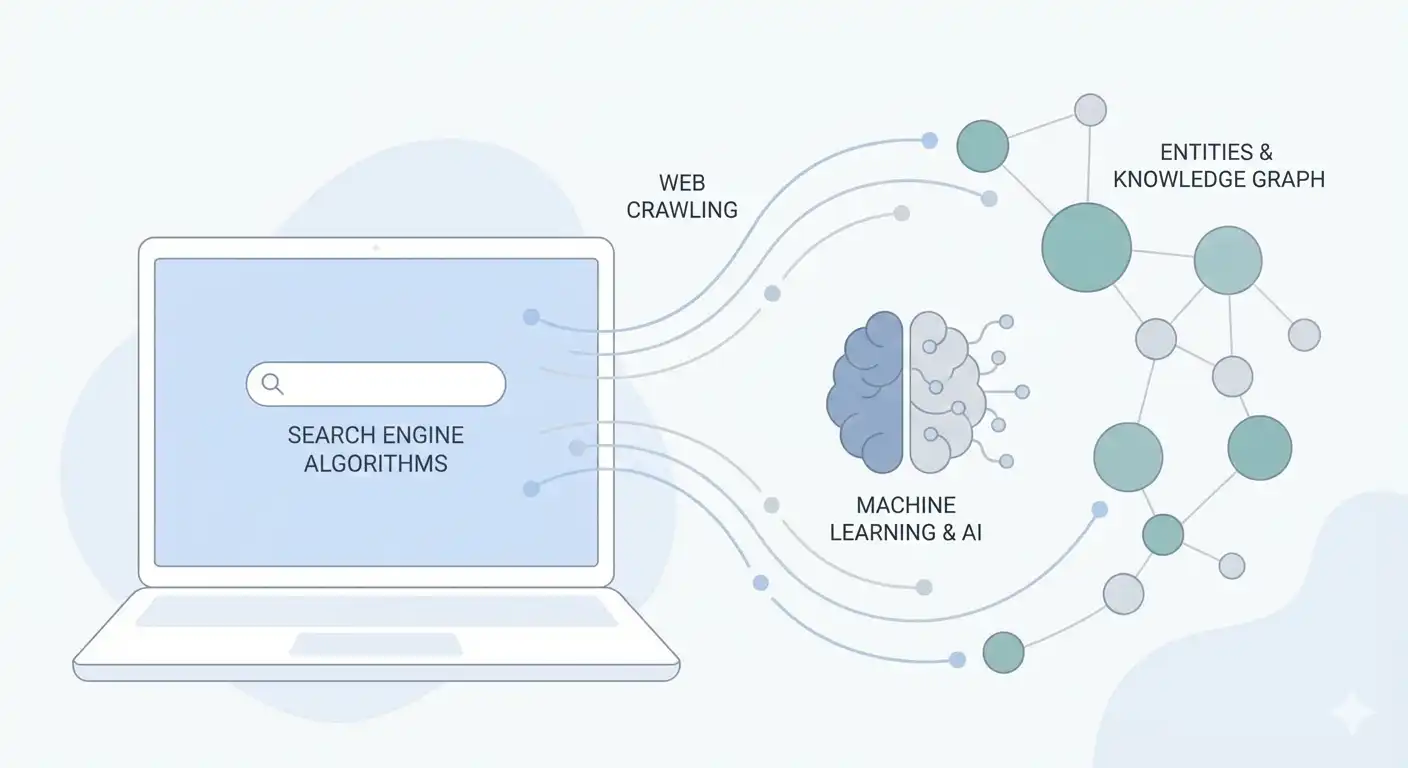
TL;DR — Search engine algorithms are the systems search engines use to discover, understand, evaluate, and rank webpages. Google, Bing, Yandex, Baidu, and other search engines use their own ranking systems, but many solve the same fundamental problems: relevance, quality, context, freshness, authority, and spam. Google’s major algorithm updates from PageRank and Panda to RankBrain, BERT, and today’s AI-powered search, show how search has evolved beyond simple keyword matching. The key SEO lesson isn’t to memorize algorithm names, but to understand what each system was designed to improve and create content that genuinely satisfies search intent.
Introduction
Search engine algorithms are the systems that decide which pages appear in search results, which pages deserve more visibility, and how results should be ordered for a particular query.
But there is an important distinction that often gets lost:
Search engine algorithms are not the same thing as Google algorithms.
Google, Bing, Yandex, Baidu, and other search engines operate their own ranking systems. They may solve many of the same fundamental problems such as discovering webpages, understanding content, determining relevance, evaluating quality, and fighting spam. But they do not necessarily use the same systems, signals, or weighting.
Google receives the deepest attention in SEO discussions because it dominates worldwide search. In August 2026, Google accounted for about 91.1% of worldwide search-engine market share, while Bing had about 4.5%, followed by Yahoo, Yandex, DuckDuckGo, and Baidu at much smaller shares. Source: StatCounter Global Stats
That explains why Google’s algorithm history gets so much attention.
But it does not make other search engines irrelevant.
The bigger lesson is that search algorithms have evolved around a common problem: helping people find useful information from an enormous and constantly changing web.
This guide explains that evolution from the early days of keyword matching to modern machine-learning and AI-assisted search.
Rather than simply listing algorithm names and dates, we’ll look at:
- What search engine algorithms actually do
- How search engines crawl, index, understand, and rank content
- Why major algorithms and systems were introduced
- What problems they were designed to solve
- How Google’s major systems evolved
- How other major search engines approach ranking
- Which SEO principles are universal and which are engine-specific
- What SEOs should actually do when algorithms change
- How AI-powered search is changing the search experience
The goal is not to memorize every algorithm name.
The goal is to understand what search engines are trying to accomplish and use that understanding to make better SEO decisions.
Before Search Engines: How the Early Web Worked?
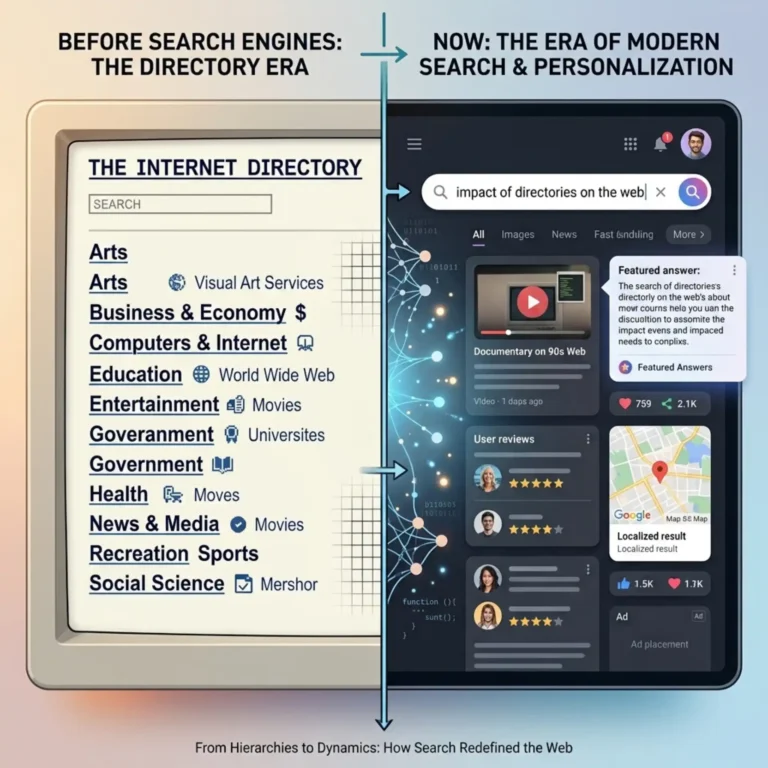
Before modern search engines, finding information on the web was much more dependent on directories and manually organized resources.
Early services such as Yahoo organized websites into categories. Websites could be submitted, reviewed, and placed into directories.
This worked when the web was relatively small.
But the web did not stay small.
As the number of webpages exploded, manually organizing everything became impossible.
Users needed a system that could:
- Discover webpages automatically
- Understand what those pages were about
- Store information about them
- Retrieve relevant pages quickly
- Decide which results were more useful than others
That requirement created the foundation for modern search engines.
The Birth of Search Engines & Keyword Matching
Early search engines relied heavily on matching words found on webpages with words entered by users.
If someone searched for a particular term, pages containing that term could become candidates for the results.
This was an important breakthrough, but it created a new problem.
If repeating a keyword helped a page appear more prominently, some website owners started repeating keywords excessively.
That contributed to practices such as:
- Keyword stuffing
- Hidden text
- Repetitive pages
- Low-value pages created primarily to capture search traffic
Search engines therefore had to solve a bigger problem:
Matching words was not enough.
A search engine needed to determine which pages were actually relevant, useful, trustworthy, and deserving of visibility.
That problem is what drove much of the algorithmic evolution that followed.
What Is a Search Engine Algorithm? (Simple Explanation)
A search engine algorithm is a set of automated systems, rules, models, and signals used to process webpages and search queries and determine which results should be shown.
In simple terms, algorithms help answer three questions:
- Which pages are eligible to appear?
- Which pages are relevant to this query?
- In what order should those results appear?
Modern search engines do not rely on one giant algorithm that handles everything.
Instead, multiple systems work together.
Some systems help discover and process webpages. Others help understand language and queries. Others evaluate relevance, quality, authority, freshness, usability, or spam.
Google itself describes Search as relying on many automated ranking systems rather than one single algorithm. Its current documentation also distinguishes between individual systems and broader ranking processes.
Algorithm vs. Ranking System
These terms are often used interchangeably, but modern search documentation increasingly talks about ranking systems rather than simply referring to everything as an “algorithm update.”
An algorithm can be thought of as a computational method used to solve a problem.
A ranking system is broader: it can include algorithms, machine-learning models, signals, data, and processes working together to determine search results.
This distinction matters because many famous names from Google’s history such as Panda and Penguin are no longer separate standalone systems in the way SEOs often remember them.
Their underlying work has evolved and, in several cases, been incorporated into Google’s broader ranking systems.
How Search Engines Actually Work
Despite the complexity behind modern search, the basic search process can be understood through three major stages:
Crawling → Indexing → Ranking
Google officially describes Search through these core stages, while Bing also describes crawling, indexing, and ranking as fundamental parts of its search process.
Crawling
Search engines use automated crawlers to discover webpages.
Google uses crawlers such as Googlebot, while Bing uses Bingbot.
Crawlers can discover URLs through:
- Links
- Sitemaps
- Previously known URLs
- Other discovery mechanisms
If a search engine cannot access a page properly, it may not be able to process or index that page.
Crawling is therefore the first technical requirement for search visibility.
I have composed a dedicated guide for advance SEOs about How to Make Every Page Crawlable. If you have interest, you may explore here.
Indexing
After discovering a page, a search engine processes its content and decides whether and how to store information about it in its index.
During this stage, systems can analyze things such as:
- Page content
- Language
- Topics
- Entities
- Links
- Structured information
- Canonicalization
- Other technical signals
But being indexed does not automatically mean that a page will rank well.
A page can be crawled and indexed while receiving very little search visibility.
If you are a beginner in SEO and want to clear your concepts about Crawlability and Indexability, I have written a detailed guide on that. You may read also.
Ranking
When someone performs a search, the search engine retrieves potentially relevant pages from its index and uses ranking systems to determine which results are most useful for that particular query.
This is where relevance, quality, context, authority, freshness, location, language, and many other considerations can come into play.
The exact combination varies by search engine and by query.
Do All Search Engines Work the Same Way?
No.
The fundamental process is broadly similar, but each search engine has its own infrastructure, ranking systems, models, policies, and priorities.
For example, Bing explains that it uses machine learning and evaluates factors including relevance, quality and credibility, freshness, location, language, and page-load experience. It also considers how users interact with search results.
Yandex similarly describes machine-learning ranking systems that analyze queries, page content, user interactions, language, location, and relationships between pages.
So the better way to think about search algorithms is:
Different search engines solve similar search problems using their own systems.
That is why SEO principles can overlap across search engines without being identical.
What Happens Between Indexing and Ranking?
One of the biggest misunderstandings in SEO is assuming:
Crawled → Indexed → Ranked
It doesn’t work that simply.
A page can be:
- Crawled but not indexed
- Indexed but rarely shown
- Shown for some queries but not others
- Ranking on page five for one query and page one for another
- Competitive for informational searches but weak for commercial searches
Crawled ≠ Indexed ≠ Ranked
These are different stages.
A crawler finding your URL does not mean the page has earned a place in the index.
Being indexed does not mean it will receive meaningful impressions.
And receiving impressions does not mean it will rank strongly.
Being Indexed Doesn’t Mean You’ll Rank
Search engines have far more candidate pages than they can display prominently for every query.
If several pages provide similar information, the search engine has to determine which ones are the strongest candidates.
This is one reason why simply publishing more content does not automatically produce more traffic.
Ranking Is Query-Specific
There is no universal ranking position for a webpage.
A page might perform strongly for:
search engine algorithms
but poorly for:
how search engine algorithms work
because the intent, competition, and expected result type can be different.
Why Two Indexed Pages Can Perform Differently
Two pages can both be technically accessible and indexed while having very different search performance.
The difference may come from:
- Intent match
- Relevance
- Content quality
- Originality
- Authority
- Topical coverage
- Freshness
- Competition
- Search context
- Technical problems
- Search-engine-specific ranking systems
This is why SEO should not stop at indexation.
Indexation makes visibility possible. It does not guarantee rankings.
How Search Engines Understand Search Queries
Search engines have evolved from simple keyword matching toward much richer understanding of language, context, intent, and relationships.
Search Intent
A search query is not just a collection of words.
It represents something the user wants to accomplish.
Common intent categories include:
- Informational: The user wants to learn something.
- Navigational: The user wants to reach a particular website or resource.
- Commercial: The user is researching options before making a decision.
- Transactional: The user is ready to take an action such as purchasing, booking, or signing up.
Consider the query:
“best technical SEO tools”
The user probably wants comparisons or recommendations.
Compare that with:
“what is technical SEO”
That user is looking for an explanation.
The words overlap, but the expected result is different.
Search algorithms therefore need to understand not only what was typed, but what kind of result is likely to satisfy the query.
Semantic Understanding
Modern search systems can go beyond exact keyword matching.
They can use language understanding, relationships between concepts, synonyms, context, and other signals to interpret what a query means.
This does not mean keywords are irrelevant.
It means modern SEO is not about repeating the exact keyword as many times as possible.
The better question is:
Does this page clearly cover what the user is actually looking for?
Entities and Context
An entity can represent a recognizable person, organization, place, product, brand, or concept.
For example, the word:
Jaguar
could refer to an animal, automobile brand, or sports team.
The surrounding content helps establish which meaning is relevant.
A page discussing engines, models, dealerships, and vehicle reviews provides very different context from a page discussing wildlife, habitats, and rainforests.
This is why modern search understanding increasingly depends on relationships between words, concepts, entities, and context rather than isolated keyword matches.
What Do Search Engines Actually Evaluate?
There is no universal checklist that guarantees a ranking.
Different search engines use different systems, and the importance of individual signals can vary by query.
However, several broad areas consistently matter across modern search.
Relevance
The page needs to be relevant to what the user is searching for.
A technically perfect page cannot compensate for targeting the wrong intent.
Content Quality and Usefulness
Search engines want results that help users accomplish what they came to search for.
Useful content should provide meaningful information rather than simply reproducing what already exists.
Google’s people-first guidance emphasizes original information, substantial value, expertise, and content created primarily to help people rather than manipulate rankings.
Understanding and Context
Search engines need to understand:
- What the page is about
- What topics it covers
- Which concepts are related
- Which audience it serves
- What the page is trying to help the user accomplish
Clear structure and contextual relevance make that easier.
Authority and Links
Links remain an important part of search.
Google’s current documentation states that PageRank remains one of its core ranking systems, although PageRank has evolved considerably since Google first launched.
The practical lesson is not:
Get as many backlinks as possible.
It is:
Build genuine authority through relevant, trustworthy references and useful content.
Freshness When Freshness Matters
Not every query requires fresh content.
If someone searches for:
“latest Google algorithm update”
fresh information is extremely important.
But if someone searches for:
“what is photosynthesis?”
an older authoritative explanation can remain useful.
Search engines therefore need to determine when freshness actually matters for the query.
Google documents dedicated freshness systems for queries where users reasonably expect recent information.
Page Experience
A useful page also needs to be usable.
Important areas include:
- Mobile accessibility
- Page performance
- Secure delivery
- Clear navigation
- Readability
- Avoiding disruptive experiences
Page experience is not a single magic ranking switch, but poor technical or usability conditions can create real problems for users and search visibility.
Spam and Manipulation
Search engines also need systems that identify attempts to manipulate rankings.
These can include:
- Keyword stuffing
- Manipulative links
- Scaled low-value content
- Cloaking
- Other deceptive practices
The exact spam systems differ between search engines, but the underlying objective is similar:
Prevent manipulation from displacing genuinely useful results.
Important: These are some of the factors that can influence how well a page performs in search, but they are not a guaranteed ranking checklist. Search engines use many systems and signals, and there is no formula you can apply that guarantees a page will rank. If you want to understand which SEO factors actually matter, how they work, and how to prioritize them in real-world SEO, explore my SEO Factors guide.
Major Search Engine Algorithms and Systems: What They Were Built to Solve and What SEOs Should Learn
Algorithm names are easy to memorize.
Understanding why they existed is much more useful.
The following table focuses on major systems and milestones, particularly Google’s well-documented evolution, while also showing the broader lesson for SEO.
| Search engine/system | Why was it introduced? | What changed in Search? | What should SEOs learn today? |
|---|---|---|---|
| Google PageRank | To use links and relationships between pages as an important way of understanding importance and authority. | Search could evaluate the web’s link structure rather than relying only on page text. | Build genuine authority and earn relevant links. Don’t chase backlink volume blindly. |
| Google Panda | To improve the quality of results by addressing large amounts of low-value or poor-quality content. | Content quality became a much stronger part of how Google evaluated search results. | Don’t publish pages simply because a keyword exists. Make each page genuinely useful. |
| Google Penguin | To address manipulative link practices intended to influence rankings. | Artificial link-building tactics became much riskier. | Earn relevant links instead of manipulating link profiles or anchor text. |
| Google Hummingbird | To improve Google’s understanding of queries beyond simple word matching. | Google became better at interpreting the meaning and intent behind queries. | Optimize around topics, intent, and meaning—not keyword repetition. |
| Google RankBrain | To help Google interpret complex and previously unfamiliar queries using machine learning. | Machine learning became an important part of query understanding and ranking. | Create content that addresses concepts and user needs naturally. |
| Google BERT | To improve understanding of language and the relationships between words in queries. | Google became better at interpreting context and natural language. | Write clearly and explain relationships between concepts instead of forcing exact phrases. |
| Google MUM | To explore more advanced understanding across language and information formats. | It demonstrated Google’s direction toward more capable AI systems. | Don’t try to “optimize for MUM.” Focus on clear, useful, well-structured information. |
| Helpful Content System | To better reward content created primarily to help people rather than content created mainly to attract search traffic. | People-first content became an explicit part of Google’s search-quality direction. | Create content because it solves a real user problem, not simply because a keyword has volume. |
A note about Google’s historical algorithm names
These names should not all be treated as independent algorithms still operating exactly as they did when first launched.
Google’s systems have evolved.
For example, Google says Panda became part of its core ranking systems in 2015, Penguin became part of its core systems in 2016, and the Helpful Content System was incorporated into core ranking systems in March 2024.
That is why historical algorithm names are best understood as milestones in Google’s evolution, rather than as a list of separate switches that SEOs can optimize for today.
What about MUM?
MUM is particularly important to describe accurately.
Google’s current documentation says MUM is an AI system used for specific applications and is not currently used for general ranking in Google Search.
So MUM belongs in the history of Google’s AI evolution, but it should not be presented as:
“The MUM ranking factor.”
There is no such optimization checklist.
Major Search Engines Beyond Google
Google deserves the deepest coverage because of its enormous market share, but the search ecosystem is broader than Google.
In August 2026, global search share was approximately:
- Google – 91.1%
- Bing – 4.5%
- Yahoo – 1.23%
- Yandex – 0.99%
- DuckDuckGo – 0.70%
- Baidu – 0.62%
These numbers explain why most SEO research focuses on Google.
But they also show why it would be inaccurate to use “Google algorithm” as a synonym for “search engine algorithm.”
Bing
Bing operates its own crawling, indexing, and ranking systems.
Microsoft explains that Bing uses machine learning to rank results and evaluates factors including relevance, quality and credibility, freshness, location, language, and page-load experience. It also considers user interactions with search results.
This is an important reminder:
Many SEO fundamentals are not uniquely Google concepts.
Relevance matters.
Quality matters.
Freshness can matter.
Context matters.
Technical accessibility matters.
But the exact implementation and weighting are search-engine specific.
Yandex
Yandex also uses machine-learning ranking systems.
Its official documentation explains that its systems analyze the query, page content, user interactions, language, location, relationships between pages, and other factors.
Yandex therefore provides another example of a search engine using its own ranking infrastructure while solving many of the same fundamental search problems.
Baidu
Baidu is particularly important when discussing search in the Chinese market.
Its ecosystem and search environment differ from the global markets where Google dominates, so SEO strategies designed for Google should not automatically be assumed to transfer perfectly to Baidu.
The broader lesson is simple:
Search engine optimization is not always one-size-fits-all.
If a business receives meaningful traffic from another search engine, that engine deserves its own technical and search-performance analysis.
What Is Universal Across Search Engines and What Isn't?
This is one of the most useful ways to understand search algorithms.
Different engines may use different ranking systems, but many fundamental principles overlap.
| Generally universal | Search-engine specific |
|---|---|
| Pages need to be discoverable | Exact ranking systems |
| Content needs to be understandable | Signal weighting |
| Relevance matters | Algorithm names |
| User intent matters | SERP feature behavior |
| Quality matters | Specific machine-learning models |
| Technical accessibility matters | Webmaster tools and reporting |
| Authority can matter | How links are interpreted |
| Freshness can matter | How freshness is calculated |
| Spam can hurt visibility | Exact spam detection systems |
| Search context matters | Personalization methodology |
This distinction helps prevent a common SEO mistake:
Taking a Google-specific observation and treating it as a universal law of search.
For example, a ranking behavior observed in Google does not automatically prove that Bing, Yandex, or Baidu uses the exact same signal in the same way.
The safer approach is to identify the underlying principle first.
Google Core Updates: Why They Matter More Than Individual Algorithm Names
SEOs often hear about a “Google algorithm update” and immediately ask:
“What did Google punish?”
That question can lead to the wrong diagnosis.
Google describes core updates as broad changes to its core ranking systems rather than simple penalties against individual websites.
What a Core Update Means
A core update can change how Google’s systems evaluate and rank content.
That means some pages can move up while others move down.
A ranking decline does not automatically mean that Google manually penalized the website.
Why Rankings Change
A page can lose visibility because:
- Competitors improved
- Search intent changed
- Google changed how it evaluates relevance
- The page became less competitive
- Another page provides stronger information
- Search results changed
- A technical issue appeared
- The query itself changed
- The site’s content no longer matches what users need
The right diagnosis therefore requires evidence.
How to Analyze a Core Update
Don’t immediately rewrite the entire website.
Instead:
- Confirm when the update happened.
- Identify which URLs changed.
- Identify which queries changed.
- Compare winners and losers.
- Study the new SERP landscape.
- Check technical and indexing issues.
- Look for patterns across affected pages.
- Improve the actual weakness you identify.
- Monitor the results.
The update itself is not the diagnosis.
The ranking change is the symptom.
What Pattern Do Major Algorithm Updates Reveal?
When you look at major Google algorithm milestones together, an interesting pattern appears.
Search evolved from:
Keyword matching
toward:
Link relationships
then:
Content quality
then:
Query understanding
then:
Machine learning and language understanding
then:
People-first quality systems
and now toward increasingly sophisticated AI-assisted search experiences.
The names changed.
The technology changed.
The scale changed.
But the fundamental problem remained:
How can a search engine identify the most useful information for a particular user and query?
That is the pattern SEOs should remember.
Not:
Panda = thin content
Penguin = links
BERT = NLP
Those summaries are useful for history, but they are not enough for modern SEO decision-making.
What Should You Do When a Search Engine Updates Its Algorithms?
The correct response is not panic.
It is diagnosis.
1. Confirm the Timing
Before blaming an algorithm update, establish whether your traffic or rankings actually changed around the update period.
Use:
- Google Search Console
- Analytics
- Rank tracking
- Search-engine webmaster tools
- Your own change history
2. Identify the Affected Pages
Don’t say:
“My website lost traffic.”
Find out:
- Which URLs lost traffic?
- Which pages gained traffic?
- Which pages remained stable?
- Is the pattern sitewide or limited to one section?
3. Analyze the Queries
A page can lose visibility for some queries while improving for others.
Look at:
- Query intent
- Search demand
- Search features
- Ranking changes
- New competitors
- Branded vs non-branded queries
4. Compare the New Winners
This is one of the most important steps.
Don’t ask only:
“What did Google change?”
Ask:
“What are the pages now winning that my page isn’t doing as well?”
Study the SERP.
Look at:
- Intent satisfaction
- Content depth
- Original information
- Structure
- Expertise
- Clarity
- Supporting evidence
- User experience
- Topical coverage
5. Check Technical Issues
Content isn’t always the reason.
Check:
- Indexation
- Canonicals
- Robots directives
- Internal links
- Rendering
- Status codes
- Mobile usability
- Site performance
- Migration changes
- Accidental noindex directives
6. Improve the Actual Weakness
Don’t rewrite a page simply because an algorithm update happened.
If the problem is poor intent match, fix intent.
If the problem is weak information, improve the information.
If the problem is outdated content, update it.
If the problem is technical, fix the technical issue.
If the page is fundamentally redundant, merging or removing it may make more sense.
7. Make Controlled Changes
Avoid changing ten things at once.
If you make massive changes without understanding what caused the problem, you lose the ability to determine which change helped.
Good SEO diagnosis is closer to controlled experimentation than random editing.
If Your Traffic Drop May Involve a Google Penalty
Not every ranking drop means your site has been penalized. Core algorithm changes, changes in search intent, stronger competitors, technical issues, and changes in how Google evaluates content can all cause organic visibility to decline.
But if your analysis points to a manual action or a potential spam-related issue, the next step is different from a normal algorithm recovery process.
I help businesses investigate Google ranking and traffic drops, identify whether a penalty or search-spam issue is actually involved, and work through the recovery process where appropriate. If you suspect your site has been affected by a Google penalty, you can learn more about my Google Penalty Removal Service.
How I Analyze Algorithm Changes in Real SEO Work
I don’t start by asking:
“What did Google punish?”
I start by asking:
“What changed in the search results?”
That difference matters.
When analyzing an algorithm-related traffic change, I typically work through a sequence like this:
Step 1: Find the affected URLs
I identify which pages actually changed instead of treating the whole domain as one unit.
Step 2: Find the affected queries
A traffic decline becomes much more meaningful when you know which searches caused it.
Step 3: Separate ranking loss from demand loss
Sometimes a page loses traffic because rankings dropped.
Sometimes the search demand itself changed.
Those are completely different problems.
Step 4: Compare the SERPs
I look at what replaced the page.
This often tells me more than reading speculation about the algorithm update.
Step 5: Check content and intent
I ask:
- Does the page satisfy the current intent?
- Is the answer clear?
- Is it substantially useful?
- Does it provide something original?
- Does it cover the important concepts?
- Is it stronger than the pages now winning?
Step 6: Check technical factors
Then I verify whether crawling, indexing, rendering, internal linking, canonicalization, or other technical issues are involved.
Step 7: Look for sitewide patterns
If ten similar pages dropped together, that tells me something different from one isolated URL losing rankings.
Step 8: Make targeted improvements
Only after identifying the likely weakness do I decide what to change.
That’s the difference between:
“Google updated its algorithm, so let’s rewrite everything.”
and:
“The SERP changed, here’s what changed, and here’s the specific weakness we need to address.”
How Are Search Algorithms Evolving for AI Search and What Happens to Search Engines?
AI assistants have changed how people access information.
Instead of typing a query into a search engine, opening several results, and comparing pages, users can now ask an AI assistant a question and receive a synthesized answer in seconds.
That shift is real. But it does not necessarily mean that search engines are becoming obsolete.
AI Is Changing How People Search
The traditional model looked something like this:
User → Search Engine → Search Results → Website
The emerging model increasingly looks like:
User → AI Assistant → Synthesized Answer → Sources / Websites
The interface has changed, and in some cases the number of traditional search-result clicks may decrease.
But the underlying need for information discovery has not disappeared.
AI systems still need access to information from somewhere. Depending on the system and use case, that information can come from model training data, connected databases, retrieved documents, websites, search indexes, or live web sources.
This is why it is too simplistic to say that AI has made search engines irrelevant.
Are Search Engines Actually Going Away?
Probably not in the simple way many predictions suggest.
Search behavior can certainly change. People may use traditional search less for some types of questions while using AI assistants more for research, comparison, summarization, and conversational queries.
But that is different from search itself disappearing.
In fact, search technology is increasingly being incorporated into AI-powered experiences. Google is combining traditional Search with AI Overviews and AI Mode, while Microsoft is integrating search and AI experiences through Bing and Copilot.
The more likely future is not necessarily:
Search engines → AI → Search engines disappear
It may look more like:
Search infrastructure + AI systems + new interfaces
Search engines may increasingly become part of the infrastructure that helps AI-powered systems discover, retrieve, organize, and verify information rather than always presenting that information as a traditional list of ten blue links.
That is an evolution of search, not necessarily its death.
What Does This Mean for SEO?
The biggest change may not be that SEO disappears. It may be that ranking is no longer the only way a brand can be discovered through search.
A page can potentially be valuable in several ways:
- Ranking directly in traditional search results
- Being referenced as a source in AI-generated answers
- Helping search engines understand a topic or entity
- Building the authority and trust associated with a brand
- Providing original information that other systems can retrieve or cite
This makes the underlying principles of SEO even more important: clear information, strong topical relevance, useful content, technical accessibility, trustworthy sources, and genuine expertise.
The tactics and interfaces may continue to change.
The fundamental problem remains the same:
How does a system find useful information, understand it, evaluate it, and deliver it to someone who needs it?
That is why I would not frame the future as “Google versus AI.”
A better way to look at it is:
Search is evolving from a destination people visit into a capability that can exist inside many different interfaces.
AI may become the interface for more searches. Search engines may continue to power discovery and retrieval behind the scenes. And new models may emerge that we cannot predict yet.
What is much easier to predict is that useful, trustworthy, discoverable information will continue to matter.
For SEOs, that means the goal should not be to chase every new acronym or predict which platform will “kill Google.”
The better approach is to understand how information discovery is evolving and make your website a source worth discovering, understanding, ranking, and referencing.
Common Misunderstandings About Search Engine Algorithms
“There is one Google algorithm.”
Reality: Google uses many ranking systems working together.
“Every algorithm update is a penalty.”
Reality: Core updates are broad changes to Google’s ranking systems. A ranking decline does not automatically mean a manual or algorithmic penalty.
“Panda and Penguin are still separate algorithms I need to optimize for.”
Reality: Their evolution has been incorporated into Google’s broader ranking systems. Panda became part of core ranking systems in 2015 and Penguin in 2016.
“Helpful Content is still a completely separate system.”
Reality: Google incorporated the Helpful Content System into its core ranking systems in March 2024.
“MUM is a Google ranking factor.”
Reality: Google says MUM is not currently used for general ranking in Search. It is used for specific applications.
“E-E-A-T is one ranking factor.”
Reality: E-E-A-T is better understood as a framework for evaluating qualities Google wants its systems to surface, rather than a single measurable ranking factor.
“AI search replaced SEO.”
Reality: AI search experiences still rely heavily on search infrastructure, relevance, quality, technical accessibility, and other established principles.
“An algorithm update means I should rewrite everything.”
Reality: First diagnose what changed.
Sometimes the correct action is to improve content.
Sometimes it is to fix technical issues.
Sometimes it is to consolidate pages.
And sometimes no major change is justified at all.
FAQ Section
A search engine algorithm is a collection of computational systems, rules, models, and signals used to discover, understand, evaluate, and rank webpages for search queries.
Search engines generally crawl webpages, process and index their content, understand queries and pages, evaluate relevance and quality, and then rank eligible results for particular searches.
No. Google, Bing, Yandex, Baidu, and other search engines use their own ranking systems and infrastructure. However, many of them solve similar fundamental problems such as relevance, quality, freshness, and spam.
Google dominates worldwide search. In August 2026, Google accounted for about 91.1% of global search share, compared with about 4.5% for Bing.
That makes Google’s algorithm evolution especially important to SEOs, but it does not mean other search engines should be ignored.
Yes. Google’s current documentation says PageRank remains part of its core ranking systems, although it has evolved significantly since Google’s early days.
No, not in the way they are often described in SEO articles. Google incorporated Panda into its core ranking systems in 2015 and Penguin in 2016.
Their historical lessons still matter, but SEOs should not treat them as separate modern ranking switches.
No. Google incorporated the Helpful Content System into its core ranking systems in March 2024.
The underlying people-first principle remains highly relevant.
Don’t immediately rewrite your entire website.
First confirm the timing, identify affected URLs and queries, compare the new SERPs, check technical issues, identify genuine weaknesses, and then make targeted improvements.
Not completely. Google’s current guidance says its generative AI search features are built using its existing Search ranking and quality systems alongside additional AI capabilities.
Not necessarily.
Start with strong universal SEO fundamentals: crawlability, indexability, relevance, useful content, clear structure, authority, and good user experience.
Then adapt your strategy if a specific search engine represents meaningful traffic or business value.
Final Thoughts
Search engine algorithms have changed dramatically since the early days of keyword matching.
We’ve moved from relatively simple text matching toward systems capable of understanding language, context, entities, relationships, quality, authority, freshness, and increasingly complex search behavior.
Google’s algorithm history is full of famous names:
PageRank. Panda. Penguin. Hummingbird. RankBrain. BERT. MUM. Helpful Content.
But memorizing those names is not the real skill.
The real skill is understanding why those systems were created and what problems they were trying to solve.
And that lesson extends beyond Google.
Bing, Yandex, Baidu, and other search engines have their own systems, but they face many of the same fundamental challenges:
- How do we discover the web?
- How do we understand a page?
- What does the user actually want?
- Which result is most relevant?
- Which content is useful and trustworthy?
- How do we prevent manipulation?
- How do we adapt when information changes?
That is why sustainable SEO is not about chasing individual algorithm names.
Algorithm history gives you context.
Search data gives you evidence.
SERPs give you clues.
And your job as an SEO is to connect them.
The search engine may change its systems.
The interface may change.
AI may change how results are presented.
But the fundamental objective remains remarkably consistent:
Help users find useful information as efficiently as possible.
The better your SEO strategy understands that objective, the less dependent it becomes on chasing every new algorithm headline.