You’ve probably noticed it happening to your own searches. You ask Google something, and before you even scroll to a result, there’s already an answer sitting at the top, built from a handful of sources stitched together.
Here’s the question that actually matters: when AI puts together that answer, why does it pick certain pages and skip others completely?
That’s what we’re breaking down here. Not theory. Not vague “be helpful” advice. The actual mechanics of how AI systems decide what’s worth quoting, and what you can do about it.
Wait, Isn't This Just SEO With a New Name?
Kind of, but not quite. Traditional SEO asks “how do I rank #1?” AI citation optimization asks “how do I become the sentence that gets lifted out and shown to the user?“
Those aren’t the same question. You can rank decently and never get cited. You can also get cited from a position that wouldn’t have made anyone’s top 10 a few years ago. The game changed, and most content out there hasn’t caught up.
The Part Most Articles Skip: Why Structure Alone Moves the Needle
Here’s something genuinely interesting that recent research uncovered. A study out of the University of Tokyo and University of Tsukuba (the GEO-SFE framework, if you want to look it up) tested something clever: they kept the actual content identical, same facts, same claims, same sources, and changed only how it was structured.
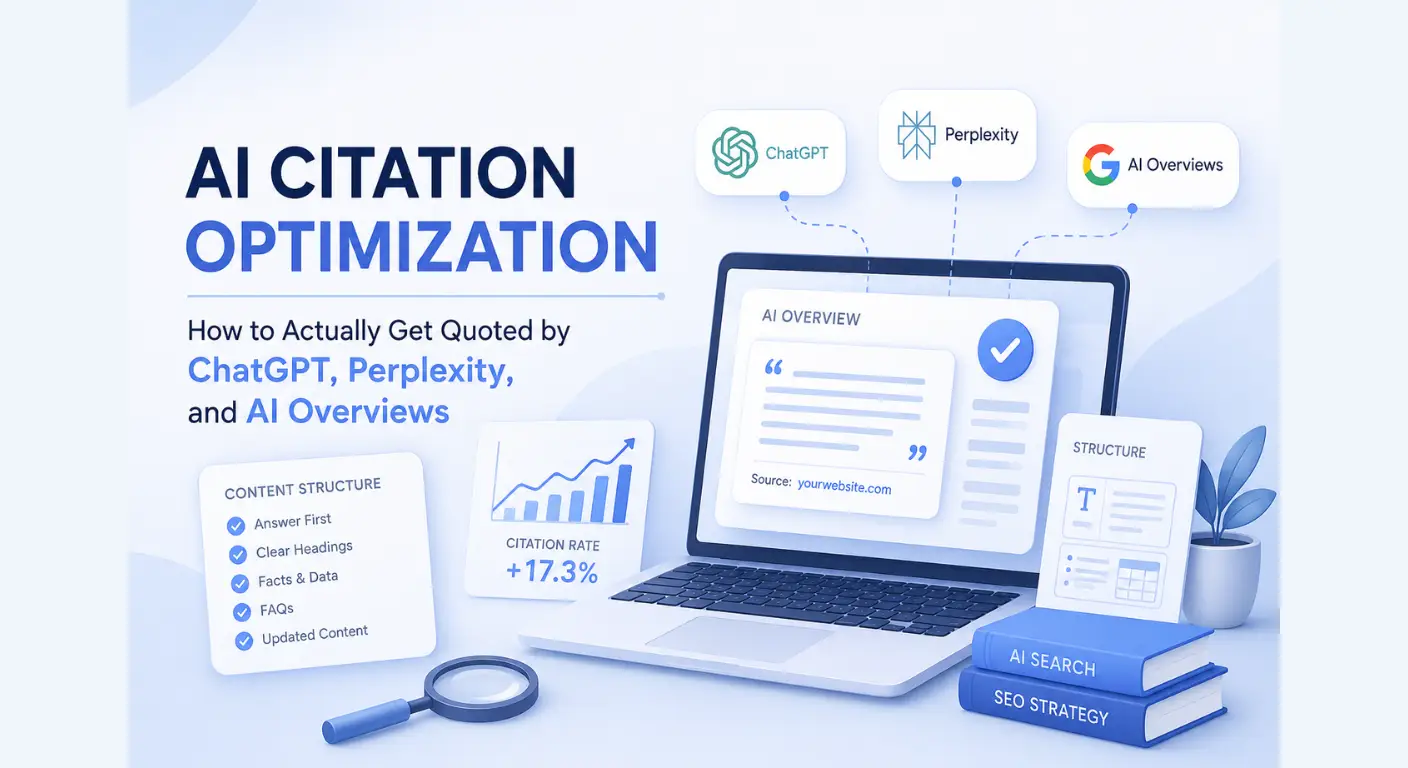
The result? A 17.3% improvement in citation rates from structure alone, nothing about what the content said changed.
That’s worth sitting with for a second. It means a chunk of your citation potential is sitting on the table right now, not because your content is wrong, but because of how it’s formatted on the page.
Study research source link: GEO-SFE research paper by University of Tokyo & University of Tsukuba
How AI Actually Picks What to Quote
Think of it like a 5-stage filter, and your content has to survive every stage:
1: Can it even find you?
If a page isn’t crawlable or indexed, none of the rest matters. This is the most basic gate, and it’s the same crawlability fundamentals we cover in crawlability and indexability.
2: Does it rank, or show up in the fan-out?
For straightforward informational questions, Google’s AI Overviews still lean heavily on pages already ranking well. But here’s the shift: citations from top-10 organic pages dropped from about 76% to 38% over just eight months. AI systems are increasingly pulling from a wider net of sources, not just whoever’s sitting at position #1.
3: Does it match the actual question?
Not “is this topic related” but “does this specific passage answer this specific question.” Vague, scene-setting intros get skipped in favor of content that gets straight to the point.
4: Can the answer be cleanly pulled out?
This is where structure earns its keep. A fact buried in the middle of a dense paragraph is much harder to extract than the same fact sitting in a short, standalone sentence or a table row.
5: Can it be attributed back to you?
Clear authorship and consistent entity signals (your brand name, your site, your expertise) all factor into whether the citation actually gets connected to you, not just absorbed anonymously into the answer.
What Actually Works, In Practice
Answer first, context after
Nearly half of all AI citations come from the first third of a page. If your opening paragraph is throat-clearing before you get to the point, you’re losing your best shot at being quoted. Say the actual answer, then explain it.
Break facts out of paragraphs
A statistic sitting inside a 300-word paragraph is much less likely to get cited than the same statistic sitting alone in a bolded line or a table. Give your best claims room to breathe.
Use headings that match real questions
Not “Benefits” as a heading, but “What are the benefits of X for Y.” AI systems extract by matching the question to a heading, so write headings the way someone would actually ask.
Write FAQs as real, standalone questions
Each question and answer should make complete sense on its own, without needing the surrounding paragraphs for context. That’s exactly what gets lifted into an AI answer.
Cover the topic from multiple angles, not just one article
A single well-written page competes with a whole cluster of content covering the topic from different sides. This is part of why building out a real content cluster, the kind we’re doing across this site, matters more than perfecting one page in isolation.
Keep it current
Content updated within the last couple of months consistently earns more citations than content that’s gone stale. A “last updated” note isn’t just a nice touch, it’s a real trust signal AI systems weigh.
A Quick Gut-Check You Can Run Right Now
Open any page on your site and ask: if I deleted everything except the first two sentences of each section, would those sentences still make sense and answer the obvious question a reader has? If yes, you’re already most of the way there. If no, that’s exactly what to fix first.
Why This Genuinely Matters (Not Just Hype)
It’s fair to be skeptical of anything trending this hard, so here’s the honest version: brands that get cited in AI Overviews see meaningfully more organic clicks than competitors who don’t get cited at all, even though the click-through rate on AI-powered searches overall is lower than traditional search. Being the name AI mentions, even without a click every time, builds recognition that compounds.
This isn’t a replacement for solid SEO. It’s the same foundation (genuine expertise, clear writing, real structure) read by a second audience that didn’t exist a few years ago.
Where This Fits
This is one piece of the bigger picture. If you haven’t already..,
AI SEO in 2026: What Actually Works covers the full framework this sits inside, intent mapping, entity coverage, and the human-plus-AI workflow that ties it all together.
FAQ Section
No. Google’s own AI Overviews still lean heavily on pages that already rank well for informational queries. Strong traditional SEO and citation-friendly structure work together, not against each other.
Not necessarily. A meaningful share of AI citations don’t include a clickable link at all, the brand gets mentioned by name instead. That still builds recognition and trust, even without the click.
Foundational structural work can show movement within a few weeks. Building the broader authority and cross-platform presence that supports consistent citations typically takes a few months of sustained effort.
Largely yes, generative engine optimization (GEO) and answer engine optimization (AEO) are different names for closely related practices, all describing how to get content cited inside AI-generated answers rather than just ranked in a list of links.