
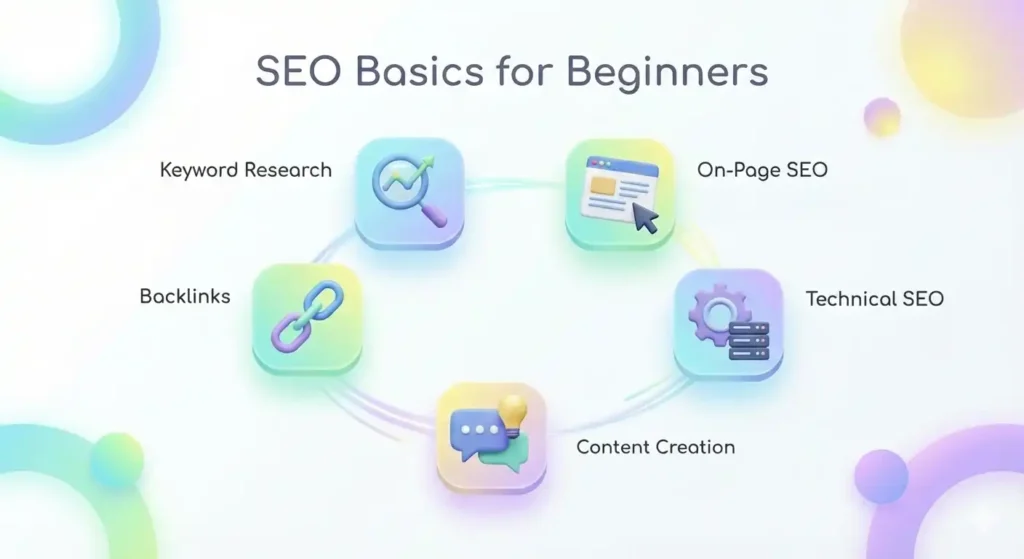
Over the past few years, I’ve audited beginner websites that struggled to rank not because of competition, but because they missed basic SEO fundamentals like search intent alignment and internal linking. This guide breaks those essentials down in the simplest way possible.
Search Engine Optimization (SEO) is the foundation of online visibility. If you want your website to appear on Google when people search for products, services, or information, understanding SEO basics is essential.
In simple terms, SEO helps search engines understand what your website is about, decide when to show it, and rank it against competitors.
In this beginner-friendly guide, you’ll learn:
What SEO is and why it matters in 2026
How search engines actually work behind the scenes
How to apply SEO fundamentals step by step to grow organic traffic long-term
This guide is written for absolute beginners, but the principles also apply as your site grows.
What Is Search Engine Optimization (SEO)?
SEO stands for Search Engine Optimization. It’s the process of improving your website so search engines like Google can understand, trust, and rank your pages for relevant searches.
Instead of paying for ads, SEO focuses on earning traffic naturally by providing the best possible answers to what people are searching for.
For Example: If someone searches “best running shoes for flat feet,” Google won’t rank a homepage. It will rank a detailed guide comparing shoe types, support features, and recommendations. That’s SEO in action matching content to intent.
Good SEO helps you:
Increase organic (free) traffic over time
Reach users who are actively searching for your solution
Build long-term authority and trust in your niche
SEO isn’t about tricks or shortcuts. Modern SEO is about:
Helping users find the most helpful, accurate, and reliable content as quickly as possible.
How Does Search Engines Work?
Before applying SEO tactics, it’s important to understand how search engines operate. According to Google SEO starter guide, Google follows a three-step process:
1. Crawling
Google uses automated programs called bots (Googlebot) to discover new and updated pages by following links across the web.
If your page has no internal or external links pointing to it, Google may never find it.
2. Indexing
Once a page is crawled, Google decides whether to store it in its database (index).
Pages are indexed only if they are:
Accessible (not blocked by technical issues)
Original and valuable
Easy to understand
3. Ranking
When a user performs a search, Google ranks indexed pages based on:
Relevance to the query
Content quality
Page usability (mobile, speed, layout)
Authority and trust signals
Important: If your website can’t be crawled or indexed properly, rankings won’t happen; no matter how good your content is.
Beginner Tip: How to Check If Google Indexed Your Page
Go to Google
Search:
site:yourdomain.com/page-urlIf it shows → Indexed
If not → Use Search Console URL Inspection
If you are curious to learn how Googlebot or any bot works, you should explore this guide here!
Keyword Research: The Core of SEO
Keyword research helps you understand what people are searching for, how often, and why.
Without keyword research, you risk creating content that nobody is looking for.
Types of Keywords
Short-tail keywords: Broad searches
Example: SEO basicsLong-tail keywords: More specific and intent-driven
Example: SEO basics for beginners in the US
For beginners, long-tail keywords are usually easier to rank for and bring more targeted traffic.
Search Intent Matters
Google ranks pages based on search intent, not just keywords.
Common intent types:
Informational: Learn something
Commercial: Compare options
Transactional: Take action or buy
Beginner SEO blogs should focus primarily on informational intent, building trust before conversions.
Step-by-Step Beginner Method
Step 1: Go to Google and type your topic
Step 2: Look at autocomplete suggestions
Step 3: Scroll to “People Also Ask”
Step 4: Note repeated phrases
Step 5: Use those as subheadings in your article
This is a practice for you. By doing this, you’ll be able to find topics for your blogs.
On-Page SEO Fundamentals
On-page SEO includes everything you optimize within a page to help Google and users understand your content.
Key On-Page Elements
Title tag: Clearly explains what the page is about
Meta description: Encourages users to click from search results
Headings (H1–H3): Organize content logically
Content quality: Helpful, original, and easy to read
Internal links: Guide users and search engines to related pages
Well-structured pages improve:
Rankings
Readability
User engagement
Real Example of On-Page SEO Optimization
Let’s look at how a small change can make a big difference.
Before Optimization:
SEO Tips
This title is too broad and doesn’t tell users or Google who the content is for or what they will gain.
After Optimization:
10 SEO Tips for Beginners to Rank Faster in 2026
This improved version works better because it:
✔ Targets a specific audience (beginners)
✔ Adds a clear benefit (rank faster)
✔ Includes a number (which increases clicks)
✔ Uses a timely signal (2026)
✔ Naturally includes relevant keywords
As a result, the optimized title is more likely to attract clicks, match search intent, and perform better in rankings.
Self-assesment for you: “If I saw this title in Google, would I click it over the others?” If the answer is no, your on-page SEO still needs improvement.
Technical SEO Essentials (Beginner Level)
Technical SEO ensures your website is accessible and crawlable.
Core Technical Basics
- XML sitemap submission
- Mobile-friendly design
- Fast page speed
- HTTPS security
- Proper URL structure
- Clean site navigation
You don’t need to be a developer, but ignoring technical SEO can block your growth.
Beginner Technical Checklist
✔ Submit sitemap in Google Search Console
✔ Check Mobile-Friendly Test
✔ Fix broken links
✔ Ensure pages load under 3 seconds
If you want to learn about technical SEO in depth, then click here!
Content That Ranks on Google
Many beginners think longer content automatically ranks. In reality, Google ranks content that completely satisfies the query. Sometimes 800 focused words beat 3,000 unfocused ones.
Content is the backbone of SEO, but not all content ranks.
Google favors content that is:
Written for humans, not algorithms
Clearly answers real questions
Logically formatted with headings
Updated and accurate
Supported by examples and context
Instead of keyword stuffing, focus on topical depth, covering a topic completely and clearly.
Backlinks & Off-Page SEO Basics
Backlinks in off-page SEO are links from other websites pointing to yours. They act as trust and authority signals. Think of backlinks as recommendations. When trusted sites link to you, Google sees your content as more credible.
For Example: If a fitness blog links to your guide on “home workout tips,” Google sees your page as more trustworthy in the fitness niche.
Beginner-Friendly Link Building Methods
Guest blogging on relevant websites
Digital PR and mentions
Business listings and profiles
Being referenced as a helpful resource
Always prioritize quality over quantity. A few strong links beat dozens of weak ones.
How to Measure SEO Success?
SEO is measurable, and beginners should track performance from the start.
Key SEO Metrics
Impressions (how often you appear in search)
Clicks from search results
Organic traffic growth
Keyword rankings
Engagement metrics (time, bounce rate)
Essential Tools
Google Search Console
Google Analytics
Keyword research tools
Tracking data helps you:
Improve what’s working
Identify weaknesses early
Make informed SEO decisions
First Thing to Do After Publishing
Submit URL in Search Console
Request indexing
Monitor impressions after 7–14 days
Common SEO Mistakes Beginners Should Avoid
If you are begginer in SEO, you must avoid the following mistakes:
- Keyword stuffing
- Ignoring search intent
- Publishing thin content
- Skipping technical basics
- Expecting instant results
SEO is a long-term strategy; patience and consistency matter.
Frequently Asked Questions (FAQs)
No. SEO basics are easy to understand, but mastering SEO requires consistent practice and testing.
SEO is a long-term strategy, not an instant solution. Most websites start seeing noticeable improvements within 3 to 6 months, depending on competition, industry, and content quality. Highly competitive niches can take longer. Consistency in publishing helpful content and improving your site over time is the key to sustainable results.
Yes. SEO continues to evolve, but organic search remains one of the most reliable and scalable traffic sources.
Yes, beginners can absolutely start SEO without coding skills. Many important SEO tasks like keyword research, content optimization, internal linking, and using tools like Google Search Console do not require programming knowledge. However, basic technical improvements such as site speed or structured data may eventually need developer support.
A page should focus on one primary keyword and a few closely related secondary keywords. Instead of trying to rank for dozens of different terms, it’s better to cover one main topic thoroughly. Search engines are smart enough to understand related phrases, so natural writing around the topic works better than keyword stuffing.
SEO and paid ads serve different purposes. SEO builds long-term, sustainable traffic without paying for each click, while paid ads provide immediate visibility but stop bringing traffic once the budget runs out. For most businesses, a combination of both works best — ads for quick results and SEO for steady long-term growth.
Conclusion: From SEO Basics to Real Growth
Understanding SEO basics is the first step, but implementing them correctly is what drives real results.
If you want to rank in competitive markets like the US, you need:
- A clear SEO roadmap
- Proper technical setup
- Content aligned with search intent
- Consistent optimization
Ahmad Fraz is a seasoned SEO strategist and digital marketing expert with over 9 years of experience helping brands like Dyson, 3M, Marriott, and CureMD achieve measurable growth. Specializing in technical SEO, content strategy, and data-driven optimization, at Ahmad Fraz SEO, he empowers businesses of all sizes to improve visibility, drive qualified traffic, and achieve long-term digital success. His insights and actionable strategies are backed by years of hands-on experience and proven results.