
Something fundamental has changed in search. Not gradually. Not quietly. Fundamentally.
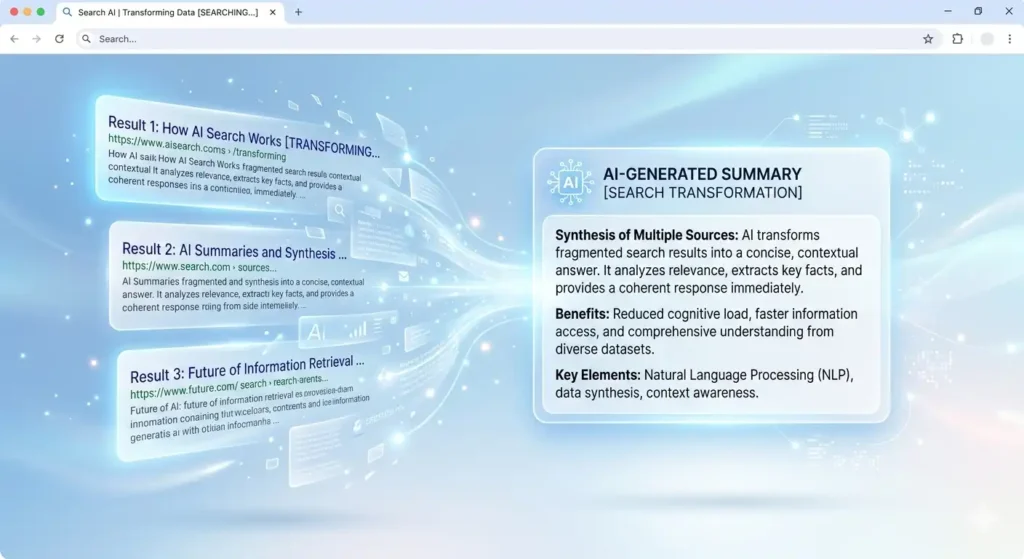
If you search almost any informational query today, you’ll often see an AI-generated summary sitting above the traditional blue links. That shift is powered by what Google introduced as Search Generative Experience (SGE), now commonly evolving into AI Overviews.
Most blogs explain what SGE is. But very few explain what it actually means for traffic.
And even fewer explain how to position your website so that Google’s AI considers your content worth summarizing.
Instead of repeating definitions, let’s reverse-engineer the system. Because when you understand how it behaves, you stop fearing it and start using it.
Let’s Clarify What SGE Actually Does (Without the Fluff)
At a surface level, SGE blends traditional search with generative AI. Instead of showing only ranked links, Google synthesizes insights from multiple sources and presents a summarized answer directly in the SERP.
But here’s the subtle shift:
Google is no longer just ranking content.
It’s extracting, evaluating, and recombining it.
That means your page isn’t competing only for position.
It’s competing for citation.
And citation requires something stronger than basic optimization. It requires clarity, coverage, and authority. Which brings us naturally to the next question.
How Does SGE Decide Which Pages to Pull From?
Google has never fully disclosed the exact mechanism. But patterns are visible.
After analyzing SGE-triggered queries across informational and commercial topics, strong signals emerge.
Pages That Appear More Frequently in AI Summaries Tend To Have:
- Clear, structured headings
- Direct answers under sub-questions
- Comprehensive topical coverage
- Neutral, factual tone
- Demonstrated expertise
- Updated and relevant context
Meanwhile, pages that rarely appear usually have:
- Thin explanations
- Rewritten generic content
- Poor formatting
- Over-optimization
- No real value beyond surface definitions
This alone explains why some sites maintain visibility while others lose impressions.
But that’s just structural preference.
The bigger shift is behavioral.
SGE vs Traditional Google Search: What Has Actually Changed?
Let’s compare clearly:
| Factor | Traditional Search | SGE / AI Overviews |
|---|---|---|
| Results Format | 10 blue links | AI summary + cited links |
| User Journey | Click → Explore | Read → Maybe Click |
| Information Depth | Distributed across sites | Synthesized instantly |
| Traffic Flow | Higher click dependency | Higher zero-click potential |
| Ranking Focus | Position-based | Authority + extractability |
Notice something important.
Traditional SEO was heavily position-focused. Whereas, SGE visibility is authority-focused.
That’s a strategic shift, not a cosmetic one.
That shift doesn’t just change how users consume information. It changes how SEO works at its core.
How SGE is Rewriting the Rules of SEO Now?
For years, SEO was largely about one thing:
Climb the rankings.
Position #1 meant maximum clicks.
Position #5 meant less visibility.
Simple.
But SGE has introduced a second layer of competition and named it AI SEO..
Now you’re not only competing for ranking position.
You’re competing to be selected as a trusted source inside AI summaries.
And that changes the rules in three major ways.
1. Ranking Is No Longer the Only Visibility Metric
You could technically rank #3…
…but still not appear inside the AI Overview.
Meanwhile, a deeply authoritative page ranking #7 might get cited.
Why?
Because SGE prioritizes extractable expertise over raw position.
This means SEO success now includes:
• Ranking visibility
• AI citation visibility
• Brand presence in summaries
It’s no longer a single battlefield.
2. Topical Authority Is Replacing Isolated Keyword Optimization
Old-school SEO often focused on: One keyword. One page. Rank it.
SGE favors: Topic ecosystems.
If your site demonstrates depth across related subtopics, Google is more confident summarizing you.
This makes:
- Content clusters
- Internal linking
- Semantic coverage
It is more important than ever.
3. E-E-A-T Signals Have Become Structural, Not Optional
Experience, Expertise, Authority, Trust.
Before SGE, these were ranking enhancers. After SGE, they are visibility qualifiers.
AI summaries avoid weak credibility signals.
That means:
- Clear author identity
- Real-world insights
- Updated data
- Balanced tone
Are not “nice to have” anymore. They are strategic necessities.
And when you combine all three shifts together, something becomes clear.
SGE hasn’t killed SEO. It has upgraded it.
Which brings us to the next logical concern most website owners have, ‘the traffic’.
Is SGE Reducing Organic Traffic?
Short answer: For some queries, yes.
Long answer: It’s filtering weak content out of visibility.
Informational, low-intent searches are increasingly becoming zero-click experiences.
But high-intent queries especially those involving services, product comparisons, or decisions still generate clicks.
The real impact looks like this:
Surface-level blogs lose impressions.
Deep, authoritative resources gain citation visibility.
Transactional pages remain critical for conversions.
So instead of asking, “Is SEO dead?” a better question is: “Is shallow SEO dead?”
That answer is much clearer.
What Types of Queries Trigger SGE Most Often?
Based on observation trends, SGE commonly appears for:
- Informational queries
- “How does” or “What is” searches
- Comparison-based searches
- Product research queries
- Broad topic overviews
It appears less frequently for:
- Pure navigational searches
- Exact brand lookups
- Certain local intent queries
- Sensitive topics
Understanding this matters because not every keyword strategy should be AI-focused. Which leads to something practical.
How to Increase Your Chances of Being Referenced Inside SGE
This is where most blogs stop being useful.
Let’s go deeper.
1. Expand Context Within a Single Page
SGE favors pages that answer multiple connected sub-questions.
For example, instead of writing:
“What is SGE?”
Also cover:
How it works
Its SEO impact
Traffic implications
Optimization strategies
Future outlook
Context density increases citation probability.
2. Structure Content for Extractability
AI systems parse structure.
Use:
- Clear H2 and H3 hierarchy
- Bullet lists
- Comparison tables
- Direct answer paragraphs
- Logical flow
If AI cannot easily identify clean segments, it moves to a better-structured page.
3. Demonstrate Real Authority Signals
SGE appears to prioritize trustworthy sources.
That means:
Author identity
Experience-backed explanations
Unique perspective
Data-supported insights
Clear positioning
Generic rewrites rarely get surfaced.
4. Build Topic Clusters, Not Isolated Posts
If your website has one SGE article and nothing related, authority is weak.
But if you also cover:
AI in search
E-E-A-T
Zero-click searches
Future of SEO
Then Google recognizes topical depth.
And topical depth strengthens summarization likelihood.
Where Most of the Blogs About SGE Are Weak
After analyzing top results, common gaps appear:
- Over-focus on definition
- Lack of SEO strategy detail
- No real discussion of traffic impact
- No structured optimization roadmap
- No forward-looking prediction
They explain what SGE is. They don’t explain how to adapt.
And adaptation becomes even more important when we look ahead.
The Real Shift: From Ranking to Being Worth Summarizing
Traditional SEO mindset:
“How do I get position #1?”
AI-era mindset:
“Would Google trust my page enough to synthesize it?”
That difference changes how you create content.
You focus less on keyword density.
More on:
- Clarity.
- Depth.
- Relevance.
- Authority.
- User value.
And ironically, when you optimize for those, you improve traditional rankings too.
Frequently Asked Questions About Google’s Search Generative Experience (SGE)
SGE is Google’s AI-powered search feature that generates an AI-created summary at the top of the search results by combining information from multiple sources. It delivers direct answers to complex questions in a conversational style, often with links to the original sources. It’s designed to help users get context and clarity faster than traditional search.
SGE often provides answers directly on the search results page. When users find what they need from the AI summary itself, they may not scroll down to click through. This can reduce organic traffic, especially for simple informational queries, and means content needs to offer deeper value to entice clicks.
No. SGE doesn’t trigger for all types of queries. It appears mainly for informational, comparison, or complex topic searches. Simple navigational searches (like direct brand names), song lyrics, and some specific queries may not trigger an AI overview.
Yes. The AI summary usually includes source attributions, which link back to pages Google used in its answer. That means even if your site isn’t clicked traditionally, it may still be cited as a source which can drive indirect visibility and authority.
Yes, but the impact may be different than before. While FAQ schema alone isn’t a guarantee for AI snippets, clear Q&A sections help SGE understand your content and increase chances of being cited, especially when written in a conversational, clear style.
No. SGE currently sits on top of traditional results., blending AI with regular links. Traditional SEO still matters, landing organic rankings and being clicked remains crucial, especially for high-intent queries. The main shift is toward summarization and citation, not complete replacement.
SGE was first rolled out widely in the US market, and expanded slowly to other regions. Availability may vary based on location and language support, as Google continues gradual global rollout.
To increase your chances of being referenced by SGE, focus on:
- Clear structured headings and bullet lists
- Comprehensive answers with depth
- Topical authority (multiple related sub-topics)
- Real examples and credibility signals
- Natural language that matches conversational queries
These improve extractability which is what generative AI looks for.
Take Control of Your AI Search Visibility
SGE is changing how websites get noticed online. Don’t let your pages get buried in AI-generated summaries.
My AI SEO Services help you:
Optimize content for AI summaries
Build topical authority that gets cited
Increase visibility in Google’s generative search
Ready to get noticed by AI search? Contact Ahmad Fraz SEO today!
Final Perspective
SGE isn’t a threat. It’s a filter.
A filter that removes surface-level content and elevates structured authority.
Websites that adapt early will:
- Retain traffic
- Gain AI visibility
- Strengthen brand trust
- Capture higher-intent visitors
The ones that repeat generic explanations? They’ll slowly fade from SERP visibility.
And that’s why the question isn’t whether SGE will affect your traffic.
The question is whether your content is built to survive an AI-first search engine.
Ahmad Fraz is a seasoned SEO strategist and digital marketing expert with over 9 years of experience helping brands like Dyson, 3M, Marriott, and CureMD achieve measurable growth. Specializing in technical SEO, content strategy, and data-driven optimization, at Ahmad Fraz SEO, he empowers businesses of all sizes to improve visibility, drive qualified traffic, and achieve long-term digital success. His insights and actionable strategies are backed by years of hands-on experience and proven results.