
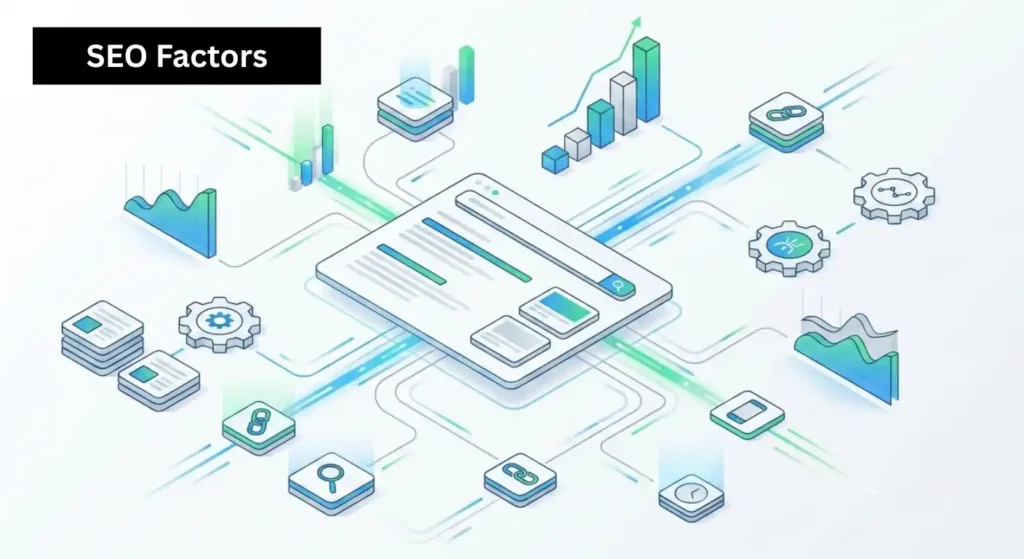
Search engine optimization has evolved far beyond keywords and backlinks. Today, SEO factors cover everything from content quality and user experience to technical performance and brand authority. In this guide, I break down the most important SEO key factors that actually influence Google rankings in 2026, based on real-world experience and up-to-date best practices.
Whether you’re a beginner or refining an existing strategy, this page will help you understand what matters most, what Google ignores, and how to prioritize your efforts.
What Are SEO Factors?
SEO factors are the signals search engines use to evaluate and rank web pages in search results. These factors help Google determine:
- How relevant a page is to a search query
- How trustworthy and authoritative the website is
- How good the user experience is
People often call these SEO ranking factors, but in reality, ranking factors are just a subset of the broader SEO factors ecosystem.
Why SEO Factors Matter More Than Ever in 2026
According to Google SEO guidelines, Google’s algorithms are now heavily focused on:
- Search intent satisfaction
- Content usefulness and experience
- Technical reliability and performance
- Brand trust and authority (E‑E‑A‑T)
This means you can no longer rank by optimizing one or two elements. Success comes from aligning all major SEO factors into a single, cohesive strategy.
Core SEO Factors That Influence Google Rankings
Below are the most important SEO key factors, grouped by category for clarity.
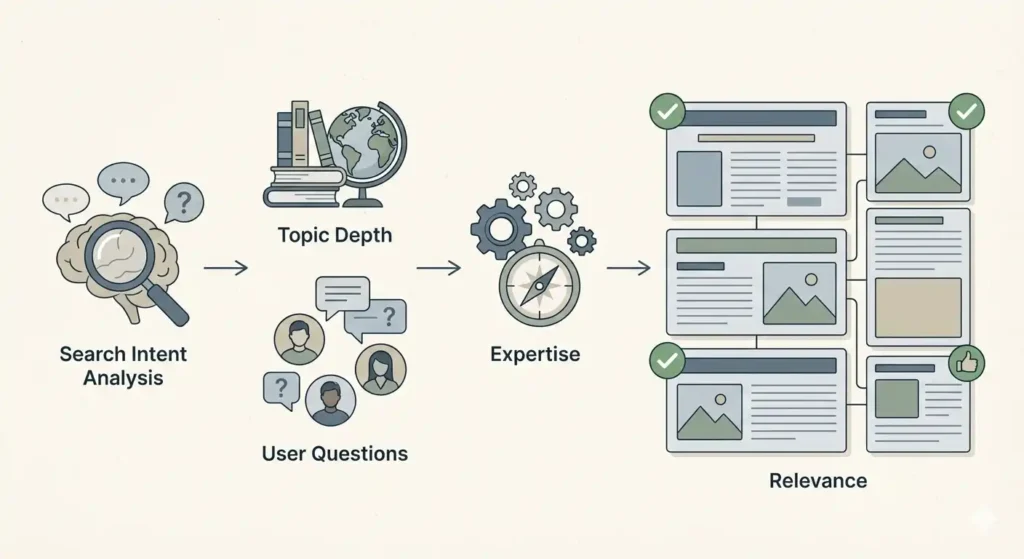
Content is the strongest SEO factor because it directly determines whether a page deserves to rank.
What Google Evaluates in Content?
|
Content Signal |
What Google Looks For |
Practical Focus |
|
Search Intent |
Does the page fully answer the query? |
Match informational, commercial, or transactional intent |
|
Depth & Coverage |
Is the topic covered comprehensively? |
Cover subtopics competitors skip |
|
Originality |
Is there something unique? |
Add examples, frameworks, experience |
|
Freshness |
Is the content updated? |
Refresh stats, screenshots, references |
|
E-E-A-T |
Is the author credible? |
Demonstrate experience & expertise |
Example (Real-world):
If someone searches SEO factors, Google expects more than definitions. It expects categories, prioritization, examples, and guidance on what actually moves rankings. In the industry wise SEO studies, pages that only list factors without explaining why they matter usually stagnate.
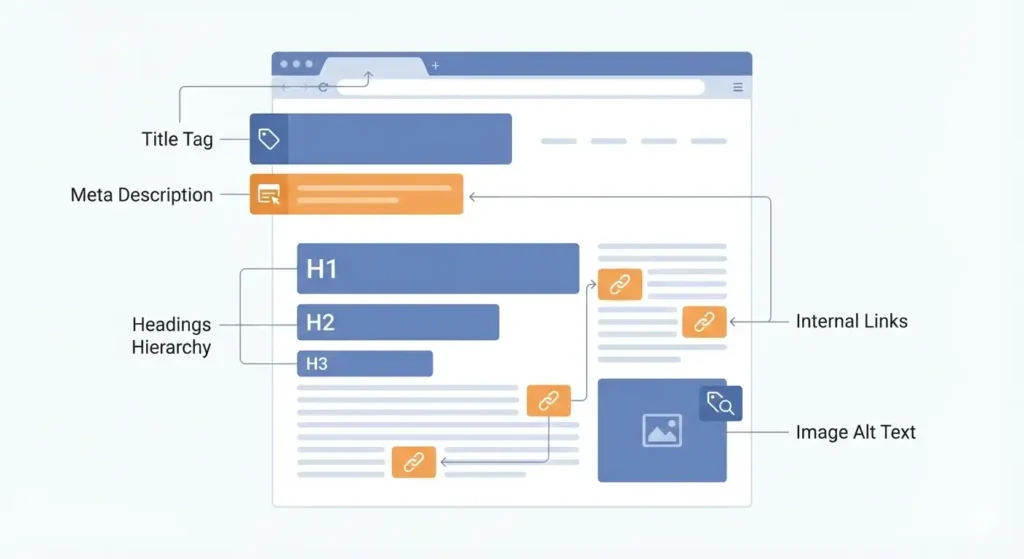
On-page SEO factors help search engines clearly understand your content and its relevance.
On-Page SEO Key Factors Table
On-Page Element | Best Practice | Common Mistake |
Title Tag | Primary keyword + intent | Keyword stuffing |
Meta Description | Written for CTR | Auto-generated text |
Headings | Logical H1–H3 flow | Skipping hierarchy |
URLs | Short & descriptive | Random parameters |
Internal Links | Contextual & relevant | Excessive exact match |
Images | Optimized alt text | Missing or generic alt |
Example:
For this page, using “SEO Factors (2026): Complete Guide…” as the title sets context, timeframe, and intent. Supporting headings then naturally target seo ranking factors, on-page seo factors, and related terms.
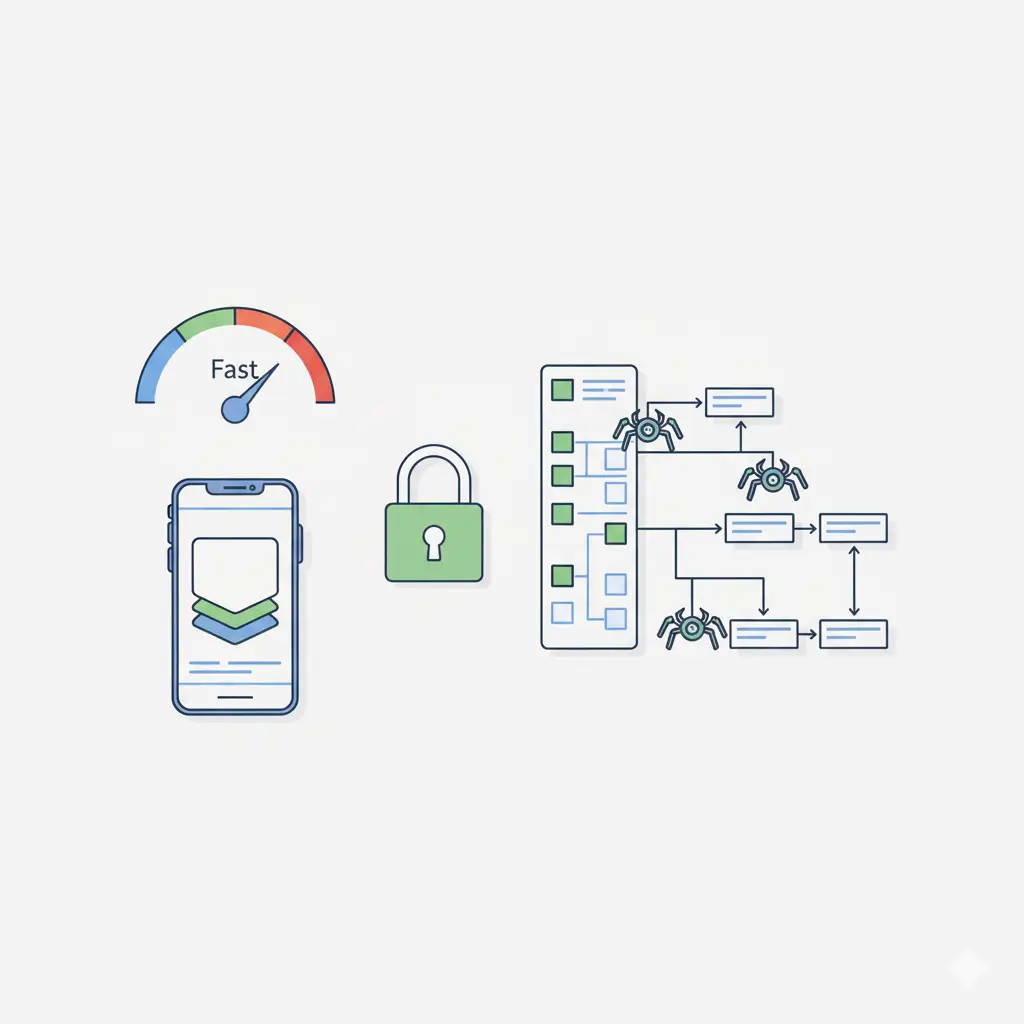
Technical SEO ensures your site can be crawled, indexed, and rendered without friction.
Core Technical SEO Factors
|
Technical Factor |
Why It Matters |
|
Page Speed |
Impacts rankings & UX |
|
Mobile-First Design |
Google indexes mobile version |
|
HTTPS |
Trust & security signal |
|
Crawlability |
Ensures content discovery |
|
Index Control |
Prevents waste & duplication |
Example:
I’ve seen strong content fail simply because important pages weren’t indexed properly. Fixing crawl and indexation issues alone often results in noticeable ranking improvements without changing content.

Off-page SEO ranking factors establish authority beyond your website.
Off-Page SEO Factors Breakdown
|
Factor |
Impact on Rankings |
|
Editorial Backlinks |
Very High |
|
Brand Mentions |
High |
|
Link Relevance |
Critical |
|
Anchor Diversity |
Medium |
|
Link Velocity |
Contextual |
Example:
A single contextual backlink from a trusted industry site often outperforms dozens of low-quality directory links. Google evaluates who is vouching for you, not just how many.
User Experience & Engagement Signals
Google increasingly evaluates how users interact with your site.
Important UX-related SEO key factors include:
- Low bounce rate
- High dwell time
- Clear navigation and layout
- Readable typography
- Minimal intrusive ads
A positive user experience reinforces content quality and relevance signals.
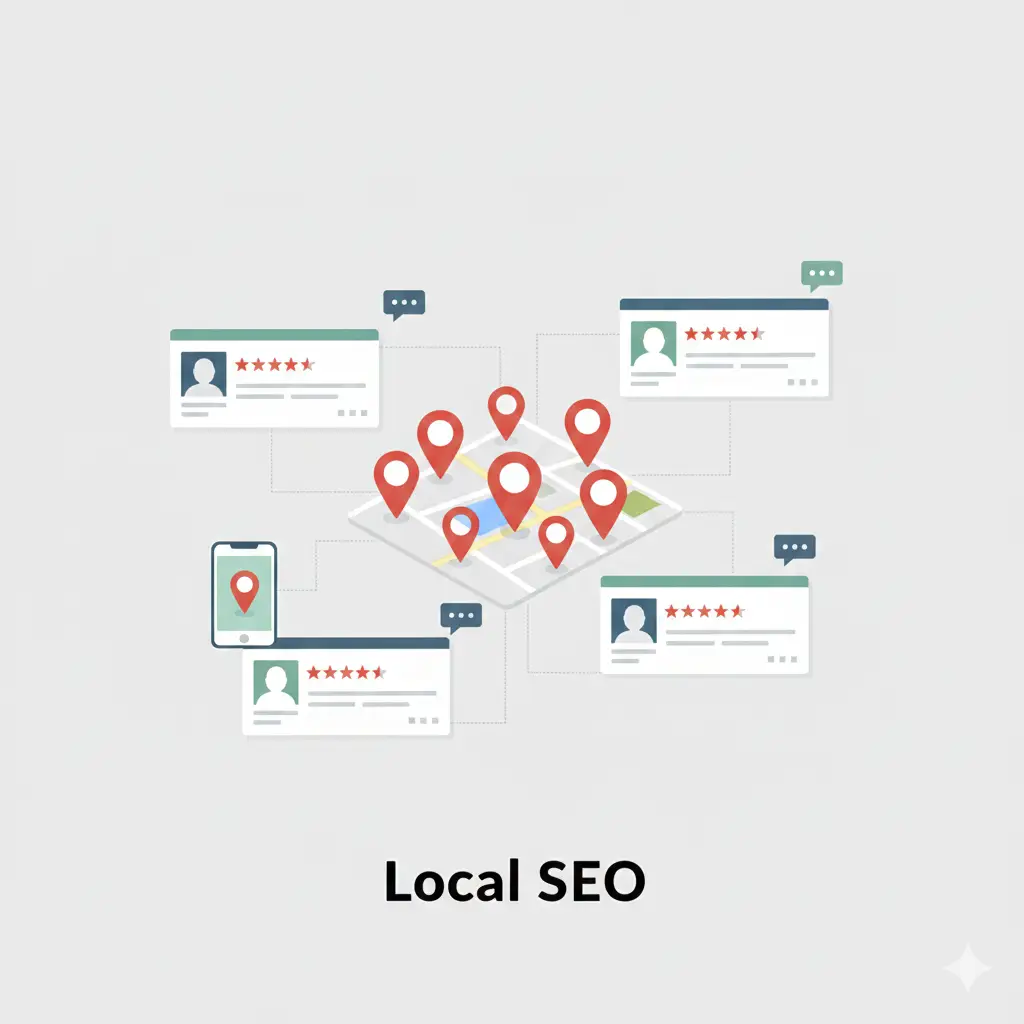
Local SEO factors influence visibility in map packs and location-based searches.
Local SEO Ranking Factors Table
|
Local Signal |
Importance |
|
Google Business Profile |
Very High |
|
Reviews & Ratings |
High |
|
NAP Consistency |
High |
|
Local Links |
Medium |
|
Proximity |
Contextual |
Example:
For service-based businesses, optimizing Google Business Profile and earning genuine reviews often delivers faster ROI than traditional link building.
Schema markup helps search engines better understand your content and may improve visibility through rich results.
Common schema types include:
- FAQ schema
- Article schema
- Organization schema
- Local business schema
While schema is not a direct ranking factor, it enhances SERP appearance and click-through rate.
Google Ranking Factors SEO Checklist
Use this checklist to audit and improve your website:
- ☐ High-quality, intent-focused content
- ☐ Optimized title tags and meta descriptions
- ☐ Proper heading hierarchy
- ☐ Fast loading speed and mobile optimization
- ☐ Secure HTTPS connection
- ☐ Clean internal linking structure
- ☐ Quality backlinks from authoritative sources
- ☐ Optimized Google Business Profile (if local)
- ☐ Positive user engagement metrics
- ☐ Structured data where applicable
SEO Factors vs SEO Ranking Factors: What’s the Difference?
SEO factors cover everything that impacts organic visibility.
SEO ranking factors specifically refer to the signals Google uses to order results in the SERPs.
In short:
- SEO factors = the full ecosystem
- Ranking factors = algorithmic signals within that ecosystem
Understanding both helps you build a balanced, future-proof SEO strategy.
Final Thoughts
SEO success in 2026 is no longer about chasing loopholes or isolated tactics. It’s about aligning content, technical performance, authority, and user experience around real search intent.
By focusing on the SEO key factors outlined in this guide, you create a foundation that not only improves rankings but also drives sustainable, long-term organic growth.
If you’re serious about improving visibility, start by strengthening the fundamentals because that’s what Google rewards most.
Frequently Asked Questions About SEO Factors
From my experience and ongoing SERP analysis, the most important SEO factors are content quality, search intent alignment, backlinks, technical performance, and user experience. Google does not rely on a single signal; it evaluates how well all these factors work together.
Not exactly. SEO ranking factors are the algorithmic signals Google uses to order search results, while SEO factors include everything that contributes to organic visibility, including content strategy, UX, branding, and trust signals.
Core SEO factors remain relatively stable, but their weight changes frequently. For example, page experience and helpful content have become more influential in recent years, while manipulative link tactics have lost impact.
Yes. Backlinks remain one of the strongest off-page SEO ranking factors. However, relevance, authority, and editorial placement matter far more than link quantity.
Neither works alone. Technical SEO ensures your content can be crawled and indexed, while content determines whether it deserves to rank. Weakness in either area limits overall performance.
How I Personally Use SEO Factors in Real Campaigns?
When I work on SEO projects, I don’t treat SEO key factors as a checklist to blindly follow. I prioritize them based on search intent, competition level, and business goals.
My usual process looks like this:
- First, I analyze the SERP to understand what Google is rewarding
- Then, I map content depth against top-ranking competitors
- I fix technical gaps that block crawling or indexing
- I strengthen on-page SEO to improve topical clarity
- Finally, I build authority through relevant links and brand signals
This approach allows SEO factors to work together instead of competing with each other.
Common Mistakes People Make With SEO Factors
Many websites fail to rank not because SEO is difficult, but because factors in SEO are misunderstood or misused.
Common mistakes I see include:
- Focusing on keywords while ignoring search intent
- Over-optimizing on-page elements
- Building backlinks without relevance
- Ignoring technical SEO basics
- Publishing content without depth or originality
Avoiding these mistakes alone can dramatically improve ranking stability.
Final SEO Factors Action Plan
If you want to apply everything from this guide, focus on these priorities:
- Create content that fully satisfies the search intent
- Strengthen on-page SEO for clarity, not manipulation
- Fix technical issues that block performance
- Build authority with relevant, high-quality backlinks
- Continuously improve user experience
SEO success comes from execution, not theory.
Ready to Improve Your Rankings?

If you’re struggling to rank despite trying different SEO tactics, the issue is usually not effort, it’s prioritization.
At Ahmad Fraz SEO, I help businesses identify which SEO factors are holding them back and create data-driven strategies that deliver sustainable growth.
If you want a clear SEO roadmap instead of guesswork, get in touch with me and let’s fix what’s actually stopping your site from ranking.
Ahmad Fraz is a seasoned SEO strategist and digital marketing expert with over 9 years of experience helping brands like Dyson, 3M, Marriott, and CureMD achieve measurable growth. Specializing in technical SEO, content strategy, and data-driven optimization, at Ahmad Fraz SEO, he empowers businesses of all sizes to improve visibility, drive qualified traffic, and achieve long-term digital success. His insights and actionable strategies are backed by years of hands-on experience and proven results.