
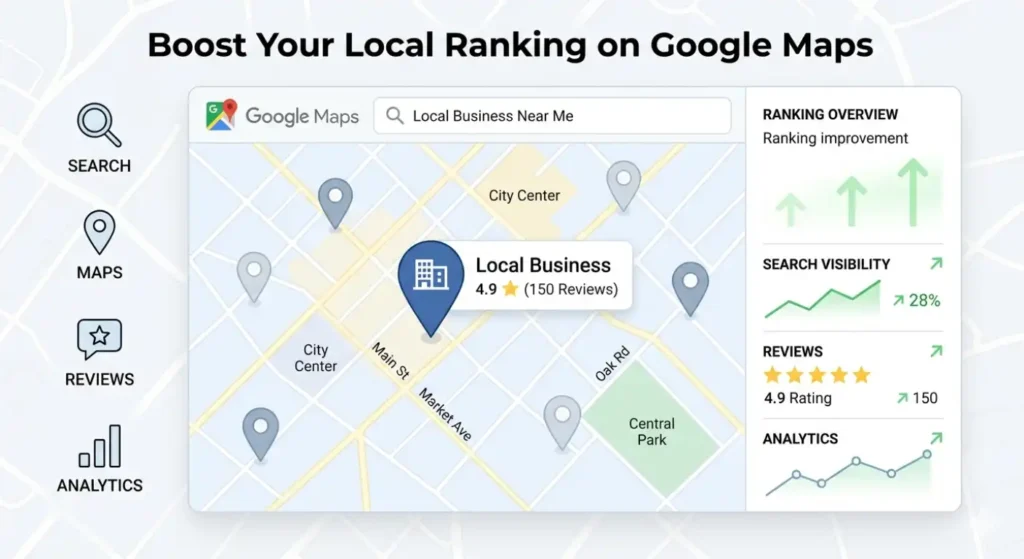
You’ve set up your Google Business Profile, added your services, maybe even got a few reviews, but you’re still not showing up in the Google Map Pack.
If your competitors are getting all the calls while your listing stays invisible, there’s a reason and it’s usually not what most businesses think.
In this guide, I’ll break down exactly why your business might be missing in local search results, and how to fix it step by step. By the end, you’ll know how to improve your local rankings and attract more customers.
How Google Map Pack Rankings Actually Work
Google doesn’t randomly pick businesses for the Map Pack. Rankings are determined mainly by three factors:
Relevance – How well your business listing matches the search query
Proximity – How close your business is to the searcher
Prominence – Your online reputation, backlinks, citations, and reviews
If any of these signals are weak, your business will struggle to appear, no matter how polished your profile looks.
These are not my words this is what Google says. According to Google’s own local search documentation, “local results are based primarily on relevance, distance, and prominence,” which collectively help the search engine determine the best local businesses to show for a given search query.
7 Reasons Why Your Business Isn’t Ranking (And How to Fix Each One)
1. Your Google Business Profile (GBP) Is Not Fully Optimized
Many businesses set up their GBP but stop there. Google favors listings that are complete, accurate, and active.
How to fix it:
Select the correct primary and secondary categories
Add detailed descriptions of services
Upload geo-tagged photos and videos regularly
Post updates and offers to engage users
2. You Don’t Have Enough Reviews (Or the Right Kind)
Reviews aren’t just for trust, they’re a ranking factor. A few generic reviews won’t help you compete in your city.
How to fix it:
Ask happy customers for reviews promptly
Encourage reviews mentioning services or location
Respond professionally to all feedback
3. Your Business Information Is Inconsistent (NAP Issues)
If your Name, Address, and Phone (NAP) aren’t consistent across the web, Google gets confused.
How to fix it:
Audit all citations and directory listings
Correct inconsistencies immediately
Ensure your website info matches exactly
4. You Don’t Have Local Backlinks
Backlinks from local sources show Google that your business is trusted in your community.
How to fix it:
Partner with local organizations
Get listed on local blogs or news sites
Collaborate with local vendors
5. Your Website Isn’t Optimized for Local SEO
Even with a perfect GBP, your website plays a big role. Location-specific pages, keywords, and internal linking matter.
How to fix it:
Add city + service landing pages
Include location keywords in headers and content
Use structured data (Schema) for local business
6. Your Competitors Are Simply Stronger
Sometimes it’s not that you’re doing anything wrong, your competitors may have better GBP optimization, more reviews, or stronger citations.
How to fix it:
Perform a competitor audit
Analyze keywords they rank for
Close the gap with structured improvements
7. You’re Ignoring Proximity & Service Area Strategy
Google favors businesses that are closer to the searcher. If you serve multiple locations but haven’t set service areas correctly, your visibility drops.
How to fix it:
Update service areas in GBP
Use geo-targeted content on your site
Focus on neighborhoods and nearby cities
What Most Local SEO Guides Don’t Tell You
Many local SEO guides promise quick results, but they often leave out the critical nuances that actually determine your ranking. Here’s what most people miss:
More reviews alone won’t guarantee ranking
While accumulating reviews is important, quality, relevance, and frequency matter more. A dozen meaningful reviews mentioning your service and location can outperform hundreds of generic ones. Google uses these signals to assess trust and relevance, so a strategic approach is better than just chasing numbers.Duplicate or spam listings can temporarily rank but hurt your trust
Some businesses think creating multiple listings will boost visibility. In reality, spammy or duplicate profiles might appear in search for a short time, but they risk penalties and long-term trust issues. A clean, verified profile consistently wins.Consistency across all listings and your website is still the #1 overlooked factor
Even small differences in your Name, Address, and Phone (NAP) across directories or website pages can confuse Google. Maintaining perfect consistency signals reliability and strengthens your prominence in local search results.
Understanding these subtle but crucial factors is what separates successful local SEO campaigns from the rest.
When Should You Consider Professional Help?
Local SEO may seem straightforward at first, but it can get technical quickly. Even if you follow all the steps above, you might still struggle to see results if your competition is strong or your strategy isn’t fully optimized.
Professional help can provide:
Structured approach: A clear roadmap tailored to your business ensures no step is missed.
Faster results: Experts know the exact tactics that move the needle and avoid trial-and-error delays.
Ongoing optimization: Local SEO isn’t one-time; it requires constant updates to reviews, listings, and website content to maintain top positions.
If you’ve spent weeks or months trying to improve your local ranking without significant results, partnering with a local SEO professional can save time, reduce frustration, and deliver measurable growth for your business.
Frequently Asked Questions About International SEO
The Google Map Pack (also called the Local 3‑Pack) is the set of three local business listings that appear above regular search results when someone searches with local intent (e.g., “plumber near me”). Being in the top 3 dramatically increases visibility, clicks, calls, and directions requests because most users click on the local pack first.
It depends on competition, your current optimization level, and how many ranking signals you improve. For most US local businesses, you may start seeing movement within 3–6 months with consistent optimization of your Google Business Profile, reviews, citations, and on‑page SEO — but competitive cities can take longer. Established competitors may need even more strategic efforts.
You can rank as a service‑area business (without a public office), but it’s generally harder because proximity is a strong ranking signal. Businesses located closer to the searcher often outrank others, even if their SEO looks weaker on paper.
There is no exact number Google reveals, but data shows that more recent, relevant reviews help significantly. Reviews account for a meaningful portion of ranking signals, and profiles with strong review volume and quality tend to perform better.
Yes. Ranking isn’t only about reviews. Google also considers your proximity to the searcher, relevance of your profile/content, and prominence signals like backlinks, citations, and engagement. Even competitors with fewer reviews can outrank you if they’re closer or more consistent in other signals.
Yes, even though the local pack is driven by the business profile, your website still contributes to local engagement signals and relevance. A strong local landing page, service area pages, and on‑page SEO help reinforce your GBP and give Google more context about what you do and where you serve.
Local ranking fluctuations happen. Sometimes changes in GBP, proximity signals, competitor activity, or reindexing delays can temporarily lower your position. It’s important to maintain consistent signals (GBP updates, reviews, citations) and track changes over time.
No. Ranking difficulty varies by city and niche. Major metro areas (e.g., New York, Los Angeles) have higher competition, so factors like reviews, citations, and local backlinks have greater impact there than in smaller towns.
Absolutely. Regular updates signal activity and relevance. Listings with up‑to‑date information, photos, posts, and engagement usually perform better because Google sees them as more active and trustworthy.
Yes. With the rise of voice assistants, optimizing your GBP and content for natural conversational queries (e.g., “best plumber open now near me”) can help capture additional local traffic.
Final Thoughts
Ranking in the Google Map Pack depends on relevance, proximity, and prominence, reinforced by a fully optimized Google Business Profile, consistent citations, quality reviews, and local SEO strategies. While following these steps can improve your visibility, many businesses benefit from expert guidance to implement a structured approach that saves time and delivers measurable results. Take action now to increase local leads, calls, and revenue, and secure your place at the top of local search results.
Ahmad Fraz is a seasoned SEO strategist and digital marketing expert with over 9 years of experience helping brands like Dyson, 3M, Marriott, and CureMD achieve measurable growth. Specializing in technical SEO, content strategy, and data-driven optimization, at Ahmad Fraz SEO, he empowers businesses of all sizes to improve visibility, drive qualified traffic, and achieve long-term digital success. His insights and actionable strategies are backed by years of hands-on experience and proven results.