Last Updated: June 2026
Let’s clear up the question everyone’s actually asking, even if they phrase it differently: “Will Google penalize me for using AI to write content?“
Short answer: NO! Google has said this directly, repeatedly, and the policy hasn’t moved. What gets penalized is thin, generic, valueless content, and AI just happens to make it really easy to publish a lot of that, fast.
So the real question isn’t “can I use AI.” It’s “am I using it in a way that actually produces something worth reading.” Let’s get into what that looks like in practice.
What Google Actually Said (No, Really)
Danny Sullivan, who speaks for Google on this stuff, put it plainly: “We focus on the quality of content, not how content is produced.” [1]
That’s still the position. Google’s spam policies target content made to manipulate rankings with little value, whether a human or an AI wrote it. There’s no AI penalty hiding in there. There’s a low-quality penalty, and AI just makes low-quality content faster to mass-produce.
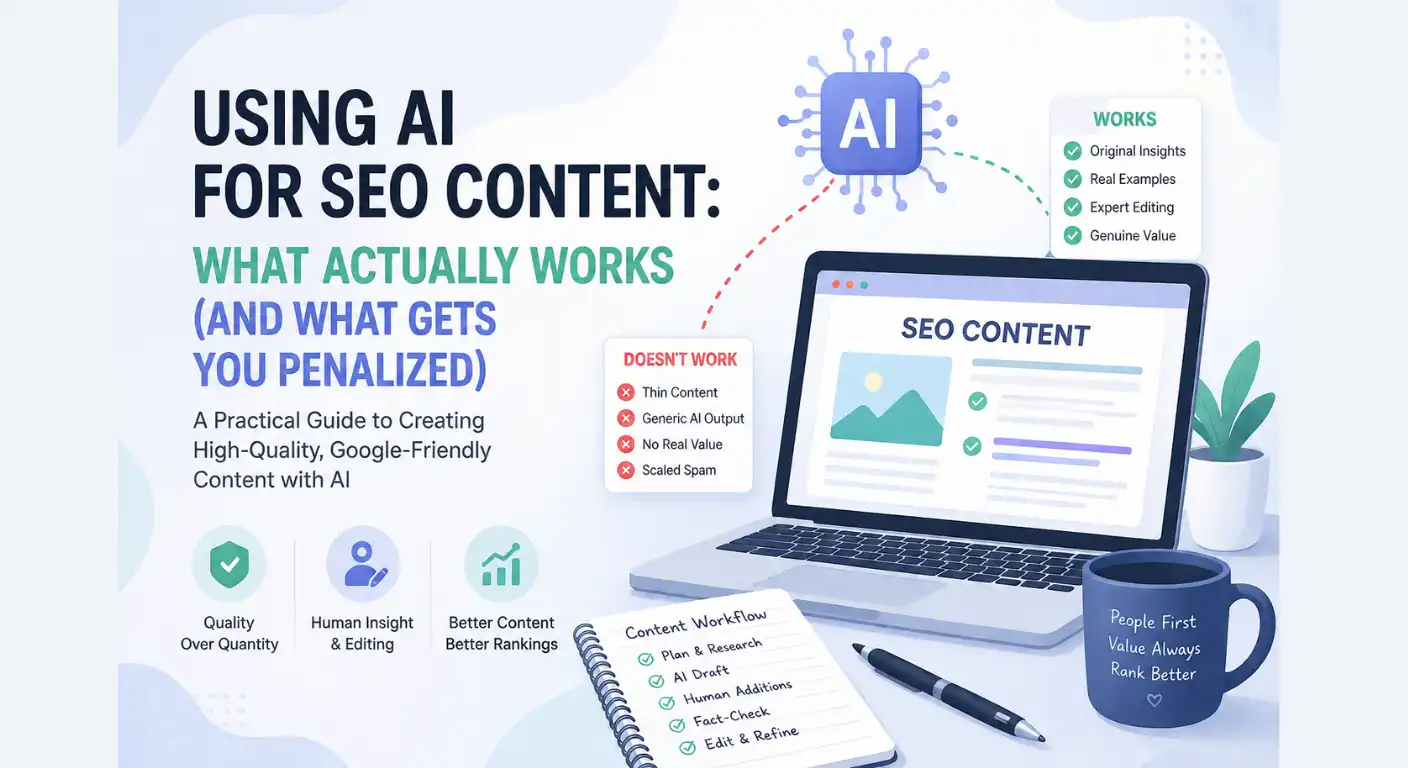
Here’s the part that should actually change how you think about this: Google’s February 2026 core update specifically went after low-quality AI content lacking originality and depth, and the sites that got hit with 40-60% traffic drops were the ones scaling generic, unedited AI output. Sites publishing AI-assisted content with real expert editing and genuine value kept performing fine. [2] [3] [4]
Same tool. Wildly different outcomes. The difference was entirely in how it was used.
The Workflow That Actually Holds Up
This is roughly what we run, and it lines up closely with what the data says actually works:
Humans set the direction first
Topic, audience, search intent, the actual points worth making, decide these before AI touches anything. AI is bad at deciding what’s worth saying. It’s good at helping you say it faster once you know.
AI handles the heavy lifting of research and structure
Pulling together background information, drafting an outline, generating a first pass at the writing, this is where AI genuinely saves real time, and there’s nothing wrong with leaning on it here.
A human adds what AI genuinely can’t
This is the step that actually matters most, and it’s the one people skip when they’re in a rush. Real examples. Specific numbers. An actual opinion or conclusion, not just a neutral summary of “both sides.” First-party information, things that came from your own client work, your own data, your own conversations, none of which exists anywhere else on the internet for an AI to have learned from.
Fact-check everything before it goes live
AI is confident even when it’s wrong. A human checking claims against real sources isn’t optional, it’s the step that separates “helpful content” from “content that happens to sound helpful.”
Edit for the way people actually talk
Cut the fluff. Use normal words. If a sentence sounds like it’s trying to sound impressive instead of trying to be clear, rewrite it.
Your Actual Advantage: The Stuff AI Can't Make Up
Here’s something worth sitting with. Every competitor with an internet connection has access to the same AI tools you do. So what makes your content different from theirs if you’re both starting from the same prompt?
The answer is first-party information. Things that exist nowhere else for an AI to scrape or learn from:
- The exact language real clients use to describe their problems (pull this from actual calls or messages, not guesses)
- Questions that come up in real conversations that never show up in keyword research tools
- What actually happened in a specific project, the numbers, the timeline, the thing that surprised you
- An opinion you’ve actually formed from doing the work, not a balanced, say-nothing summary
This is the one thing that genuinely can’t be replicated by a competitor running the same AI tool you are. It’s the actual moat.
What Consistently Underperforms (Watch For These)
A few patterns show up again and again in AI-assisted content that struggles to rank, worth checking your own work against:
Over-paraphrased content
Text that’s been spun and reworded so many times it’s lost any actual specificity. It reads smooth but says almost nothing.
No real takeaway
Articles that present information neutrally from start to finish but never actually conclude anything or take a position. Readers (and increasingly, AI systems looking for a clear, citable answer) notice the absence.
Definitions without examples
Explaining what something is in the abstract, without ever showing what it actually looks like in a real situation.
Padding instead of insight
Filling word count with facts everyone already knows, rather than including the one or two things only someone who’s actually done the work would know.
On Disclosure: Do You Have to Say You Used AI?
There’s no SEO requirement to disclose AI assistance, Google doesn’t ask for it and doesn’t reward or penalize based on it. Some publishers add a transparency note anyway (“researched with AI assistance, reviewed and edited by our team”) because it builds trust with readers, not because it affects rankings.
What does matter more than disclosure: clear, accurate authorship. A real byline tied to a real person with real credentials carries genuine weight for E-E-A-T, especially the “experience” part, which AI fundamentally cannot fake on its own.
A Quick Self-Check Before You Publish
Read the piece and ask: if I removed every sentence that’s also true of the next ten articles on this exact topic, what would actually be left? If the honest answer is “not much,” that’s the content that needs another pass, more specifics, a real example, an actual stance, before it goes live.
Where This Fits
This workflow is one part of the bigger picture covered in AI SEO in 2026: What Actually Works, alongside citation optimization and building genuine entity and topic coverage. All three work together rather than as separate, standalone tactics.
FAQ Section
Not for being AI-generated. Google’s policies target low-quality, manipulative content regardless of who or what produced it. AI-assisted content that’s genuinely accurate, original, and useful performs the same as well-written human content.
No, there’s no SEO requirement to disclose it. It’s a transparency choice some publishers make for their audience’s sake, not a ranking factor either way.
Publishing the first draft without adding anything an AI couldn’t have produced on its own, no real examples, no specific data, no actual opinion. That’s what reads as generic, and that’s what gets filtered out.
Yes, meaningfully. Google holds YMYL (Your Money or Your Life) content to stricter standards regardless of how it’s written, and unreviewed AI output on medical, financial, or legal topics is exactly where a lack of genuine human expertise shows up fastest, and matters most.