In the early days of search engine optimization, ranking a website was a straightforward two-pillar game: publish keyword-rich content (On-Page SEO) and acquire as many external hyperlinks as possible (Off-Page SEO). Search engine algorithms were simple, web page structures were lightweight, and technical barriers were virtually non-existent.
Then, the web evolved. Dynamic JavaScript frameworks emerged, websites scaled into millions of programmatic pages, and search engines like Google deployed sophisticated, multi-stage crawling and rendering pipelines.
Modern search engine algorithms realized that exceptional content and strong backlinks are meaningless if a website cannot be efficiently crawled or rendered. Thus, a critical third pillar emerged to complete the ecosystem: Technical SEO. Rather than replacing On-Page or Off-Page strategies, Technical SEO acts as the foundational enabler that allows your content and link authority to actually perform and achieve maximum ranking potential.
Today, Technical SEO is no longer a luxury or an optional audit item; it is the fundamental backbone of your entire digital ecosystem.
Think of your website as a modern skyscraper:
On-Page SEO (Content): The interior design, paint, and furniture that make the building valuable and attractive to visitors.
Off-Page SEO (Backlinks): The reputation, recommendations, and foot traffic directing people to the building.
Technical SEO (Architecture): The structural foundation, steel beams, plumbing, electricity, and elevator shafts.
No matter how breathtaking your interior design is or how many people recommend your building, if the foundation is cracked or the elevators don’t work, nobody can enter, explore, or live in it.
In search engine terms: if your technical foundation fails, Googlebot cannot crawl, evaluate, or index your content. Your highest-quality articles and money pages will sit completely invisible in search results, trapped behind invisible technical barriers.
The Technical SEO Skeleton: How the Pillars Connect
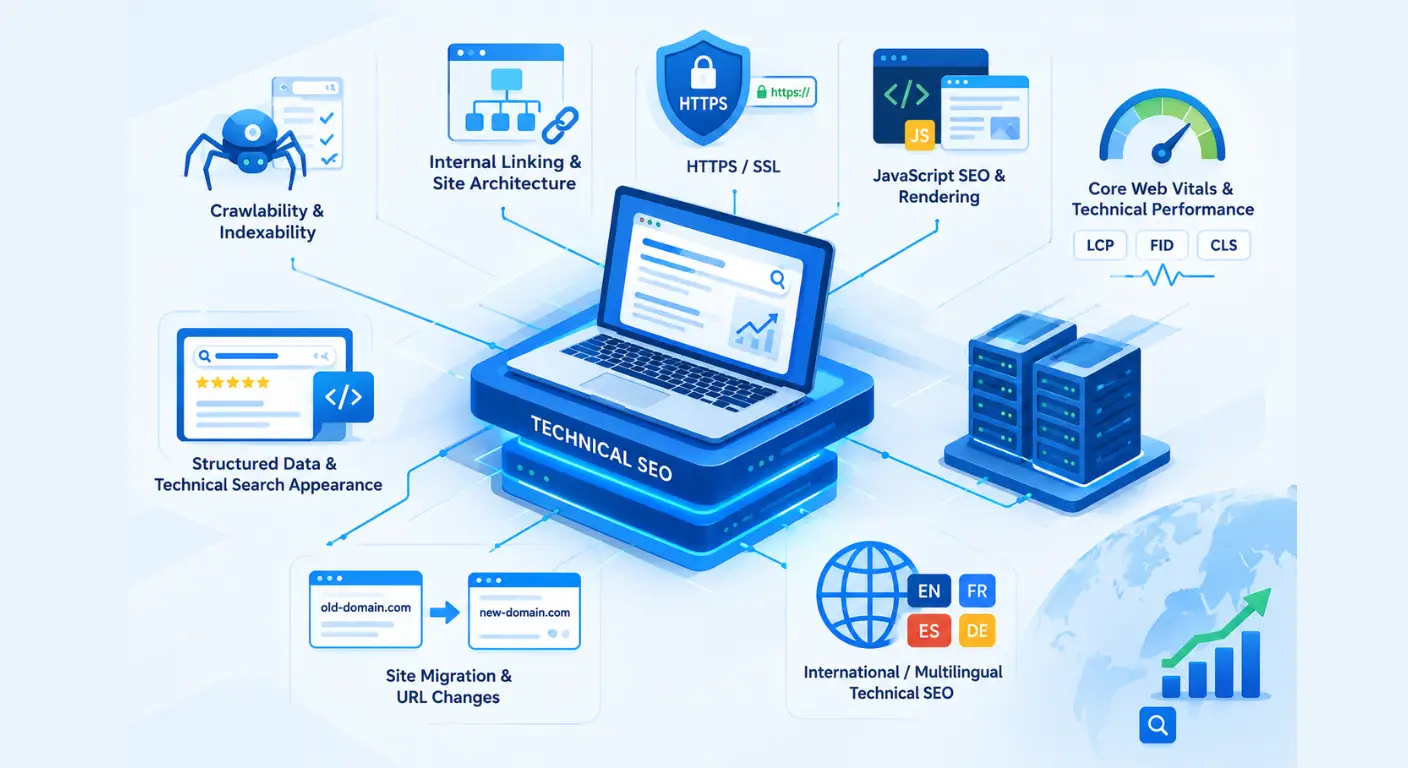
Technical SEO is not a single, isolated tactic. It is a complex skeleton built from multiple interconnected technical bones.
The major parts of Technical SEO are:
- Crawlability & Indexability
- Site Architecture & Internal Linking
- Technical Foundation (HTTPS, SSL, Security & Protocols)
- JavaScript SEO & Rendering
- Core Web Vitals & Technical Performance
- Structured Data & Technical Search Appearance
- Site Migration & URL Changes
- International / Multilingual Technical SEO
When every bone in this skeleton is properly aligned, your website becomes an effortlessly navigable highway for search engines maximizing crawl efficiency, preserving link equity, and ensuring stable organic growth.
In this master guide, we will examine each bone of the Technical SEO skeleton step-by-step. You will learn how each technical layer functions behind the scenes, why it directly dictates search engine behavior, and the severe business risks your domain faces when these technical elements are ignored.
Crawlability & Indexation Engine: Discovering and Storing Search Assets
The Technical Concept in Technical SEO
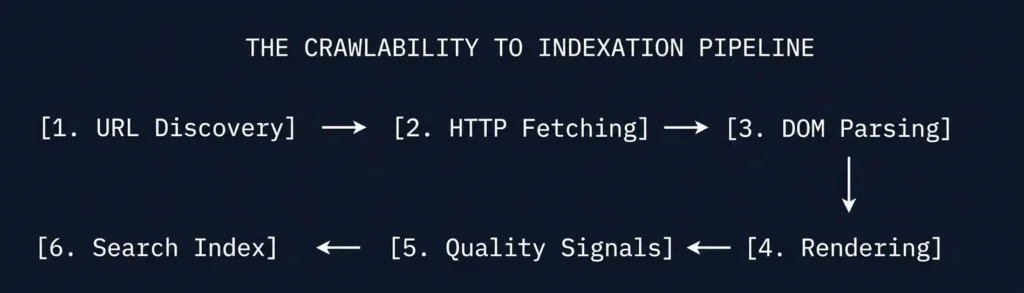
Search engines do not rank websites in real-time. Instead, they discover raw URLs, download their code, and evaluate whether to store them in a master search database. Crawlability represents a search engine’s technical capability to access and fetch a web page, while Indexability determines whether that page meets the quality and directional standards to be permanently stored in Google’s index.
Core Functions, Technical Controls & Failure Consequences
1. Crawlability (The Accessibility Layer)
Core Function: Enables automated search crawlers (e.g., Googlebot) to discover, reach, and download the source HTML code of a web page.
Technical Controls: Governed by
robots.txtaccess rules, HTTP status codes (200 OK vs. 403/404/5xx server errors), DNS resolution speeds, hosting uptime, and XML sitemap architecture.Failure Consequences: Misconfigured
robots.txtrules or high server response times block search engines completely, wasting crawl budget and leaving critical revenue pages hidden from search bots.
2. Indexability (The Storage Layer)
Core Function: Evaluates, renders, and determines whether a successfully fetched page should be parsed, assigned entity relevance, and saved in search engine databases.
Technical Controls: Managed via meta robots tags (
noindex),<link rel="canonical">tags, content uniqueness thresholds, and sitewide quality signals.Failure Consequences: Accidental
noindextags, unaligned canonical links, or duplicate URL variations cause search index bloat, cannibalization, or total de-indexation of key landing pages.
Site Architecture & Internal Link Mechanics: Designing the Network for Link Equity & Context
A website’s architecture is much more than a visual menu or a UX navigation system. It is the underlying structural highway that controls how search engines crawl deep content and distribute domain authority (PageRank). Without a calculated site structure, even high-authority backlinks acquired at the homepage level fail to reach and rank your deep commercial landing pages.
Understanding the Architectural Framework: Depth, Silos, and Equity
Site Architecture and Internal Linking operate on three fundamental structural levers:
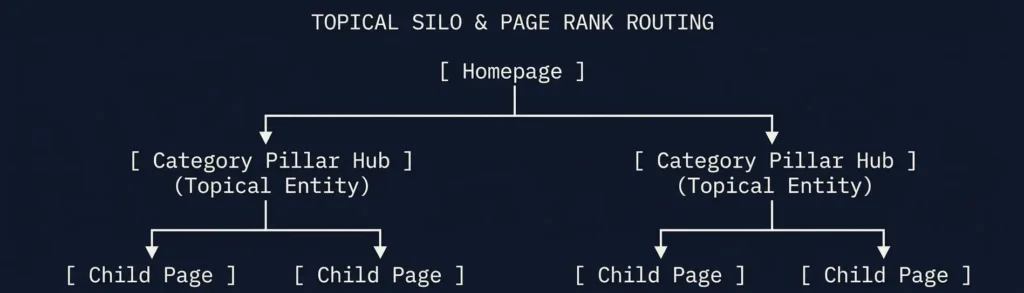
Crawl Depth & The 3-Click Boundary: Every additional click depth between the homepage and a target URL dilutes the PageRank equity passed to that document. A flat architecture ensures that search crawlers and users can access any indexable URL within 3 clicks or fewer from the root domain.
Topical Siloing & Contextual Clustering: Randomly linking unrelated posts confuses search engine NLP models. Structural siloing organizes content into distinct thematic buckets, ensuring that child articles only pass relevance and context upwards to their designated parent hub.
Internal PageRank Conductors: External backlinks naturally land on blog posts and press pages. Strategic contextual internal links act as conductors, routing this accumulated authority directly down to high-converting service or product pages that rarely earn direct external links.
The Business Impact of Structural Neglect: Trapped Authority & Orphan Assets
When site architecture is built without technical SEO foresight, domains suffer from silent performance ceilings:
Orphan Pages: High-value content assets left without contextual internal links become completely invisible to search crawlers, resulting in wasted publishing budgets and non-indexed URLs.
Equity Traps & Dilution: Link authority gets trapped in site-wide headers, footers, or unmanaged tag archives instead of flowing into core money pages.
Keyword Cannibalization: Without clear internal link anchors pointing to a master canonical URL, search engines struggle to identify which page should rank for a primary entity, leading to ranking fluctuations.
While a streamlined site architecture creates the ideal pathways for link equity and crawler navigation, those pathways cannot function reliably on an unstable or insecure infrastructure. To ensure search engines and users trust your network, we must evaluate the foundational protocols that keep your domain secure and accessible.
Security Protocols & Infrastructure Integrity: HTTPS, SSL, and Server Resilience
Security and network protocols establish the trust baseline between your web server, search crawlers, and end users. While content and link architecture drive organic relevance, infrastructure stability ensures your website remains accessible, safe, and free from technical interruptions that undermine search engine trust.
Encryption Standards: How TLS/SSL Signalling Impacts Organic Search
Modern search engines treat user security as a foundational ranking component. Installing an SSL certificate upgrades your protocol from HTTP to HTTPS, establishing an encrypted session between the browser and your origin server:
The HTTPS Ranking Signal: Google officially integrated HTTPS as a lightweight sitewide ranking factor to encourage universal web encryption. Beyond ranking boosts, HTTPS is mandatory for enabling modern, high-speed web protocols like HTTP/2 and HTTP/3, which significantly accelerate connection handshake times for mobile users and search crawlers alike.
The Danger of Mixed Content Dependencies: A common architectural flaw occurs when a page is served over HTTPS but loads supporting assets (CSS files, JavaScript libraries, images) via insecure HTTP URLs. Browsers block these unencrypted requests or flag the page with security warnings, which degrades both user trust and search engine evaluation scores.
Server Status Codes & Health Checks: What Googlebot Expects from Your Hosting
Search crawlers constantly evaluate server responsiveness during their crawling cycles. The HTTP response codes returned by your server directly dictate how aggressively search engines continue to explore your domain:
200 OK & Healthy Handshakes: Indicates optimal communication. Crawlers fetch documents efficiently without triggering fallback mechanisms.
301/302 Redirect Chains: Excessive hop-by-hop redirects increase latency and consume crawler CPU cycles, slowing down content discovery.
5xx Server Level Failures: When your origin server returns
500 Internal Erroror503 Service Unavailablecodes during a crawl spike, search engines immediately slow down their fetch rate to prevent taking your site offline. Persistent 5xx errors eventually lead to temporary de-indexation of target URLs to protect searchers from landing on broken pages.
A secure, resilient server guarantees that search crawlers can safely connect and download your raw files. However, modern web development rarely stops at sending static HTML. Today’s dynamic web applications rely heavily on client-side scripts to build the final page layout, introducing a completely different set of technical challenges: JavaScript SEO and Rendering.
JavaScript SEO & Rendering Pipelines: Bridging Dynamic Code and Search Crawlers
JavaScript powers the interactive, dynamic features of the modern web. Frameworks like React, Angular, Vue, and Next.js allow developers to build fast, application-like user experiences. However, search engines treat client-side code very differently from traditional static HTML, making JavaScript execution a critical focus area for technical SEO architecture.
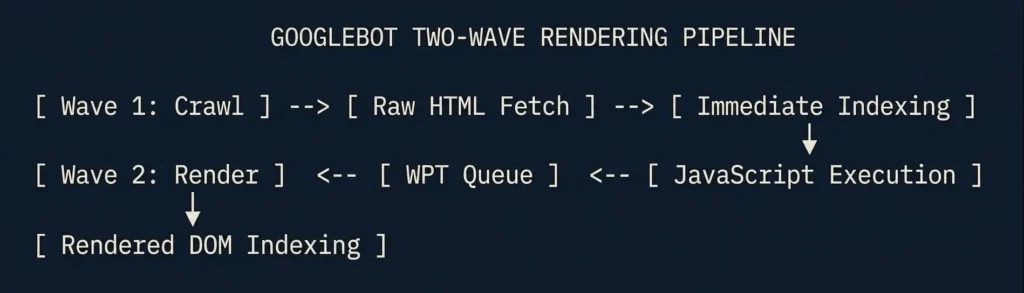
Inside Google’s Two-Wave Indexing Model
To conserve computational resources, Googlebot separates the initial fetch of a web page from the execution of its client-side JavaScript code. This process happens in two distinct phases:
Wave 1 (Raw HTML Processing): Googlebot fetches the initial HTTP response from your server and immediately parses the static HTML source code. If your critical page content, internal links, or canonical directives depend entirely on client-side JavaScript execution, Googlebot sees an empty container and indexes only the base template.
Wave 2 (The Render Queue & Web Rendering Service): If the page requires JavaScript execution, it is placed into a Web Rendering Service (WRS) queue. Once computational resources become available which can take hours or even days, WRS opens the page in a headless Chromium browser, executes the JavaScript, generates the final rendered DOM, and updates the search index with the full content.
Rendering Strategies: Choosing the Right Engine for Search Crawlers
To eliminate the indexation delays and risks associated with client-side execution, technical SEO architects work with engineering teams to deploy hybrid rendering solutions:
Client-Side Rendering (CSR): The browser downloads a minimal HTML shell and fetches data via JavaScript APIs. Highly risky for SEO because search engine crawlers must wait for Wave 2 rendering to see content and follow internal links.
Server-Side Rendering (SSR): The web server executes the JavaScript on every request and delivers fully constructed HTML directly to the browser and search crawlers, ensuring immediate Wave 1 indexation.
Static Site Generation (SSG): Pages are pre-rendered into static HTML files during the build process, offering maximum crawl efficiency and instant indexation without runtime server overhead.
Dynamic Rendering: A hybrid configuration where the server detects incoming requests and serves pre-rendered static HTML to search crawlers while serving standard Client-Side JavaScript applications to human users.
Common JavaScript SEO Pitfalls That Hurt Indexation
Unfollowable Script-Based Links: Using JavaScript click handlers (
<button onclick="...">or<div location.href="...">) instead of standard HTML anchor tags (<a href="...">) prevents search crawlers from discovering downstream pages.Client-Side API Timeouts: If your web application relies on slow third-party APIs to populate text or pricing data, Google’s rendering engine may time out before the data loads, indexing an incomplete page.
Shadow DOM Isolation: Web components built inside closed Shadow DOM trees can hide structural content and internal links from search crawlers if not implemented using light DOM fallbacks.
Ensuring search crawlers can parse and render your JavaScript DOM guarantees that your content gets indexed. However, rendering code efficiently is not just a search crawler requirement, it directly impacts how fast real users experience your pages. To maintain user engagement and meet Google’s page experience standards, we must look at performance engineering: Core Web Vitals and Page Speed.
Core Web Vitals & Performance Engineering: Optimizing the Browser Rendering Path
Technical performance is no longer measured simply by how quickly a server responds with an initial HTML file. Modern page speed is defined by browser-level rendering milestones and real-user experience metrics. Google’s Core Web Vitals (CWV) framework measures how real users perceive loading performance, interactivity responsiveness, and visual stability during page execution.
The Core Web Vitals Triad: LCP, INP, and CLS
Google evaluates user experience using three primary, real-world field metrics:
Largest Contentful Paint (LCP) — Loading Performance: Measures the time it takes for the largest visual element (hero image, background graphic, or main text block) within the viewport to render. Slow LCP is typically caused by unoptimized server response times (TTFB), render-blocking JavaScript/CSS, or uncompressed hero images.
Interaction to Next Paint (INP) — Responsiveness: Replaced FID (First Input Delay) as a core metric to measure overall page interactivity. INP tracks the latency of all user interactions (clicks, taps, keyboard inputs) throughout the entire page lifecycle, flagging long JavaScript main-thread tasks that freeze the user interface.
Cumulative Layout Shift (CLS) — Visual Stability: Quantifies unexpected layout shifts that occur while the page is loading. Common culprits include images without explicit width and height dimensions, dynamically injected ads or banners, and custom web fonts causing FOIT/FOUT (Flash of Unstyled Text).
Real-User Field Data (CrUX) vs. Synthetic Lab Data (Lighthouse)
A major point of confusion in technical performance auditing is the difference between lab measurement tools and actual ranking signals:
Field Data (Chrome User Experience Report – CrUX): Collected from opted-in Chrome users navigating your site in real-world network conditions. This is the actual data Google uses for organic search ranking evaluations over a 28-day rolling window.
Lab Data (Lighthouse / PageSpeed Insights): Generated in a controlled, simulated environment (throttled CPU and mobile network). Lab data is essential for local debugging during development, but improving a Lighthouse score alone will not boost rankings if your real-world CrUX field data remains poor.
Critical Technical Performance Bottlenecks Across the Stack
Render-Blocking Assets: Synchronous CSS and JavaScript files queued in the HTML
<head>halt the browser parser, preventing pixels from rendering on screen until those files are fully downloaded and executed.Unoptimized Media Delivery: Serving oversized, uncompressed legacy image formats (PNG/JPEG) instead of modern compressed formats (WebP/AVIF) without responsive
srcsetattributes bloats network payloads.Main-Thread Thread Blocking: Heavy JavaScript execution monopolizes the browser’s single main thread, causing user inputs (clicks, navigation toggles, form entries) to feel sluggish or unresponsive.
Optimizing browser performance and Core Web Vitals ensures that users and crawlers experience lightning-fast page loading and interaction. But fast rendering only presents raw content to the browser. It doesn’t explicitly tell search engine algorithms what that content mathematically means. To bridge this gap between raw text and machine understanding, we turn to Structured Data and Semantic Search.
Structured Data & Semantic Search Appearance: Translating Content into Knowledge Graph Entities
Search engine algorithms have evolved far beyond basic string matching and keyword density. Modern search engines rely on Natural Language Processing (NLP) and vector embeddings to construct a conceptual model of the web called the Knowledge Graph. Structured data acts as the ultimate translator between human language and machine logic, converting unstructured text into clear, unambiguous entities and relationships that search engines can instantly parse.
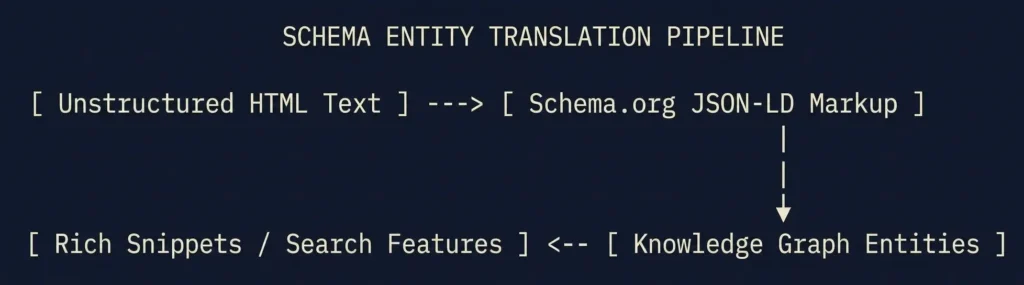
The Architecture of Semantic Markup: JSON-LD and Schema.org
While legacy schema implementations used inline microdata or RDFa attributes embedded directly inside HTML tags, modern technical SEO architecture exclusively uses JSON-LD (JavaScript Object Notation for Linked Data).
JSON-LD separates your structured data layer from your presentation layer. Placed inside a clean <script type="application/ld+json"> tag within the document head, JSON-LD allows developers and technical SEOs to declare explicit entity properties—such as authors, products, organizations, FAQs, and articles—without cluttering the visible HTML layout.
When implemented correctly, JSON-LD schemas explicitly define the connections between entity nodes. For example, instead of allowing Google to guess whether a name on a page is an author, a reviewer, or a subject, a nested @type: "Person" schema inside an Article wrapper explicitly signals the exact entity relationship to Google’s Knowledge Vault.
Rich Results, Search Features, and SERP Real Estate Expansion
Beyond entity disambiguation, structured data serves a major commercial purpose: unlocking visual enhancements in organic search results. Pages enhanced with valid schema markup qualify for Rich Results, including star ratings, pricing/availability badges, recipe cards, event schedules, and interactive FAQ accordions.
These rich features dramatically increase your visual footprint on the Search Engine Results Page (SERP). By occupying more vertical screen space and displaying immediate trust signals, structured data directly drives higher Click-Through Rates (CTR) even without changing your numerical ranking position.
Schema Validation, Syntax Errors, and Entity Misalignment Risks
Deploying structured data without strict technical validation can backfire. If your JSON-LD syntax contains simple punctuation errors or missing required fields, search engine parsers discard the entire schema block without warning.
More critically, schema spam or entity misalignment such as applying Product markup with star ratings to a non-eCommerce blog post violates Google’s Search Essentials guidelines. This can trigger manual actions or cause search algorithms to strip rich result eligibility across your entire domain.
Technical SEO Auditing, Diagnostics & Logging: Real-Time Telemetry & Health Monitoring
Technical SEO is not a one-time setup; it is a continuous engineering practice of telemetry, issue identification, and system optimization. As enterprise websites push new code deployments, update product databases, and alter internal link structures, silent technical bugs inevitably creep into the ecosystem. Systematic auditing and server diagnostic logging provide the clear visibility needed to isolate technical bottlenecks before they impact organic revenue.
Synthetic Crawls vs. Server Log Analysis: Two Views of Site Health
Effective diagnostics require combining two complementary auditing methodologies:
Synthetic Site Auditing (DOM-Level Emulation): Using crawler tools to simulate search engine behavior across your public DOM. Synthetic audits inspect static code, parse JavaScript execution, flag broken internal links, detect canonical mismatches, and identify orphan pages across your site structure.
Server Log File Analysis (Server-Level Truth): While synthetic crawlers simulate how Googlebot should behave, server log files reveal how search engines actually behave in real-time. Log files record every single request made by Googlebot, providing raw data on crawl frequency, HTTP status codes, bandwith consumption, and crawler response to new URLs.
The Power of Log File Diagnostics for Enterprise Infrastructure
Log file analysis exposes critical infrastructure issues that standard auditing tools completely miss. By filtering server access logs for user agents like Googlebot-Image or Googlebot-Desktop, technical teams can map exact crawler movements:
Crawl Budget Wastage Identification: Uncover hidden crawler traps where Googlebot burns significant bandwidth repeatedly fetching dynamic filter variations, internal search parameters, or non-indexable utility URLs.
Crawl Frequency Anomalies: Detect sudden drops in crawler activity across core revenue categories. A sharp decline in Googlebot requests often serves as an early indicator of server latency issues, soft 404 explosions, or algorithmic quality drops weeks before rankings actually drop.
Orphan Asset Discovery: Identify pages that search engines access via old external links or sitemaps but have zero internal links directing users to them within the current site architecture.
Maintaining continuous telemetry through log analysis and DOM audits ensures your existing technical framework runs smoothly. However, the ultimate test of a technical framework occurs when that architecture must undergo major structural changes such as migrating domains, updating CMS platforms, or restructuring URL paths. So it is the best time to explore Site Migrations and Architectural URL Changes.
Site Migrations & Architectural URL Changes: Preserving Equity Through Infrastructure Shifts
A website migration whether changing domain names, switching CMS platforms, restructuring URL hierarchies, or merging multiple web properties, is one of the highest-risk operations in technical SEO. When URL paths change, search engine algorithms must re-evaluate every single document, rebuild internal link graphs, and transfer accumulated historical ranking signals (PageRank and entity trust) to the new destination. Without a meticulous technical execution plan, migrations often lead to catastrophic traffic drops.
The Signal Transfer Mechanics: How Search Engines Process URL Changes
When Googlebot encounters a URL migration, it relies on specific protocol-level indicators to verify that the target document has permanently moved:
301 Permanent Redirect Mapping: A strict 1:1 direct mapping from old URLs to their exact canonical equivalents on the new structure. Using non-permanent 302/307 redirects or sending all old traffic to the homepage destroys granular page equity, causing search engines to treat the move as soft 404 errors.
Canonical Signal Consolidation: The legacy URL’s canonical tag must temporarily point to the new destination URL while redirects are processed. This signals to Google’s indexing engine that ranking signals and historical backlink authority should be attributed entirely to the new target.
Search Console Change of Address Tool: For domain-level moves, executing an official Change of Address request directly inside Google Search Console accelerates Googlebot’s re-crawling priority and signal consolidation.
Pre-Launch vs. Post-Launch Execution Checklist
Successful site migrations require precise synchronization across staging environments, server configurations, and live DNS cutovers:
Staging Environment Isolation: Ensure the staging site is strictly protected behind server-level HTTP Basic Authentication or IP whitelisting to prevent search crawlers from discovering and indexing duplicate content before official launch.
Sitemap Dual-Submission: Keep your legacy XML sitemap active alongside your new XML sitemap post-launch. Submitting the old sitemap forces Googlebot to rapidly re-crawl legacy URLs, discover the 301 redirects, and update the index faster.
Post-Launch Redirect & Log Audit: Immediately monitor server log files post-cutover to verify that crawlers are hitting 301 redirects smoothly, with zero 404 error spikes, infinite redirect loops, or broken internal canonicals.
Successfully executing a site migration ensures that your core domain retains its search engine equity during major code or structure overhauls. But for enterprise platforms expanding across global markets, managing a single site structure is only the beginning. Let’s examine the complexities of multi-region routing in the next section.
International & Multilingual Technical Architecture: Regional Routing & Signal Synchronization
Expanding a digital enterprise across global markets introduces complex technical routing challenges. When a domain serves users across different countries and languages, search engines must determine which localized URL variation should appear in specific search engine results pages. Without a clean international framework, search crawlers treat localized pages as duplicate content, diluting ranking equity and confusing language targeting.
URL Architecture Frameworks for Global Expansion
Selecting the right domain infrastructure sets the foundation for international search engine signaling. Enterprises generally choose between country-code top-level domains (ccTLDs like example.de), subdomains (de.example.com), or subdirectories ([example.com/de/](https://example.com/de/)).
Country-code TLDs send the strongest geo-location signals to search engines, but they require building domain authority from scratch for every national market. Subdomains allow separate hosting and server locations, yet they still isolate authority across different sub-properties. Subdirectories offer the most sustainable technical compromise for most organizations, consolidating all international link equity into a single parent domain while maintaining clear folder structures for regional content.
Hreflang Implementation & Reciprocal Annotation Rules
The primary technical mechanism for managing multi-regional content is the hreflang annotation. Hreflang attributes tell search engine algorithms exact language and country targeting rules for every page variation. This ensures that a user searching in London receives the en-gb page version while a user in New York sees the en-us asset, even if the underlying copy is nearly identical.
The most critical architectural requirement of hreflang is absolute reciprocity. If Page A links to Page B using an hreflang="de" tag, Page B must send a corresponding return link back to Page A with an hreflang="en" attribute. If this bi-directional connection breaks on either side, search engine parsers invalidate the annotation pair entirely. Furthermore, every language cluster must include an x-default fallback tag to route unmatched global traffic to a designated fallback landing page.
Canonical Alignment and Geolocation Pitfalls
A common mistake in international technical architecture is misconfiguring canonical tags across regional variations. Each localized URL must contain a self-referencing canonical tag pointing directly to itself alongside its hreflang references. Pointing canonical tags from all international versions back to the main US homepage forces search engines to index only the US URL, ignoring all localized variations.
Additionally, automatically redirecting users based on their IP address can block search engine crawlers from discovering regional content. Because Googlebot primarily crawls from IP addresses based in the United States, forced IP redirects lock crawlers into the US version, preventing them from accessing and indexing European or Asian language subfolders.
Establishing a resilient international architecture ensures search engines route users to the correct language and regional assets worldwide. But as web architectures grow in scale and complexity, manually diagnosing log files, generating schema, and auditing dynamic JavaScript becomes impossible. Here we try to understand how AI Is Revolutionizing Technical SEO.
The Role of AI in Technical SEO: Optimizing for LLMs, RAG Pipelines, and Agentic Web Crawlers
The search landscape is undergoing a fundamental structural transition from keyword-matching indexation to generative context retrieval. Modern AI engines such as Perplexity, OpenAI SearchGPT, Google Gemini, and Anthropic Claude do not simply return ranked lists of external links; they parse, synthesize, and construct direct answers using Retrieval-Augmented Generation (RAG). To maintain brand visibility in an AI-first web, technical site architecture must evolve from serving human browsers and classic crawlers to delivering machine-optimized, high-density context blocks.
The Shift from PageRank to Entity Retrieval in LLM Pipelines
Generative engines process information through high-dimensional vector spaces rather than traditional PageRank link graphs alone. When a user submits a prompt, RAG pipelines query vector databases to extract precise semantic chunks from authoritative web documents, feeding those chunks directly into the Large Language Model’s context window.
For technical SEO architects, this means page layout must prioritize topical density and clear semantic boundaries. Pages with deep content hierarchies, explicit headers, and unambiguous entity references allow LLM scrapers to extract relevant passages without introducing noise or hallucinated context, directly increasing your site’s probability of being cited as a trusted source in synthesized answers.
Machine-Readable Data Formats: Markdown, JSON-LD, and LLM-Friendly DOMs
While human users rely on visual styling, CSS animations, and layout design, AI scrapers favor lightweight, highly structured data layers that minimize token processing costs. Heavy DOM trees bloated with nested visual wrappers, unoptimized client-side JavaScript, and inline presentation code add unnecessary overhead to LLM parsing pipelines.
Modern AI-ready architectures separate the visual UI from the semantic data payload. Utilizing clean semantic HTML elements (<article>, <section>, <aside>), robust JSON-LD schema graphs, and providing structured plain-text or Markdown endpoints enables AI web agents to extract factual relationships, tabular data, and entity definitions instantly during single-pass crawling cycles.
Managing AI Crawlers: Robots.txt Directives, Bot Governance, and Content Licensing
The emergence of AI search has created a new class of automated scrapers, including GPTBot, ClaudeBot, PerplexityBot, and Bytespider. Managing these user-agents requires a strategic technical balance between securing proprietary data and maximizing generative search exposure:
Training Scrapers vs. Search Retrieval Agents: Certain AI user-agents collect data strictly to train base foundation models, while others fetch real-time web content specifically to supply context for live search queries.
Server Bandwidth and Scraper Governance: High-frequency AI scrapers can overwhelm origin servers with relentless request volumes. Technical teams must configure targeted
robots.txtrules, rate-limiting parameters, and edge firewalls (CDNs) to allow discovery agents while blocking aggressive training bots that provide no direct referral traffic.
Autonomous Technical SEO: Agentic Workflows for Real-Time Site Optimization
Beyond changing how search engines read websites, artificial intelligence is revolutionizing how technical teams maintain site health. The era of manual quarterly site audits is being replaced by agentic, continuous technical SEO workflows.
AI-driven telemetry systems now run alongside server infrastructure, automatically parsing real-time access logs, detecting soft 404 explosions, identifying broken canonical links, and generating dynamically adjusted JSON-LD schema. These autonomous agentic workflows fix technical bottlenecks in staging pipelines before bad code reaches production, establishing a truly self-healing technical architecture.
Technical SEO Tool Stack & Infrastructure Equipment: Enterprise Diagnostics
Technical SEO at scale cannot rely on guesswork or single-point audit solutions. An enterprise technical SEO stack acts as an observatory, combining real-time crawler emulation, server log parsing, synthetic performance tracking, and API-driven data pipelines. Equipping your engineering team with the right diagnostic suite ensures full visibility across both client-side user experience and server-side search engine behavior.
The Diagnostic Layer: Emulation, Log Analytics, and Indexation Telemetry
Different tools illuminate different corners of your technical architecture. Enterprise teams categorize their software stack into specific functional layers:
Site Crawlers & DOM Emulators: Tools like Screaming Frog SEO Spider, Lumar (formerly DeepCrawl), and Botify simulate Googlebot’s fetch-and-render execution cycles at scale. They excel at identifying orphan pages, canonical conflicts, JavaScript execution timeouts, and broken internal link paths across millions of URLs.
Server Log File Parsers: Platforms such as Loggly, Splunk, Screaming Frog Log File Analyser, or custom Python/ELK stack scripts read raw server access logs directly. They bypass DOM rendering entirely to show exact crawler request frequencies, bandwidth draw, HTTP status code distributions, and bot IP verification.
API-Driven Performance & Indexing Pipelines: Integrating APIs from Google Search Console, Google PageSpeed Insights, and IndexNow allows technical architects to automate real-time alerts. Custom Looker Studio dashboards pull daily Index Status reports and Chrome User Experience (CrUX) metrics, alerting engineers to crawl anomalies or performance regressions immediately after code deployments.
In large enterprise organizations, the biggest challenge in technical SEO is rarely identifying bugs, it is securing development resources to fix them. Technical SEO issues often get buried in engineering backlog queues, competing against product feature releases and bug fixes. Establishing a formal technical SEO governance framework bridges the gap between search performance goals and software engineering workflows.
Prioritizing Technical Debt: The Impact vs. Effort Matrix
Technical SEO audit logs often generate thousands of flagged line items, causing developer overwhelm. Effective technical governance relies on converting raw audit data into business-driven user stories prioritized by financial risk and execution effort.
High-impact critical blockers such as sitewide noindex leaks, broken 301 redirect chains on top revenue pages, or server 5xx surges, must trigger immediate high-priority Jira or GitHub tickets. Conversely, low-impact cosmetic updates, like minor alt-text omissions or non-critical schema validation warnings, are grouped into quarterly maintenance sprints to ensure developer time is spent protecting primary organic revenue channels.
Integrating SEO Quality Gates into Continuous Integration (CI/CD) Pipelines
The most mature enterprise technical SEO organizations move from reactive auditing to proactive prevention. By integrating automated testing scripts into development Continuous Integration and Continuous Deployment (CI/CD) pipelines, engineering teams validate technical SEO rules before code reaches production servers.
Using headless browser testing and automated DOM validators, the CI/CD pipeline checks staging environments for broken canonical tags, missing meta robots directives, severe Core Web Vitals regressions, and schema syntax errors. If a new pull request breaks critical search directives, the automated build fails immediately, preventing technical regressions from ever reaching live search engine crawlers.
Conclusion
Technical SEO is not a series of isolated optimizations, but an interconnected engineering framework that serves as the backbone of your digital presence. By aligning secure infrastructure, intuitive site architecture, efficient crawling and rendering pipelines, and performance-optimized code with semantic structured data and AI-ready DOM architectures, enterprise organizations build a resilient ecosystem that maximizes organic search visibility. When backed by real-time log diagnostics, structured migration protocols, and automated CI/CD quality gates, these eleven technical pillars transform a standard website into a high-authority growth engine capable of sustaining long-term organic dominance across both traditional search engines and emerging generative AI platforms.
What’s Next? Exploring Technical SEO Services & Getting in Touch
This guide was crafted to provide a comprehensive, conceptual overview of Technical SEO architecture, enterprise mechanics, and foundational best practices.
If you would like to explore how I apply these exact frameworks, diagnostic workflows, and execution strategies across live enterprise environments, feel free to visit my Technical SEO Services for a detailed look at my service offerings and methodology.
Additionally, if there is a complex technical topic you feel wasn’t fully covered here, or if you have specific questions regarding your own website’s architecture, you can reach out to me directly. I am always open to discussing technical search strategies and sharing actionable insights.
Frequently Asked Questions (FAQs)
What is Technical SEO?
Technical SEO is all about making sure search engines like Google can easily access, read, and understand your website. Think of it as the foundation of a house, while your content is the furniture and design, technical SEO ensures the structure is solid, fast, and safe so Googlebot can walk in without any broken doors or slow elevators.
Why is Technical SEO important?
Even if you have the best content in the world, search engines won’t rank your website if they can’t properly load or read your pages. Technical SEO is important because it removes invisible barriers like slow loading speeds, broken links, or security warnings that prevent your site from ranking well and turning visitors into customers.
What is included in Technical SEO?
Technical SEO covers everything behind the scenes that affects how your site functions. This includes making your website load fast (Core Web Vitals), ensuring it works perfectly on mobile phones, securing it with HTTPS, organizing your page URLs, fixing broken links, and giving Google a sitemap so it knows exactly which pages to index.
What is a Technical SEO specification?
A Technical SEO specification is simply a clear checklist or instruction guide created for web developers. When building a new website or making big changes, this document tells developers exactly how to write the site’s code such as how redirects, URLs, and mobile speed should work, so the site stays search-engine friendly from day one.
How do you conduct a Technical SEO site audit?
A technical SEO audit is like a full health checkup for your website. Instead of guessing, you use specialized tools to scan every page of your site to find hidden problems like broken links, slow-loading images, or duplicate content. Once the scan is done, you organize the issues by priority so you can fix the most critical bugs first.
What is the fundamental difference between Technical SEO and On-Page SEO?
While On-Page SEO focuses on content relevance, keyword optimization, and user intent alignment, Technical SEO focuses on the underlying infrastructure that enables search engines to discover, crawl, render, and index that content. Technical SEO ensures that search engines can access and interpret your web pages efficiently, providing the foundational baseline required for On-Page content and Off-Page authority to rank.